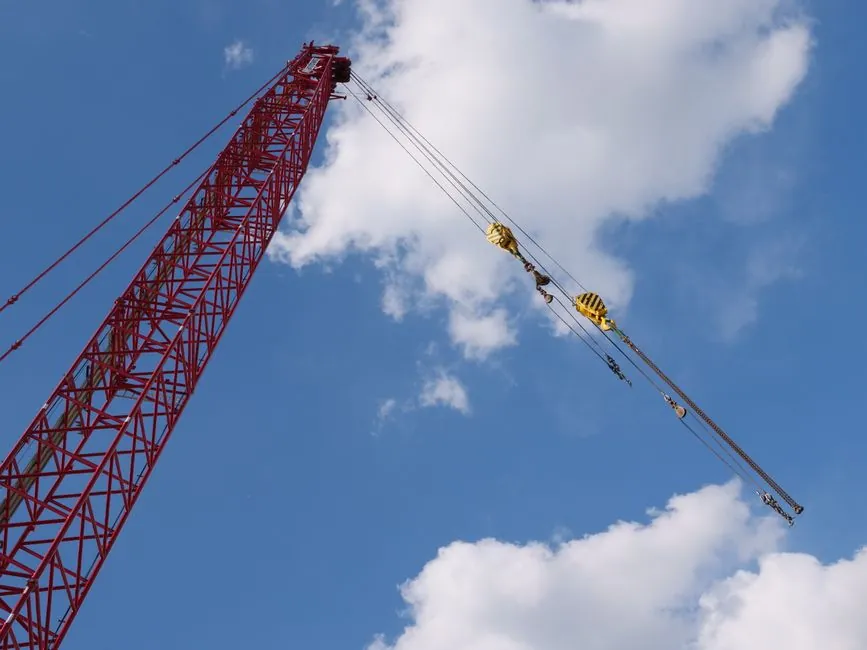
A vertical lift module (VLM) stores inventory on two parallel columns of trays separated by a single central elevator; the elevator, commonly called the extractor, is the only moving element that handles trays inside the unit [S2][S5].
When a SKU is requested, the extractor travels vertically to the target tray, engages it, lifts it off the storage stack, and presents it at a waist-height access opening, completing the goods-to-person cycle in seconds [S2][S4][S9]. For context on what a VLM is and how it compares to other storage, the vertical lift module reference covers architecture, while the linear module entry shows the broader family of axis-based material-handling modules.
Trigger: How a Pick Request Reaches the Extractor
The pick cycle starts outside the machine: an operator either scans a picking document/barcode or types a SKU into the VLM software, and the request is routed to the onboard controller [S3][S5].
Kardex describes a button-press or barcode-scan interface on the Shuttle VLM, with the request immediately assigning a specific tray to the access opening [S3]. White Systems frames it the same way: when an operator or connected software requests an item, the extractor automatically retrieves the correct tray and presents it at an ergonomic access opening [S2]. Vidir Solutions adds that laser sensors measure each tray on the way in or out, so the controller already knows exact tray dimensions before dispatching the elevator [S4]. FCBCO lists a third trigger mode, batch recall, where the system sequences several trays back-to-back to satisfy a multi-line order [S5].
Mechanical Path: From Requested SKU to the Access Opening
Once a tray is identified, the elevator rides a vertical mast in the center channel between the front stack and the back stack, stopping at the level of the target tray [S5].
FCBCO describes the action plainly: an elevator runs vertically up and down the center of the unit, pulling trays from storage and presenting them to a worker at the front of the unit [S5]. GlobalSpec uses the same wording in an October 2025 piece on warehouse VLMs: the extractor retrieves the tray and delivers it to the picking window, and the window opens at waist height for the operator [S1]. PeakLogix's product page goes one step further, naming the device an inserter/extractor, because the same carriage that pulls a tray out also returns a tray to its slot after the pick is complete [S8].
Typical VLM columns are tall, with FCBCO reporting some manufacturers offer units over 50 feet high, and trays up to 12 to 13 feet wide and 30 to 40 inches deep [S5]. A single VLM in that footprint, roughly 13 ft wide by 10 ft deep, can hold hundreds or thousands of parts in only about 130 square feet of floor area, which is why the extractor's single-axis travel time is the binding throughput constraint [S5].
Engagement: How the Extractor Grips a Tray Without an Operator
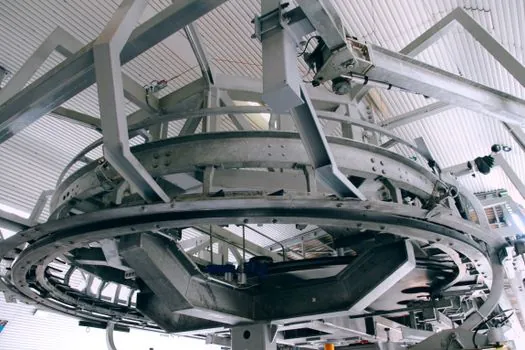
Engagement is the part the marketing copy skips: the extractor does not have a human hand, so it uses a powered gripping or hooking mechanism that pulls the tray off its stack from the central channel [S5][S8].
FCBCO's mechanics are explicit: an elevator travels the center channel, both retrieving and putting away trays in the unit, and the elevator is called up by either scanning a picking document or recalling a tray by manually entering a SKU number [S5]. PeakLogix's product copy calls the same mechanism an inserter/extractor, which retrieves and stores the tray in a designated location after the operator confirms the pick [S8]. The Kardex Shuttle uses a belt-driven lift with a telescoping extractor that inserts between the front and rear columns, engages the tray, and retracts it into the elevator for the ride to the access opening [S6]. Swisslog's January 2026 explainer restates the principle: when an operator selects an item via software, an automated extractor retrieves the required tray, and the tray is delivered to an access opening at the operator station [S9].
Height Measurement and Tray Slotting on Return
The extractor's job is not finished when the tray leaves the column; on the way out, a laser on the elevator profiles the load so the controller knows the tallest point of the contents [S4][S5].
Vidir's spec sheet states that laser sensors measure each tray as items are picked or replenished, and FCBCO explains why: the height is measured to ensure that the tray is placed in a location that can accommodate the height of the product, which also minimizes wasted vertical space by fitting trays tightly in the system [S4][S5]. SJF's product reference adds that this measurement step is what allows a VLM to eliminate the honey-combing effect seen in conventional racking, where partially filled shelves waste cubic volume [S7]. In practice the controller uses the height map to drive the extractor back to the lowest free slot that can accept the tray, then inserts it, completing the put-away half of the inserter/extractor cycle [S5][S8].
Operator Interface and Picking Aids at the Window
Once the extractor presents a tray at the access opening, the system shifts from motion control to pick confirmation, and most modern VLMs add light, laser, or display guidance to drive accuracy at that step [S3].
Kardex documents the pick-to-light stack on its Shuttle VLM: LED indicators show operators exactly what to pick and in what quantity, and an LED Navigator can be configured for different languages, which is useful in multilingual warehouses [S3]. For trays with many small parts, a laser pointer rides a track at the top of the access opening and swivels in depth to pinpoint the exact picking location with a focused spotlight [S3]. GlobalSpec and Vidir both confirm that the window itself is at waist height, removing the bend, reach, and climb that drive ergonomic injuries in conventional shelving [S1][S4].
Capacity, Throughput, and What the Extractor Cannot Do
The extractor's cycle time is the VLM's throughput ceiling, and two design constraints define it: tray weight and the unit's vertical travel distance [S5].
FCBCO lists per-tray payload ranges from light spare parts up to over 2,000 lb per tray on heavy-duty configurations, which sets the upper bound on what the extractor's drive and gripper must handle [S5]. The same article notes that VLMs are a goods-to-person technology, meaning the operator footprint is limited to the width of the access opening, so the only walking a picker does is between adjacent VLMs, not down aisles [S5]. SJF's product page frames the practical limit differently: VLMs work best for SKU counts that fit in the unit's tray inventory; very long, oversized, or hanging goods that do not sit flat on a tray are poor fits and are usually handled by a cable tray style rack or a horizontal carousel instead [S7].
Where the VLM Sits Next to Other Module-Based Automation
VLMs are one slice of a wider category of axis-based warehouse modules, and a side-by-side helps a buyer pick the right one [S7].
On three decision criteria, footprint density, single-item cycle time, and operator travel, a VLM scores well on density (using full building height up to 50+ ft) and operator travel (goods-to-person, no aisle walking), but its single-item cycle is bounded by the extractor's vertical travel [S5][S7]. A horizontal carousel wins on cycle time for a small fixed SKU set but uses more floor area per part; a vertical carousel shares the density win with the VLM but presents trays in a rotating loop rather than a single elevator delivery [S7]. For facilities that already standardize on modular automation blocks, a VLM is mechanically closer to a linear module with a single carriage on a vertical axis than to a conveyor or a relay module based sortation cell, and it integrates with the same WMS/SCADA layer as those components [S2][S7]. Related reading on adjacent industrial modules is collected on the vertical lift module encyclopedia page, and broader signal-routing modules are covered under wireless module and load cell module. For a deeper comparison of extractor-style handling in another vertical-axis machine, the bucket elevator capacity reference breaks down the same volume-versus-speed trade-off for continuous vertical lifting.
Failure Modes and Maintenance Cues a Process Engineer Should Watch
Because the extractor is the single mechanical element doing all tray motion, its wear parts drive most VLM downtime, and the data sources flag a few predictable issues [S4][S5].
FCBCO warns that the height-measurement laser must be kept clean and aligned, because a bad reading causes the controller to slot a tray into a position that cannot clear the load above it, which then jams the column [S5]. Vidir adds that the laser sensors on the access opening also verify tray presence during the pick, so a dirty sensor can mimic a missing-tray fault even when the extractor is healthy [S4]. On the drive side, Kardex's product note that the extractor's belt-and-pulley system travels vertically up and down the unit implies the same wear items as any vertical-axis lift: belt stretch, encoder drift, and gripper cam wear, all of which show up as slower cycle times before they show up as hard faults [S6]. The practical signal to watch is therefore cycle-time creep on a known SKU, not an alarm, because the controller will keep delivering trays as long as the gripper holds, even after the drive is degrading [S5][S6].
Trackable signals to watch through 2026: (1) extractors with integrated vision-based height profiling replacing the single laser, which would remove the dominant put-away failure mode flagged by FCBCO and Vidir; (2) WMS plug-ins that batch multiple SKU requests into a single elevator run, reducing vertical travel per pick and improving throughput on the same single-elevator hardware described above.