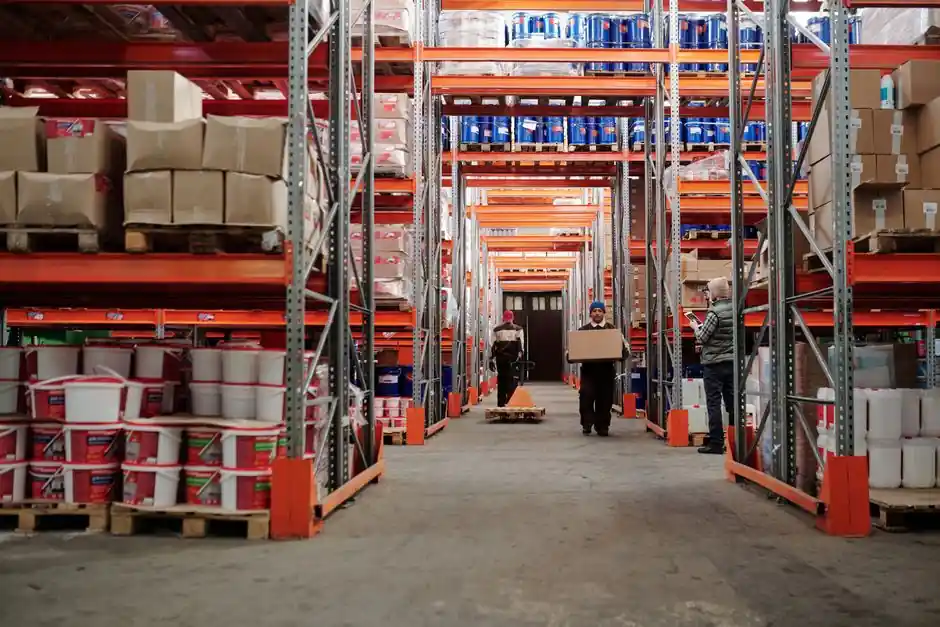
A stacker crane retrieves pallets from a storage rack by combining three servo-driven axes: rail-guided horizontal travel along the aisle, vertical lift on the mast, and telescopic-fork extension into the rack depth, all sequenced by the WMS and executed through the WCS/PLC layer [S2][S3].
Stated operating envelopes from current OEM documentation: aisle width as narrow as 1.5 m, lift height up to 45 m, cold-store operation down to -30°C, and sustained cycle rates of 30-60 pallet moves per hour per aisle [S2][S3]. The crane never enters the rack bay itself; the forks do the work, which is the design choice that lets aisles shrink to pallet-width-plus-clearance.
The Three-Axis Motion Stack That Does the Retrieval
Every retrieval is a simultaneous, not sequential, motion problem. A stacker crane for pallets runs three independent axes under one motion controller: longitudinal travel along a bottom rail anchored to the floor slab and an upper guide rail fixed to the rack profiles, vertical lift on the mast driven by a cable-pulley hoist or equivalent, and transverse fork extension that pushes the load-carrying platform into the bay [S2][S4].
The two rails are not redundant; the upper guide rail is what absorbs lateral forces generated when the forks enter and retract the pallet, and is the reason the crane can run in aisles narrower than a counterbalanced forklift would tolerate [S4]. Cradle kinematics: the forks sit on a lifting platform (the cradle) that rides the mast, so the pallet stays level from pick position to drop position, regardless of mast height. On a Lödige air-cargo unit the telescopic extension itself is 1,500 mm, which is what enables single-mast designs to reach double-deep bays without the mast cantilever growing [S5].
Step-by-Step Retrieval Sequence: From WMS Command to Pallet at the Pick Station
The retrieval begins with a discrete job from the WMS, not from a human button press. A conveyor or AGV delivers the inbound pallet to the aisle-end pickup position; the stacker crane's extraction system grips the load and places it on the lifting cradle, then the crane runs a combined translational-plus-lifting motion to the assigned storage cell, where the telescopic forks deposit the pallet [S2][S6].
Outbound retrieval mirrors the same path in reverse. The WMS selects the SKU location, the WCS dispatches the crane, the crane travels and lifts simultaneously, the forks extend into the bay, lift the pallet a few millimetres to clear the rack support, retract, descend, and deliver the pallet to the aisle-end conveyor for hand-off to picking or shipping [S2][S3]. All three axes run concurrently, which is the reason a single aisle can sustain 30-60 moves per hour instead of the sequential travel-then-lift-then-extend pattern a manual forklift is forced into [S3].
Single-Mast vs Twin-Mast vs Double/Triple-Depth: How the Retrieval Mechanism Changes
The extraction system, not the mast count, is the variable that changes how a pallet comes out of the rack. A single-mast crane uses one vertical column and is suited to lighter unit loads; Interlake Mecalux publishes an MT-1 to MT-5 range with maximum heights from 59 ft (single-deep) to 148 ft (MT-5, single-deep), and 51 ft to 148 ft in double-deep configuration, with permitted loads of 1.65 t for the lower-height models tapering to 1.1 t for the taller MT-4 and MT-5 units [S4].
Twin-mast cranes use two columns to handle heavier loads and resist higher mast torsion, and are the usual choice when the pallet rack bay is wider or the unit load pushes the single-mast envelope. Telescopic forks are the third axis of choice and are what unlock double- and triple-deep storage: the fork telescopes into the bay, picks the pallet, and retracts, allowing the crane to service a deep channel without the aisle being any wider [S4]. Travel speeds for the MT series are published at 722 ft/min with 2 ft/s² acceleration, and lift at 217 ft/min with 2 ft/s² acceleration, all while the upper guide rail keeps the mast from swaying into the rack uprights [S4]. For comparison, the Lödige air-cargo stacker crane runs at 2.5 m/s drive and 0.5 m/s lift with 0.3 m/s² drive acceleration on a 1,300 kg per-pallet load class [S5].
What Guides the Crane: Sensors, Encoders, and the WCS/WMS Handoff
Position feedback is absolute encoder on every axis, not a limit-switch chain. Each stacker crane carries absolute encoders on horizontal travel, vertical lift, and fork extension so the WCS always knows the cell coordinate, and laser or proximity sensors confirm pallet presence on the forks before any lift is commanded [S3][S6].
The WMS-to-WCS-to-PLC stack is what prevents a retrieval from grabbing the wrong cell. The WMS owns the SKU-to-location map and SKU turnover logic; the WCS translates that into a single-axis motion plan for the assigned crane; the PLC on the crane executes the plan and returns status (in-position, load-present, fault) back up the stack [S2][S4]. Safety hardware is layered on top: a maintenance cabin with safety locking bars, floodlights and CCTV on the lifting platform, and E-stop circuits that meet the relevant machinery-safety standard for the installation jurisdiction. For new builds that include conveyor hand-off gates, the gate-interlock logic on the conveyor side is typically wired to the same safety bus; see a worked example of that wiring in this roller conveyor gate interlock reference, and the emergency-stop category rules that govern the E-stop hardware in this IEC 60204-1 E-stop categories guide. The pallet stacker variants covered in those references are the truck-style cousins, not rail-guided AS/RS cranes, but the E-stop category rules apply identically to any machine with a maintenance cabin.
Throughput, Storage Density, and the Numbers Behind the Retrieval
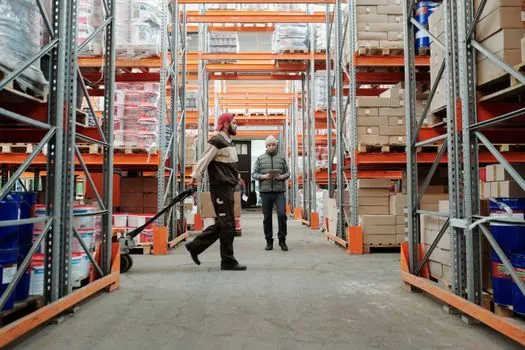
Stated density and throughput numbers from current OEM material: warehouses running a stacker crane system can utilise up to 90% of available cubic space, sustain 30-60 pallet moves per hour per aisle, and reach 45 m lift height in 1.5 m aisles, with cold-store operation down to -30°C [S2][S3]. The 90% figure is a property of the aisle-width and lift-height combination, not of the crane alone: cutting aisle width from a typical forklift aisle (~3.5-4.0 m) to 1.5 m reclaims roughly 1.5-2.0 m of floor per bay, and that compounds over the rack length.
Cycle-time decomposition worth knowing for spec work: a retrieval is dominated by horizontal travel and vertical lift running in parallel, with fork extension and retraction adding only a few seconds at the end of the move. That is why doubling the number of cranes in one aisle does not halve the cycle, and why high-throughput facilities run multiple narrow aisles with one crane each rather than one wide aisle with two cranes. Pallet-size variability is the main failure mode the WCS has to absorb: a 1200×1000 EUR pallet and a 1219×1016 GMA pallet have to clear the same bay, and the WCS uses load-presence sensors to refuse a pickup if the pallet is mis-shoved or off-centre [S3][S6]. For facilities that also need manual forklift flexibility at the loading dock, fork-length and width selection by pallet type is covered in this forklift fork sizing field guide.
Limitations and Where a Stacker Crane Is the Wrong Tool
A rail-guided stacker crane is the wrong tool when throughput is low, SKU count is high with frequent reshuffles, or the building is too short to justify the structural cost. The retrieval cycle is optimised for fixed-location storage, so any operation that requires constant re-slotting pays a double penalty: the crane still has to make the move, and the WMS has to maintain a more complex location map [S1][S2].
Other hard limits: the unit load must fit the bay footprint within the published tolerance (the WCS will refuse a misaligned pallet rather than force a pick), the rack must be installed within the crane's plumb and level tolerance so the upper guide rail actually tracks, and the floor slab must accept the bottom-rail anchor pattern. Cold-store operation to -30°C is supported by current OEM designs, but the WCS, encoders, and hoist lubrication have to be specced for that envelope at order time, not retrofitted [S2][S4]. Mines and dusty foundries typically need enclosure upgrades; a stacker crane is also a poor fit where the load unit is not a pallet, in which case a miniload AS/RS with box-handling storage handling is the correct comparison, not a storage cage or shuttle system.
Trackable signals worth watching through 2026: OEM-published maximum lift heights (current top end is 45 m / 148 ft depending on the source), cold-store lower limits (current published floor is -30°C / -22°F), and double/triple-deep telescopic fork availability, which is still listed as optional rather than standard on most published model lines [S2][S4][S5].