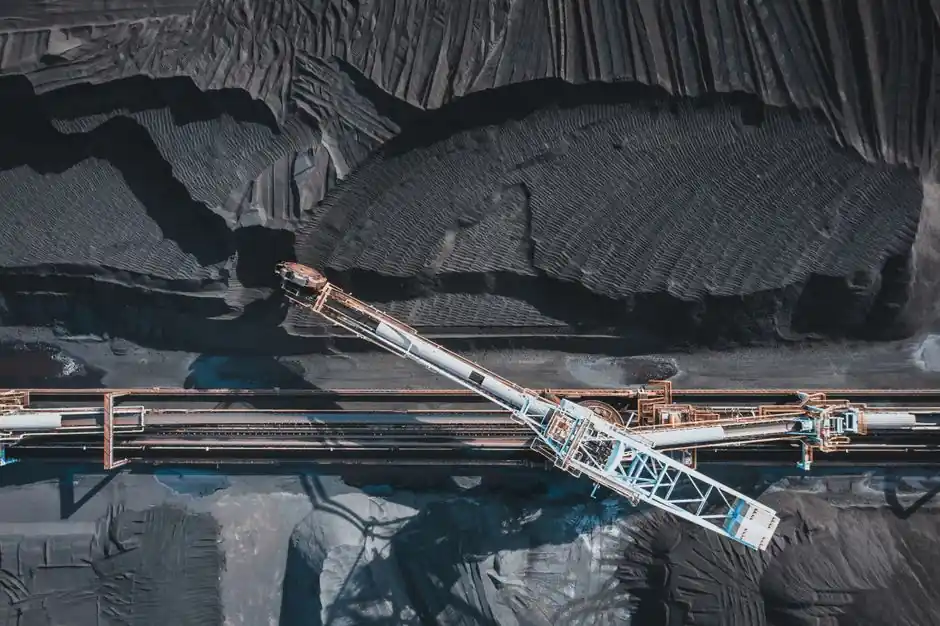
Load swing is the dominant dynamic penalty engineers must add on top of the static trolley rating, and it reshapes every load and speed decision on an overhead conveyor line [S1][S3].
Swing matters because a trolley rating of 250 lb on a Unibilt enclosed track, or 1,200 lb on a heavy-duty I-beam hook, is a static number; once the carrier moves, accelerates, decelerates or negotiates a curve, the effective capacity the system can carry without pendulum-induced chain wear, trolley derailment or pendant fatigue drops sharply [S2][S3][S5]. The three standard capacity bands (light duty 1-75 lb, medium duty 75-200 lb, heavy duty 200-1,200 lb per hook) are the starting envelope, not the operating limit, once swing, speed and curve geometry are added to the calculation [S3].
Why swing is a capacity problem, not just a comfort problem
Swing imposes horizontal and vertical dynamic loads on the trolley wheels, chain pins and track joint, so the static rating must be reduced by a swing derating factor that scales with conveyor speed and the distance between the load centre of gravity and the pendant [S3][S8]. Enclosed track systems rated 100-400 lb per carrier are particularly sensitive because the tubular track limits how much side-load the trolley bearings can absorb before wear accelerates [S5]. On I-beam monorail conveyors rated 150-2,500 lb per carrier, swing shows up as flange-edge loading on the lower beam flange, which is why I-beam sizing (S3×5.7, S4×7.7, S6×12.5) is matched to the heaviest dynamic load, not the heaviest static load [S5].
Power and free systems rated 250-1,500 lb per carrier tolerate swing better because the free track decouples the load from the powered chain, but only if the pusher dog engagement is set up correctly and the free trolleys are spaced to clear the largest swing envelope through the curve [S6]. Across all three families, the practical rule is: every 10 FPM of added conveyor speed above the 10-25 FPM manual load/unload band raises the swing derating, so a 50 FPM line carries far less per trolley than the same hook rated for 10 FPM hand-push service [S3][S5].
Speed, curve radius and the 20-40% derating band
Conveyor speed between 10-25 FPM is the conventional manual load/unload band; above this range, swing grows roughly with the square of speed, so doubling line speed from 25 FPM to 50 FPM more than doubles the pendulum amplitude on the same carrier [S3]. Industry practice translates that amplitude into a 20-40% derating of the static trolley rating on runs above 100 FPM, with the worst case at the exit of horizontal curves where the load is still moving in the original tangent direction while the chain has already rotated onto the new tangent [S3][S5].
Vertical curves are worse than horizontal curves because gravity adds a pendulum component in the plane of travel, so any layout that places a vertical bend immediately after a horizontal bend (or vice versa) without one trolley spacing of straight track between them violates the cardinal layout rule and forces an additional derating on top of the speed derate [S3]. Cardinal's published guidance: allow one trolley spacing of straight track between any horizontal and vertical change to keep chain alignment correct and to let pendulum energy dissipate before the next bend [S3].
How to recover capacity: load bars, multi-pendant hitches and trolley count

A 2-pendant load bar doubles the per-carrier capacity by spreading a 50 lb per pendant rating to 100 lb, and a 4-pendant load bar doubles again to 200 lb on the same base trolley, because the load is suspended from two or four chain points instead of one [S4]. Load bars also improve load stability through curves by resisting the twisting forces that single-point hitches cannot, which means the swing derating on a load-barred carrier is lower than on an equivalent single-point carrier at the same line speed [S4]. For larger lifts, adding more trolleys to the same carrier is the power-and-free equivalent: multiple trolleys on one carrier raise load capacity proportionally and let each trolley work at a lower percentage of its single-trolley rating [S6].
Track selection is the ceiling on this recovery: an I-beam track "realises the entire load carried on an overhead trolley conveyor", which is why heavy duty (200-1,200 lb per hook) and very heavy duty runs above 1,200 lb always use 3", 4" or 6" I-beam rather than 1-5/8" or 2-3/8" round enclosed track or rectangular enclosed track [S3][S8]. When the load exceeds the heaviest single-trolley rating on the chosen track, the only remaining lever is to reduce line speed until swing amplitude returns to the derating envelope the structural check was run for [S3][S5].
Track and trolley selection criteria that bound the swing problem
Track family choice is governed by load, temperature and cleanliness, not by swing directly, but the swing derating that follows is set by the same parameters: enclosed track for 100-400 lb carriers in clean environments up to 120 °C; I-beam monorail for 150-2,500 lb carriers in paint bake ovens up to 220 °C and foundry service; power and free for 250-1,500 lb carriers where stop, accumulate and switch are required up to 200 °C [S5]. I-beam monorail at 1.4× installed cost and power and free at 2.8-3.5× installed cost both buy swing margin that enclosed track cannot deliver, because the open architecture lets trolleys roll on a wider flange and absorb larger side loads [S5].
Within a chosen family, trolley count, trolley spacing and chain pull set the remaining swing budget: heavier chain pulls (larger X348, X458 chain in enclosed track; larger pin diameters in I-beam) resist the snap loads that swing imposes when a carrier enters or leaves a curve, and they are the correct specification when the swing derating would otherwise push the static rating below the required payload [S2][S3][S5]. Engineers comparing a 250 lb Unibilt enclosed track trolley against a 1,200 lb heavy-duty I-beam hook should pick by the heaviest single-piece load plus its swing derating, not by the headline static number, because the headline is what the chain and track can hold when the load is not moving [S2][S3].
Limits, failure modes and the layout rules that prevent them
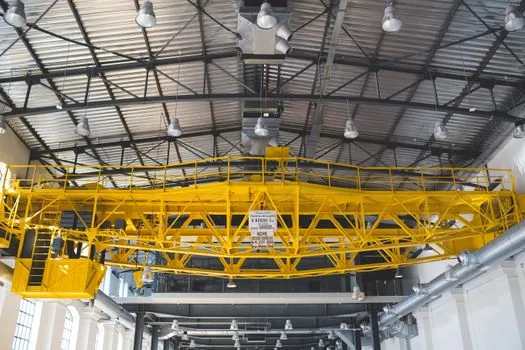
The most common swing-related failure modes on overhead conveyors are pendant fatigue at the load bar attachment, chain pin wear at curve entry, and trolley derailment at the exit of compound (horizontal-plus-vertical) bends, all of which trace back to swing amplitude exceeding the derating envelope the structural check assumed [S3][S4][S8]. The cardinal layout rules that bound these failures: place the drive at the high point of the system with the take-up in front of the drive at the low point so slack chain is pulled away from the drive chain; verify minimum horizontal and vertical curve radii against the trolley spacing tables before committing the layout; and check that loads do not collide through curves by laying out the horizontal and vertical curves, then laying in the loads [S3].
When these rules are not met, the swing derating compounds with the layout penalty and the operator sees premature chain stretch, trolley wheel flats, and pendant cracks long before the 25-35 year design life of a correctly engineered overhead chain conveyor system is reached [S3][S5]. Specifying a load bar for any carrier above 50 lb per pendant and a dual-rail I-beam monorail for any run above 250 lb per hook is the cheapest way to keep swing inside the structural budget without throttling line speed. Where a line must move hangable parts through repeated thermal or wet processes, the overhead conveyor trolley count, pendant count and curve spacing together define the swing envelope, so the comparison worth running is enclosed track vs I-beam vs power and free on load per carrier, max ambient temperature, stop/accumulate capability and installed cost (1.0×, 1.4× and 2.8-3.5× respectively) [S5].
The next trackable signal is whether new chain and trolley replacement cycles are moving earlier than the design 25-35 year envelope, which would mean swing is being under-derated in the original spec rather than the conveyor being under-engineered [S5]. For broader comparison, an arc welding machine strike-and-hold article shows the same derating logic on a different dynamic load, where the static nameplate is not the operating limit either.
Spec-level background on the components involved: swing check valve.