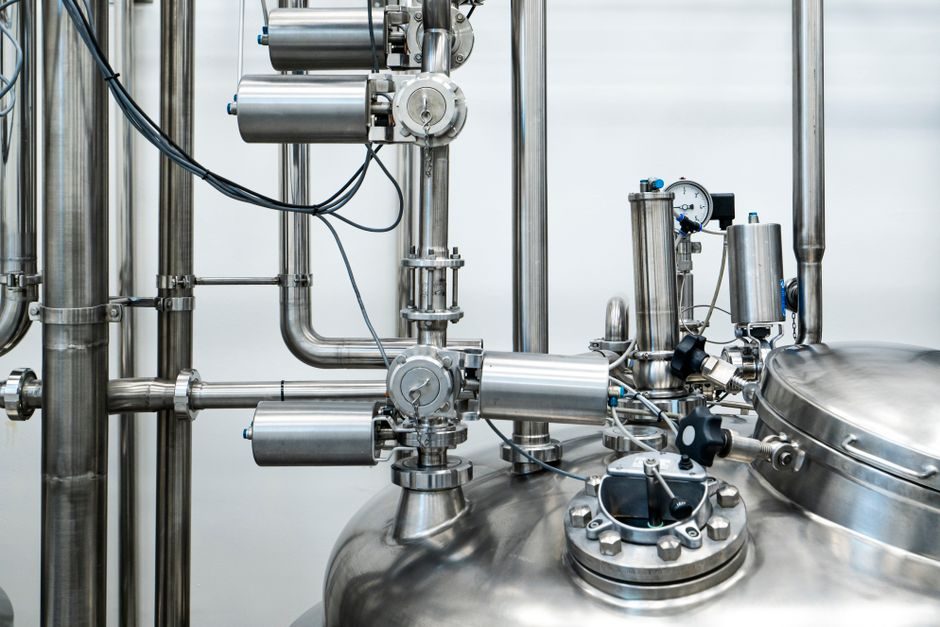
Cold-rolled stainless steel coil in 0.25-15 mm thickness traded at US$1,600/t for 10-49 t lots, US$1,500/t for 50-99 t, and US$1,400/t at 100+ t on the Made-in-China export channel as of 2025-12-09 [S5], and the price spread across order size is the first signal that large-tonnage buyers are pulling volume forward.
The product conforms to ASTM, AISI, GB, JIS, DIN, and EN standards simultaneously [S5], which means a 304 or 316 coil that clears one market will clear the others — a practical lever when a single regional mill is allocation-cutting. Reference specs for the underlying stainless steel family remain anchored to BS EN 10088-2 for strip and sheet [S1], so any certificate swap must trace back to that designation.
Where the Shortage Bites: Grade, Gauge, and Finish Combinations
Shortage risk concentrates on 304 slit coil in 0.3-0.5 mm gauges and on 316 coils destined for acidic-service heat exchangers, because 304 alone accounts for the bulk of BS Stainless's documented stock programme and 316's molybdenum content commands the higher melt premium [S1]. Available processing widths run 1000 mm at 0.3 mm thickness, 1250 mm at 0.4 mm, and up to 1580 mm from 0.5 mm to 3 mm gauge, with 3 mm as the published maximum [S1] — anything above that has to be rerouted to plate distributors like Chicago Stainless, which carries 200/300/400 series plus 1100, 3003, 3105, 5052, and 4017 aluminium coil as a buffer when stainless is on allocation [S3].
Finish codes are equally load-bearing in 2026: 2B (smooth reflective grey, the workhorse), BA (bright annealed, controlled atmosphere, highest reflectivity), 2D (cold-rolled matt), 2E (cold-rolled rough/dull), and HR (hot-rolled scaled) [S1]. Mills under allocation will deliver 2B first and push BA orders out, so any spec calling for BA on a stainless steel coil for visible architectural or food-grade polished applications needs a hard second-source qualification.
Price Bands and the Tier Discount Curve
Verified export-channel pricing on cold-rolled stainless steel coil, 0.25-15 mm thickness, was published at US$1,600/t for 10-49 t orders, US$1,500/t for 50-99 t, and US$1,400/t for 100+ t as of 2025-12-09 [S5]. The US$200/t step between 10 t and 100+ t is roughly a 12.5% volume discount and tells the field engineer exactly how much the mill wants the larger lot — a useful number when negotiating allocation extensions.
Beyond the headline coil price, secondary processing inflates the delivered cost. Chicago Stainless slits to size, cuts to length, polishes, applies PVC film, blanks, or shears from five US processing locations (Chicago, Pittsburgh, Cleveland, Baltimore, Houston) and ships coast-to-coast [S3]. Each downstream step — PVC for surface protection during stamping, polishing to a specified RA, or blanking for transfer to a press line — adds handling days, and 2026 lead times on coated or polished coil typically exceed those on bare 2B by one to two weeks.
Application-Driven Demand Pull
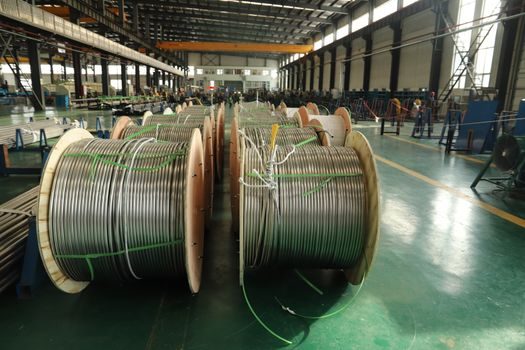
Documented end-uses for stainless slit coil span heat exchangers, heating elements, flexible tubing, filtration devices, cutlery products, springs, and surgical instruments [S1], and each of those segments pulls on the same 304/316 melt pool. Wire-mesh weavers using T304 as the standard grade — and other grades for specific acid, heat, or wear service [S4] — are direct competitors for the same cold-rolled feedstock, which is why a shortage in coil stock ripples into mesh pricing within a quarter.
Stamping fabricators face the same pinch. Exhaust gas purifier shells for auto and motorcycle applications are produced by stamping and welding stainless coil at manufacturers such as Laizhou Guangda Metal Products [S6], and any allocation cut on 0.5-1.2 mm 304 coil hits the stamping-fabrication tier before it shows up at the OEM. The deeper-drawn the part, the tighter the gauge tolerance required, and the fewer the qualified mills.
Selection Criteria by Service Environment
Choose 304 when the application needs general corrosion resistance plus easy roll-forming and welding — it remains the highest-volume grade for slit coil [S1]. Step up to 316 when the service is acidic or chloride-bearing, because the molybdenum addition raises pitting-corrosion resistance measurably [S1]. Specify 321 (304 + titanium) when intergranular corrosion after welding is the failure mode you are designing against [S1]. Drop to 430 (ferritic) for domestic and catering applications where the duty is mild and the budget is tight [S1] — ferritic 430 also brings magnetic permeability that some induction-heated fixtures require.
For process piping that ties into instrumentation or solenoid-actuated isolation, the same alloy selection logic applies at the tubing end: a 316L stainless steel coil feed into a solenoid coil-driven sample conditioning panel keeps chloride-stress-cracking risk low on the wetted side while the actuator sits in a benign cabinet. This is the kind of cross-discipline spec that gets locked in early, so the alloy decision should run ahead of the actuator decision by at least one revision.
Who the Shortage Hits, and Who It Spares
The squeeze is hardest on buyers with single-mill qualifications, single-gauge dependence, and tight just-in-time inventories. Process plants running Kanban on 304 2B coil in 0.5-1.0 mm gauges are the textbook exposure. Tooling and stamping shops locked into one Chinese export channel — for example via suppliers such as the Laizhou-based fabricator operating since 1996 [S6] — are exposed if that channel allocation-cuts.
The shortage spares buyers who have already dual-sourced across ASTM, AISI, GB, JIS, DIN, and EN-equivalent coils [S5], who hold 8-12 weeks of 2B stock rather than 2-4, and whose part design tolerates a 0.05 mm gauge shift. Service centres with five US processing points and the ability to slit, cut-to-length, polish, PVC-coat, blank, and shear [S3] can rebalance stock faster than a buyer waiting on a single mill allocation letter.
Risk Levers and Sourcing Map
Three verifiable levers reduce exposure. First, qualify a second coil source against BS EN 10088-2 [S1] now, before allocation tightens — the standard is the cross-market lingua franca and a certificate against it satisfies most European and North American QA teams. Second, push finish to 2B where the design allows, reserving BA for visible or hygienic surfaces, because 2B is the most widely produced finish [S1] and mills prioritise it under allocation. Third, lock 100+ t pricing where the 12.5% volume discount applies [S5] and warehouse the delta, accepting carrying cost in exchange for security of supply.
Cross-link your sourcing map with adjacent articles already in the catalogue: the broader Stainless Steel Coil Suppliers and Manufacturers: 2026 Sourcing Map names the mills and service centres by region, while the Silicone Rubber Supply Shortage 2026: Price Floor, Spec Levers, and Sourcing Map article documents the same shortage playbook on a parallel polymer feed — useful as a template if you are managing multi-material BOM risk.
Verifiable Signals to Watch Through Year-End
Track three data points through Q4 2026. First, the 100+ t cold-rolled coil price on Made-in-China — if the US$1,400/t floor holds, the volume discount is intact and the mill is still chasing tonnage; if it climbs toward US$1,500/t, the shortage has moved from allocation to price [S5]. Second, BA finish lead times at your primary service centre — a push from 4-6 weeks to 8+ weeks is the clearest early indicator that 2B is being protected at BA's expense [S1]. Third, slit-width availability in 1000 mm and 1250 mm coils, because those widths feed the highest volume of stamping and mesh-weaving lines and tend to ration first when melt is tight [S1][S4].