Stainless steel specification work breaks into three decisions run in parallel: pick the corrosion-resistant grade, pick the structural section (channel, pipe, plate), and pick the supply form — and 304/L versus 316/L is still the first fork on roughly 70% of the inquiries that reach service centers [S5][S6].
For process engineers, the selection also has to defend itself against chloride pitting, sensitization in the 450–850 °C window, and the post-weld loss of toughness in thick sections — every value below is anchored to a real grade or section, not a marketing line [S6][S7]. A working grasp of what makes stainless steel a separate alloy family from carbon steel and alloy steel is the prerequisite for reading any sizing table correctly.
Grade Map: 300-Series Austenitic vs 400-Series Ferritic/Martensitic
304 stainless contains 18–20% Cr and 8–10.5% Ni with a maximum carbon of 0.08%, and the "L" variant drops carbon to 0.030% max specifically to defeat chromium-carbide precipitation in the 450–850 °C sensitization range after welding [S6]. 316 adds 2–3% Mo to that 18-8 base, which is the metallurgical reason it survives chloride-rich service (coastal atmospheres, de-icing salts, bleach CIP loops) where 304 starts to pit [S6]. 410 is a 11.5–13.5% Cr martensitic grade that hardens on heat treatment and is chosen for cutlery, valve trim and pump shafts where wear resistance matters more than corrosion resistance [S6]. For structural and process equipment the practical working set is usually 304/L, 316/L, 409 (ferritic, automotive exhaust), 430 (ferritic, appliance/decorative) and the duplex 2205 — every one of those names maps to a specific ASTM A240 chemistry range, not a generic "stainless" label [S6][S7].
Selection by environment follows a tight logic: dry indoor atmosphere → 430 is acceptable; general-purpose indoor and architectural → 304/L; coastal, chemical, food-and-beverage CIP → 316/L; chloride-rich hot brine or sour service → 2205 duplex or 6% Mo super-austenitic (AL-6XN, 254 SMO) [S6]. When the section is heavy (above ~20 mm) and will see post-weld service in a corrosive medium, the 0.030% C "L" grade is the safer pick because it brings the welded HAZ under the 0.04% carbon threshold where intergranular corrosion tests (ASTM A262 Practice E) typically pass [S6].
Channel Sections: Real Dimensions for 304/L and 316/L
Stainless channels are produced in hot-rolled bar sizes matching the standard carbon-steel C-channel nomenclature, with 304/L and 316/L the two alloys most distributors keep on the floor [S7][S8]. Common depths stocked run from C3 × 4.1 (3 in. web, 4.1 lb/ft, ~1.410 in. flange width) up through C8 × 11.5 (8 in. web, 11.5 lb/ft) for light structural and skid-frame work, with larger C10, C12 and MC shapes available on mill roll [S7]. Each channel is dual-certified to ASTM A276 (bar) and ASTM A479 (pressure-vessel-quality bar) in many cases, and the same shape carries an identical dimensional envelope in 304/L and 316/L so designers can up-grade by chemistry only without re-running the structural calc [S7][S8].
Stainless channel sizing differs from aluminum channel in two ways that bite on first builds: the unit weight is roughly 2.5× that of 6061-T6 (because the density is 8.0 g/cm³ versus 2.7 g/cm³ for aluminum), and stainless cannot be field-notched or trimmed with woodworking tooling — plasma, waterjet or bandsaw are the realistic cutting methods [S7]. For skids, platforms and tower internals the typical spec reads "304/L or 316/L channel, ASTM A276, 2B or HR finish, DFARS-compliant if US government end-use" with the depth in inches, the weight per foot, and the length in feet [S8].
Pipe, Tube and Plate: Pressure Class and Wall Thickness
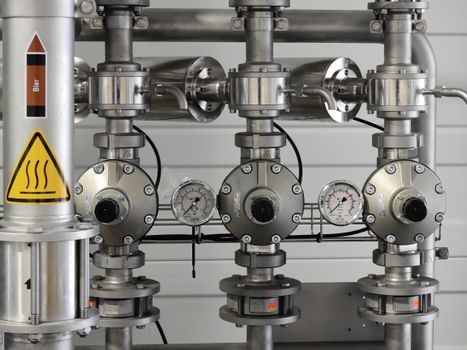
Stainless pipe is ordered by NPS (nominal pipe size) and schedule, exactly like carbon steel, and the most common schedules for process work are 10S, 40S and 80S, where the "S" suffix denotes the stainless wall series per ASME B36.19M [S7]. A 2-in. NPS Sch 40S 304/304L pipe has an outside diameter of 2.375 in. and a wall of 0.154 in., giving an internal area suitable for the same orifice-plate and control-valve sizing calcs run on a carbon-steel line, with the stainless version gaining chloride and oxidation resistance but losing roughly 5–8% in thermal conductivity [S7]. Plate is specified by thickness in inches or mm, width × length, and ASTM A240 grade; 304L plate in 3/8 in. (9.53 mm) thickness is a common baseline for tank shells and frames [S7].
Sanitary tube (ASME BPE) used in food, beverage and pharma runs on outside diameter rather than NPS — 1 in., 1.5 in., 2 in. and 3 in. OD are the dominant sizes, with 16-gauge (0.065 in.) and 14-gauge (0.083 in.) walls the default for 1–2 in. lines and 12-gauge (0.109 in.) stepping in for 3 in. and above [S9]. When stainless pipe carries a vacuum or thermal-cycling service, the 304L grade is preferred over 304 because the lower carbon cap reduces the risk of stress-corrosion cracking initiation at roll-formed or welded bends.
Selection Criteria and Who Stainless Is For (and Not)
Stainless earns its premium over carbon steel in three measurable ways: chloride pitting resistance (PREN ≥ 18 for 304, ≥ 25 for 316, ≥ 35 for 2205), elevated-temperature oxidation resistance to ~870 °C in intermittent service for 304/316, and a chrome-oxide passive film that self-heals in oxygenated water [S6]. It is the right call for wet-process equipment, hygienic piping, architectural handrails, coastal structures, exhaust manifolds and any weldment that cannot be field-galvanized [S6][S8].
Stainless is the wrong call when (1) the service is purely mechanical with no corrosion driver — a 1020 steel channel is 30–50% cheaper and machines more easily; (2) the chloride load is high and temperatures exceed 60 °C continuously, where even 316 begins to pit and 2205 duplex or a 6% Mo super-austenitic becomes the engineering answer; (3) wear or galling is the dominant failure mode — 316 galling is severe without a harder pin material, and a 17-4 PH or Nitronic 60 insert is the typical fix; or (4) weight is a constraint — stainless density at 8.0 g/cm³ is roughly 2.5× aluminum and 1.2× structural carbon steel [S6][S7]. The 2026 supply environment, with global stainless melt-shop output climbing 2% year-on-year through Q2, has not changed these selection rules; it has only tightened delivery on a few 316L sheet and plate sizes [S5].
Comparison Table: 304/L vs 316/L vs 430 vs 2205 on Four Decision Criteria

Lining the common grades against four decision criteria is the fastest way to spec a job correctly: [S1]
Corrosion (chloride pitting): 430 lowest (PREN ~17, ferritic, no Ni/Mo) → 304/L moderate (PREN ~18, no Mo) → 316/L high (PREN ~25, 2–3% Mo) → 2205 duplex highest (PREN ~35, 22% Cr, 5% Mo, N) [S6]. Strength (yield, MPa, annealed): 2205 ~450 → 316/L ~170 → 304/L ~170 → 430 ~205 (430 is harder in the annealed condition as a ferritic grade) [S6]. Temperature limit (intermittent oxidation): 304/L and 316/L ~870 °C; 430 ~815 °C; 2205 ~300 °C sustained before sigma-phase embrittlement becomes a concern [S6]. Cost (relative, plate 3/8 in., 2026 baseline): 430 ~1.0×, 304/L ~1.6×, 316/L ~2.1×, 2205 ~2.8× — these are qualitative bands, not live spot quotes, because nickel and molybdenum surcharges move monthly [S5][S7].
Common Failure Modes and Specification Traps
Three failure modes account for the bulk of field disputes. First, intergranular corrosion in welded 304 (not 304L) plate in the 3–6 mm thickness band — the HAZ sits in the 450–850 °C sensitization window long enough during multi-pass welding to precipitate chromium carbides and starve the grain boundary of Cr, which is the textbook reason ASTM A262 Practice E fails on as-welded 304 plate [S6]. Second, chloride pitting of 316 tubing in hot CIP loops above ~70 °C, often traced to under-specified surface finish — an electropolished internal surface (Ra ≤ 0.38 µm / 15 µin) dramatically out-performs a 2B mill finish in chloride pitting tests [S6][S9]. Third, galling of 316/316L threaded fasteners — a 70%–30% rule of thumb is to never run 316-on-316 without a dissimilar-metal separator, a Nitronic 60 insert, or an anti-seize compound, because galling seizes the threads on first installation [S6].
Two specification traps deserve flagging. Designers sometimes call out "stainless steel" without an ASTM or EN grade, which is the single most common reason a job ships in 304 when the service required 316 — every drawing note should read "ASTM A240 316L" or "EN 10028-7 1.4404" with the finish, thickness and width called out separately [S7]. The second trap is treating stainless channels as a drop-in for hot-rolled carbon-steel channels without verifying the bend radii and corner radii; stainless bar channel corner radii are larger than carbon-steel equivalents because they are produced on different rolls, so hole patterns and weld-joint prep must be re-checked [S7][S8].
Standards, Sourcing and Cost Levers
The five standards that govern 90% of stainless selection work are ASTM A240 (plate/sheet), ASTM A276 (bar/shape), ASTM A479 (pressure-vessel bar), ASME B36.19M (stainless pipe dimensions) and ASME BPE (sanitary tube) — every quote should reference the ASTM grade explicitly, not just the UNS number [S7][S8]. For Europe the parallel set is EN 10028-7 (plate for pressure purposes), EN 10088-2 (sheet/plate general) and EN 10217-7 (welded tube) [S5]. NACE MR0175 / ISO 15156 limits the usable grades in sour (H₂S-containing) oil-and-gas service to specific compositions — 316L qualifies only with the right hardness and inclusion control, which is why sour-service quotes are always longer than commodity 316L plate quotes [S6].
Sourcing levers in 2026 are dominated by nickel and molybdenum surcharge mechanics. 304 contains roughly 8% Ni and zero Mo, so its price tracks nickel on the LME with a several-month lag; 316 contains 10–14% Ni and 2–3% Mo, so it tracks both, and the 304-to-316 spread widens and narrows with the Mo-to-Ni price ratio [S5]. Stocked service centers carry 304/L and 316/L in standard channel, plate and Sch 10S/40S pipe sizes; 409, 430, 2205 and the 6% Mo grades are typically mill-order with 6–10 week lead times [S7][S8]. For an at-a-glance benchmark of how those alloy surcharges flow through to fabricators and stockists, the stainless steel reference page tracks the major families, and the 2026 cost-stack logic for engineered alloys runs through the same channels as the alloy steel price bands used in chemical-process spec work. For heavy-equipment and structural applications, stainless structural channel sizing remains tied to ASTM A276 and A479 dual-cert bar, and the 316/L upcharge for the same channel section is the simplest number to track month over month [S7][S8].
Two signals worth tracking over the next quarter: the monthly Stainless Steel Focus melt-shop output figure (Q2 2026 closed at +2% year-on-year, signalling balanced rather than tight supply for 304/L) and the LME nickel-to-molybdenum ratio, which sets the 304-to-316 price spread that drives most spec-substitution decisions on cost-driven projects [S5].