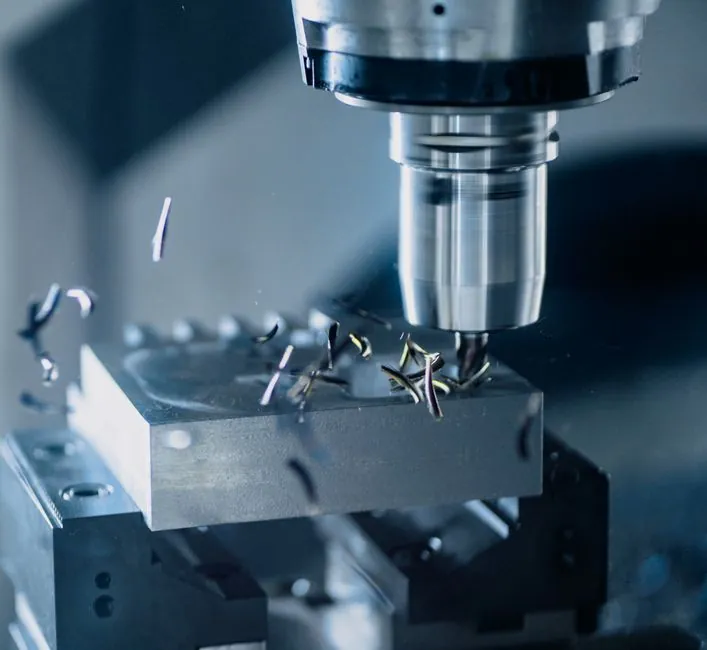
Static pressure molding machines for aerospace interior and structural composite parts are typically specified in the 1,000-3,000 ton clamp force range, with heated platens sized 1.2 x 1.5 m to 2.0 x 2.5 m and operating temperatures of 150-200°C for thermoset charge curing [S1][S2].
Selection logic on the shop floor is not driven by tonnage alone: the decisive variables are platen temperature uniformity (±5°C across the working area), vacuum-assisted venting (typically 50-100 mbar absolute in the closed mold), closed-loop pressure profiling (50-150 bar specific pressure), and documented compatibility with FST-grade sheet molding compound (SMC), phenolic prepreg, and bismaleimide (BMI) charge materials [S2][S3]. A static pressure molding machine that cannot hold ±5°C platen spread will scrap high-temperature phenolic charges regardless of clamp tonnage.
Why Static Pressure, Not Injection, for Aerospace Composites
Static (compression) molding applies closing force to a pre-measured charge of SMC, bulk molding compound (BMC), or preform rather than injecting molten polymer through a sprue, which is the structural reason the process dominates large aerospace panels, galley frames, lavatory walls, and floor panels where high strength-to-weight and impact resistance outweigh cycle time [S1][S2].
Compression molding is one of the most economical methods for processing thermosetting plastics, rubber compounds, and composite materials, while injection molding is generally favored for thermoplastics when high-volume production and complex part geometries are the priority [S1]. For a 1.5 m x 1.5 m galley frame, a static press cycles at roughly 8-15 minutes with full cure, compared with injection molding's sub-minute cycle but at far higher tool cost and limited reinforcement length. The fiber-reinforced charge retains glass or carbon fiber lengths of 12-50 mm, which is what delivers the structural stiffness cabin Tier-1 suppliers need.
Key Spec Bands Process Engineers Compare
Four spec bands separate a usable aerospace press from a mis-specified one: clamp tonnage vs. platen area (rule of thumb 3-6 tons per 100 cm² of projected area for SMC), platen heating uniformity (≤±5°C at 150°C set point), vacuum vent performance (50-100 mbar absolute, leak rate <5 mbar/min on a closed mold), and closed-loop pressure control (50-150 bar specific pressure with 1-2% transducer accuracy) [S1][S2].
On the materials side, the press must handle charge areal weights of 2-6 kg/m² for SMC and 1-4 kg/m² for prepreg, with daylight openings of 600-1,500 mm to clear deep-draw tool geometries. Heating medium is typically thermal oil (rated to 250°C) or electric cartridge heaters (rated to 300°C with PID control), and the ejector system should deliver 10-50 kN at ≤300 mm stroke for clean part release from sticky phenolic tooling. A molding decision matrix that ignores platen heating distribution will under-size a machine that otherwise looks correct on paper.
Comparison: Compression vs. Injection vs. Thermoforming for Cabin Parts
Three molding routes compete for aerospace interior work, and the right answer depends on part size, reinforcement length, and FST requirement rather than on any single spec line [S2].
Compression molding handles large structural panels (galley frames, lavatory walls, floor panels) in 1-3 m dimensions, accepts fiber lengths of 12-50 mm, and is the default for FST-grade phenolic and BMI. Injection molding produces small-to-medium components (seatbelt buckles, vent bezels, connector housings) with ±0.01 mm tolerances, sub-minute cycle, and 100% lot traceability, but is restricted to thermoplastics like PEEK and PEI (Ultem) with reinforcement lengths typically under 5 mm. Thermoforming covers thin-walled, large-area parts (sidewall panels, ceiling liners, bin doors) at the lowest tooling cost, but the wall thickness and structural performance are lower than compression-molded SMC. For a single part decision, the criterion chain is: structural load → compression; high-volume small geometry → injection; large thin cosmetic → thermoforming.
Standards, FST Compliance, and Traceability Burdens
Cabin interior parts must pass aviation burn tests (typically FAR 25.853 / CS 25.853 Appendix F vertical burn, OSU heat release ≤65/65 kW-min/m², and smoke density Ds ≤200 in 4 minutes) before any lot ships, and improper processing of PEEK, PEI, or flame-retardant polycarbonate will degrade these resin systems enough to fail the test [S2][S3].
Process control flow typically includes mold flow simulation before tool cut, melt/charge temperature profiling, closed-loop pressure ramp, and 100% lot traceability from resin pellet to installed component [S3]. Quality systems run at IATF 16949-level discipline for non-flight-rated cabin parts and at AS9100-level for primary structural composite parts, with material certificates (resin lot, fiber lot, fire-test reports) filed per shipment. A failure at any of these checkpoints triggers part rejection, scrapped production runs, and severe regulatory penalties, which is why static presses for aerospace are commonly specced with redundant thermocouples (8-16 zones on a 1.5 m platen) and on-board pressure transducers rather than relying on machine HMI alone.
Selection Criteria: Who This Machine Is For, and Who It Is Not For

A static pressure molding machine in the 1,000-3,000 ton class is for Tier-1 and Tier-2 aerospace molders running FST-grade SMC or phenolic/BMI prepregs for cabin structural panels, galley inserts, lavatory modules, and cargo compartment liners where reinforcement length above 10 mm and panel area above 0.5 m² matter [S1][S2].
It is not for shops running commodity thermoplastics at sub-minute cycles, micro-precision medical parts, or electronics encapsulation, where injection or transfer molding gives better cost-per-part. It is also the wrong tool for prototype runs under 50 parts, where thermoforming or autoclave-cured prepreg tooling gives faster lead times at lower capital exposure. Procurement should also reject any press that cannot document platen temperature uniformity data over a full 24-hour soak at 180°C, since the empty-stability profile is what determines cure consistency in production.
Limitations, Failure Modes, and Field Constraints
The dominant production failure modes on a static press in aerospace service are: platen temperature drift outside ±5°C (causing under-cure at the panel edge and over-cure at the center), vacuum-vent leakage above 5 mbar/min (causing trapped air, porosity, and burn-test failure), and inadequate specific pressure below 50 bar (causing knit-line weakness at the charge edges) [S1][S3].
Dimensional warpage is the next-tier risk: flight components endure thermal cycling from -55°C ground storage to +85°C cabin operation, and without advanced mold flow simulation and precise cooling control, molded plastics retain internal stress and shift unpredictably [S3]. Part weight above 25 kg per shot compounds these risks because ejector force and clamp deflection both scale with shot mass, and any deflection above 0.1 mm across the platen will register as a tool misalignment in the next shot. For high-mix shops running 4-6 part numbers per week, changeover time on a static press (typically 30-90 minutes for charge and tool swap) is itself a production constraint that should be written into the spec, not discovered after delivery.
Sourcing Signals to Track Through 2026

Three trackable signals are worth following into late 2026: the published platen temperature uniformity spec (≤±5°C at 150°C is the current accepted band, with ±3°C as the emerging premium spec) on new press offerings, the breadth of material-database partnerships (PEEK, PEI/Ultem, BMI, phenolic) the press builder maintains for mold flow simulation, and the on-board FST-test correlation data suppliers provide for their reference installations [S2][S3].
For cross-process context on how a compression molding machine decision compares with shell molding machine choices in metal-adjacent aerospace work, and for related selection logic on low-pressure die casting machine alternatives for non-ferrous structural brackets, the same platen uniformity and closed-loop pressure criteria apply. Reference also the static pressure molding machine entry for baseline platen and clamp definitions before locking a tonnage number into a purchase order.
See also our earlier report, Rotary Drilling Rig Selection for Demolition Projects: 2026 Spec Map.