
Steam separators and steam traps remove liquid water from a steam system, but the two devices operate on different phases of that liquid: the separator takes moisture that is still suspended as droplets in moving steam, the trap takes liquid that has already fallen out of the vapour and pooled in a low point [S1][S5].
Their selection criteria follow from that split. A separator is sized for line velocity, pressure, and the dryness target at the equipment it feeds, while a steam trap is sized for condensate load, back pressure, and the temperature/pressure envelope of the steam it must retain. Both belong in a properly designed condensate loop, and most process-steam trains now specify them as a pair [S1][S7].
Where Each Device Sits in the Steam and Condensate Loop
A steam separator is installed in the live-steam header, typically within 5 to 10 pipe diameters downstream of the boiler outlet or pressure-reducing valve, where it acts on the bulk flow rather than on pooled liquid [S1][S5]. Its job is to strip entrained water before that water reaches a control valve, heat exchanger, or turbine, because each kilogram of carryover reduces heat-transfer coefficient, increases erosion, and adds water hammer risk [S5].
A steam trap, by contrast, sits at every low point and at the discharge of every steam user, and its role is to discharge condensate as soon as it forms while holding live steam inside the system. In a properly designed steam and condensate loop the trap maintains a liquid seal that isolates the steam space from the condensate return line, and that seal is what prevents live-steam loss through the drain [S7].
Operating Principle: Droplet Removal vs Liquid Discharge
Steam separators rely on a change of momentum or on a coalescing surface to throw droplets out of the flow. Centrifugal (cyclone) designs use tangential entry to spin the stream and push the heavier water phase against the shell, where it falls to a drain pocket; vane-pack and mesh-pad designs force the flow through tortuous paths so droplets impact, coalesce, and drop out by gravity [S1][S5].
Steam traps operate on the physical difference between steam and condensate and self-actuate without external power. Mechanical float traps use density: condensate raises a float (commonly 18-8 stainless steel with sand ballast) that opens a valve, and the rising float drops the valve back onto its seat the moment steam arrives, which is what blocks live-steam loss [S1][S4]. Thermostatic traps react to temperature, opening on sub-saturation condensate and closing as the temperature approaches saturation; thermodynamic disc traps use the velocity difference between slow condensate and high-velocity flash steam to cycle a disc on its seat [S4].
Decision Criteria: Pick the Separator, Pick the Trap
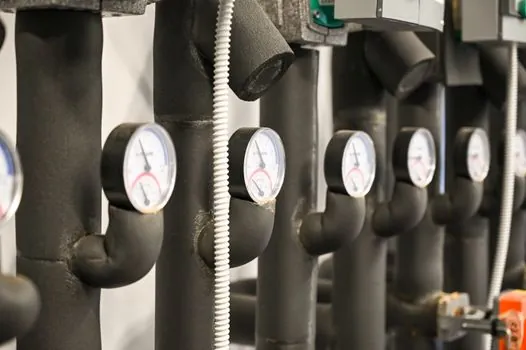
Separator selection is set by the dryness target and the line condition. For headers above about 8 m/s, a cyclone design is usually the first call because centrifugal force scales with the square of velocity; for headers below that range, or where the spec demands 1.0% or lower carryover, vane-pack or mesh-pad internals are commonly chosen because the collection surface is what drives separation at low velocity [S1][S5]. Separator sizing also needs an installed drain trap, because the water that drops out of the flow has to go somewhere, and that downstream steam trap is the second half of the moisture-removal chain [S1].
Trap selection is set by the load curve, the pressure differential across the device, and the sensitivity to steam loss. Mechanical float and inverted-bucket traps handle steady, heavy condensate loads and are tolerant of water hammer; thermodynamic disc traps handle superheat and high-temperature discharges but discharge condensate in slugs rather than continuously; thermostatic bellows traps fit tracing and low-load heating where tight temperature control matters more than capacity [S2][S4]. For more on sizing a float trap with a separator, see the float steam trap paired with condensate separator sizing guide.
Side-by-Side Comparison on Selection Criteria
On four common selection criteria, the two devices diverge sharply. On the medium handled, the separator sees two-phase wet steam with entrained droplets, while the trap sees sub-cooled or saturated liquid at line pressure [S1][S4]. On installation location, the separator is inline in the steam header, while the trap is at low points, drip legs, and equipment discharges [S5][S7]. On what failure looks like, a separator failure shows up as wet steam at the user, erosion on control valve seats, and water hammer in the header; a trap failure shows up as either waterlogging (trap stuck closed, no discharge) or live-steam loss through the drain (trap stuck open), both of which are detectable by trap-management surveys [S4]. On the deciding spec, separators are chosen on pressure class, line size, velocity, and dryness target, while traps are chosen on capacity (kg/h), inlet pressure, differential pressure, and whether the discharge is to atmosphere or to a pressurized return [S2][S4].
Use Cases, Limitations, and Common Mis-Specs
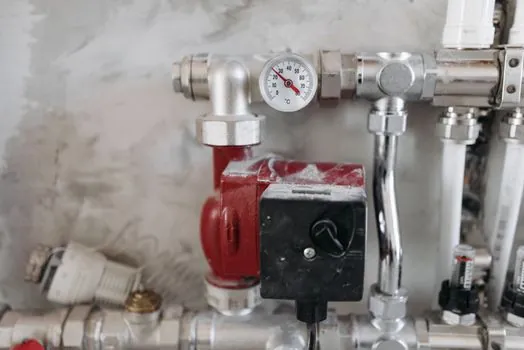
Specifying only a separator and no trap leaves every low point full of condensate, which is the classic recipe for water hammer; specifying only a trap and no separator means whatever carryover the boiler or PRV station produces travels all the way to the user, where it shows up as reduced heat-transfer area and accelerated tube failure [S1][S5]. Separator internals also need an installed drain trap to function, and that drain trap must be sized for the separator's collected water load rather than the user load, which is a frequent under-sizing error.
On orientation, a separator must be installed with the drain pocket at the bottom and the flow direction arrow aligned with the line; a trap must be installed below the drip leg it drains, with a strainer upstream to keep scale and weld slag out of the valve seat [S1][S4]. Inspection intervals on the separator baffle and internals are typically scheduled on a 12-month cycle rather than run-to-failure; for the access planning, see steam separator baffle inspection at 12-month interval, and for the upstream-of-control-valve geometry, see steam separator orientation, distance, and drain rules.
Standards, Sourcing, and a Trackable Signal
There is no single ISO or ASME standard that defines a steam separator as a product category; separator design is typically governed by the boiler or header code (ASME Section I for the connected vessel, and the project piping class for the body) plus vendor test data for carryover at rated flow [S1][S5]. Steam trap selection is informed by manufacturer capacity tables cross-referenced to operating pressure and back pressure, and condensate return design typically follows the plant's mechanical standard or the boiler-insurance provider's requirements rather than a generic product standard [S2][S7]. For internals selection within a separator body, see mesh pad vs vane pack selection guide.
For component-level specifications, see function generator.