
Selecting PPR pipe inventory for a warehouse starts with the storage envelope, not the catalog: ambient temperature must stay inside the 5°C to 30°C window, humidity held low, and stock kept out of direct UV to prevent the polymer degradation that voids pressure-rating certifications [S1].
PPR (polypropylene random copolymer) is a thermoplastic pipe stocked in standard diameters from 20mm up to 110mm, with PN pressure classes 10/12.5/16/20/25 MPa covering cold water, hot water up to 95°C, and industrial service [S2][S3][S4]. This article aligns the storage-side requirements (racking, climate, rotation) with the spec-side requirements (PN class, diameter, layer structure) so a buyer can match inventory to incoming orders without overstocking the wrong SKU.
Storage Conditions that Protect the Pressure Rating
Below 5°C, PPR loses impact strength and becomes brittle, so cold-climate warehouses need heated indoor bays plus an acclimatization period before handling to avoid cracking during forklift transfer [S1]. Above 30°C, the polymer softens, stack-height creep becomes a real risk, and long-term oxidative ageing accelerates, so air-conditioned or shaded storage with reduced tier heights is the mitigation that preserves PN-class integrity [S1]. Humidity must be kept low with active ventilation, and pipes must be shielded from direct sunlight because UV exposure shortens service life well below the rated 50-year design horizon [S1][S2]. For racks, indoor covered storage is the baseline; open-yard storage is acceptable only when stock is wrapped, shaded, and rotated inside 6 months, which matches the FIFO discipline used in storage cage selection for automotive parts logistics.
Pressure Classes and Temperature Ceilings by Service
The PN class stamped on a PPR pipe is the maximum working pressure at 20°C, and the same pipe derates sharply as water temperature rises, so warehouse SKU mapping must follow service temperature, not just room-temperature pressure. PN10 is rated 1.0 MPa and is restricted to cold water; PN16 to 1.6 MPa, PN20 to 2.0 MPa, and PN25 to 2.5 MPa, with PN16 and PN20 dominating hot-water and commercial distribution [S4]. The S-series (S5/S4/S3.2/S2.5) is the SDR-equivalent label commonly used for the same physical pipes, with S3.2 (PN16) the standard for hot water and S2.5 (PN20) for heating loops above 80°C [S2]. For a renovation-focused SKU mix, the S-series versus PN comparison is laid out in PPR Pipe Selection for Renovation: PN, SDR, and Variant Map; the same logic applies when stocking for new-build warehouse pre-orders. PPR-AL-PPR composite pipes add an aluminum mid-layer that cuts thermal expansion roughly tenfold and is the right pick for exposed risers and commercial hot-water trunks [S4].
Diameter Range and Flow-Rate Mapping

Standard PPR inventory runs 20mm to 110mm, with each diameter tied to a measurable flow band that drives warehouse SKU planning [S3]. The 20mm size carries roughly 15–20 L/min and feeds sink and basin branches; 25mm lifts to 25–35 L/min for shower and bathroom lines; 32mm reaches 40–60 L/min for main bathroom risers; 40mm covers 90–110 L/min for small-building mains; and 50mm and above delivers 150+ L/min for commercial and industrial runs [S2]. The DN20-to-3/4-inch and DN25-to-1-inch conversions are the two SKUs that walk out the door fastest in residential and light-commercial supply, so they belong on the most accessible rack face [S6]. For longer pipe runs, the rule of thumb is a 5–10% pressure drop per 10m of length, which means a 50mm trunk specified as 40mm at the drawing stage will under-deliver and force a re-order, a mistake that ties up warehouse capital in dead stock [S2].
Layer Structure, Color Code, and Special Variants
Single-layer PPR is the cost-effective default for residential cold and hot water; multi-layer PPR improves thermal stability and reduces linear expansion; PPR-AL-PPR composites add an aluminum core for the lowest expansion and the highest pressure headroom among thermoplastics [S4]. Color is a visual inventory tool rather than a performance grade: green is typically cold water, white is hot water, and gray signals industrial or chemical-resistance service, so a color-coded rack face speeds picking and reduces the wrong-SKU shipment rate [S4]. Special variants worth keeping on the shelf in defined quantities: UV-resistant PPR for any outdoor or skylit warehouse staging area, antibacterial PPR for healthcare facility orders, and fire-resistant PPR where building code or insurance specifications demand it [S4]. Fittings must be matched to the same PN class, and pipe clamp spacing for hot PPR lines must be tighter than for cold lines because of the higher linear expansion at service temperature.
Comparison: PPR vs PE vs Stainless for Warehouse Stock
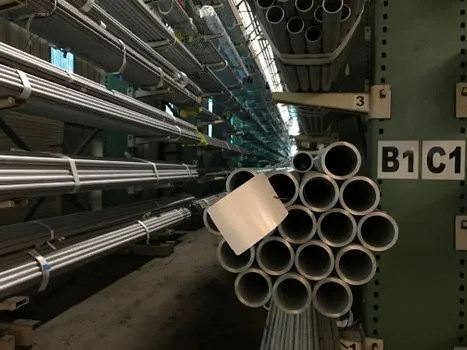
PPR, PE pipe, and stainless pipe overlap in potable-water service but diverge sharply on the parameters that drive warehouse SKU decisions. PPR delivers a 50-year design life, fusion-welded joints, and 95°C short-term temperature capability; PE (typically PE80/PE100) is the flexible, coil-delivered option for buried water mains and lower-temperature service, with butt-fusion or electrofusion joining; stainless carries the highest pressure and temperature ceiling, the longest track record in aggressive chemistry, and the highest per-meter cost, with mechanical or press-fit pipe fittings. On corrosion in potable and lightly aggressive water, all three are acceptable, but only PPR and stainless are practical above 60°C continuous, and only stainless handles steam-class temperatures. On lead time for standard diameters, PPR and PE are typically faster from regional distributors, while stainless often runs longer for non-standard sizes. On installation tooling, PPR needs a socket-fusion machine, PE needs a butt-fusion or electrofusion rig, and stainless needs a press tool or threading kit, so the warehouse should stock tooling spares alongside the most-shipped PPR diameters. For broader plastic pipe selection context across these material families, the same SKU-rotation logic applies. Field crews pairing PPR hangers to steel supports should consult pipe clamp types and classifications: a 2026 field selection reference before locking the bill of materials. [S2]
Warehouse Handling, Stacking, and FIFO Discipline
PPR pipes must be stacked on flat, clean surfaces free of sharp edges, with the heaviest PN25 and large-diameter stock on the bottom tier and lighter PN10/S5 coils above, because soft polymer flows under sustained load and a mis-stacked pallet will ovalize within weeks [S1]. Socket ends must be protected with end caps during storage and transport to keep fusion faces clean, and bundle straps should not be over-tensioned on multi-layer and PPR-AL-PPR stock because the aluminum core can crease under point loads [S1]. Inventory management must use FIFO rotation tied to manufacturing or receipt date, because even under ideal 5–30°C storage the polymer continues a slow ageing cycle and 12-month-aged stock is harder to warranty than fresh stock [S1]. For warehouses that also stage industrial controls, the same rotation discipline carries over to adjacent SKUs; the FIFO logic in best inductive sensor for HVAC: M18 spec map and selection is a useful cross-reference for dating-sensitive electronics stored alongside polymer pipe. A documented racking map, a calibrated thermometer/hygrometer per zone, and a monthly UV-exposure audit for any skylit staging area are the three controls that convert a PPR warehouse from a storage shed into a certified supply point [S1].
Standards, Certifications, and Sourcing Triggers
Quality PPR pipe should arrive with traceable certification to ISO 15874 (the international PPR piping systems standard), DIN 8077/8078 (the German dimension and quality benchmark widely accepted as a de facto spec), and applicable ASTM or national marks; the mill test certificate must show the PN class, SDR/S value, raw material grade, and production date, and any shipment missing this paperwork should be quarantined, not shelved [S4]. Warehouse re-order triggers should be set against the 20mm, 25mm, 32mm, and 50mm SKUs first, because these four diameters cover the bulk of residential and light-commercial orders, and a stock-out on any of them will push the buyer to a competitor with a shorter lead time. For a complete PPR reference, see PPR pipe and for pipe fittings compatibility; the next verification node for any PPR warehouse program is a 90-day audit of (a) temperature/hygrometer logs, (b) FIFO compliance by SKU, and (c) certificate-of-conformance completeness on the most recent three inbound shipments.