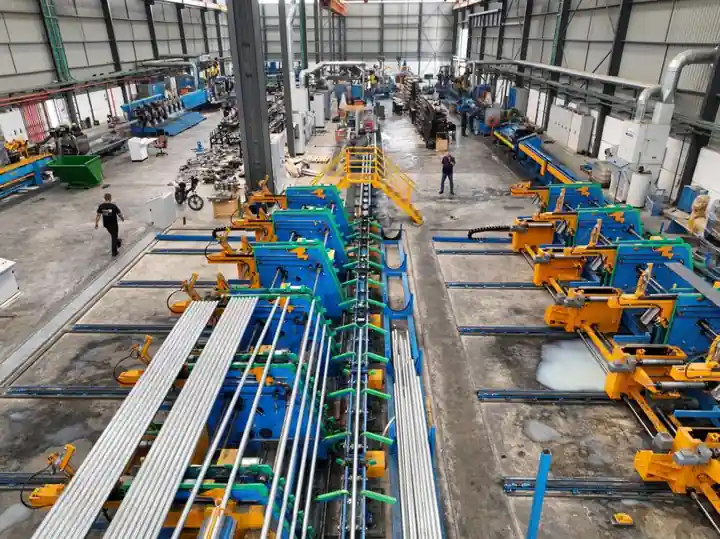
Hooked-end carbon steel fiber in the 0.75 mm diameter / 50-60 mm length format (Q195/Q235 wire, >1100 MPa tensile strength) is the default dosed reinforcement for industrial floor slabs, with model H80/60 and H67/50 both offered to that envelope [S1][S2].
Where the matrix sees chloride, acid or high-temperature exposure, micro stainless steel fiber 65/13 (0.2 mm ±0.005 mm wire, 13 mm ±10% length, >1800 MPa tensile, 304 / 316 / 316L base) is the standard substitution [S1].
Format families and what they actually do in concrete
Steel fiber for industrial concrete is sold in seven functional families: hooked-end, glued, micro, waved, stainless, melt-drawn and sheared [S2]. Hooked-end and glued types are the workhorses for slab-on-grade and jointless floors; micro stainless is specified for refractory, precast thin-wall and chemically aggressive service. Waved and melt-drawn profiles target shotcrete and tunnel linings where pull-out resistance and pumpability drive the design.
For dosed industrial flooring, two reference products bracket the market. HAREX loose-wire H67/50 is 0.75 mm ±10% diameter, 50 mm ±10% length, >1100 MPa, hooked end, while glued H80/60 lifts length to 60 mm ±10% with the same wire and strength class [S1]. The "glued" designation means the fibers are bonded in strips with water-soluble glue, which dissolves during mixing and lets the fiber disperse uniformly at typical 20-40 kg/m³ dosage rates without balling.
Geometry: aspect ratio is the design lever
Length-to-diameter (L/D) aspect ratio drives crack-bridging performance more than any other single number; the 65/13 stainless unit sits at L/D ≈ 65, while the 80/60 carbon unit sits at L/D ≈ 80 [S1]. Higher L/D gives better post-crack flexural toughness but raises the risk of balling during mix, which is why glued collations are specified above roughly L/D 60.
Tolerances matter at the pour, not on the datasheet. Diameter is held to ±0.005 mm on the 0.2 mm stainless fiber and ±10% on the 0.75 mm carbon fibers [S1]. Length is held to ±10% across both product lines.
Base material: carbon vs stainless decision

Q195/Q235 low-carbon wire is the default for indoor slabs, warehouse floors, and most precast where corrosion is not the controlling load case; this is the material behind both H80/60 and H67/50 [S1]. The trade is cost vs corrosion reserve: Q195/Q235 will rust at the surface if the slab is repeatedly wet, but in dry service it is the economic choice.
Stainless 304/316/316L is specified where the matrix exposure justifies it: food-processing floors, chemical bunds, marine platforms, swimming-pool decks, and refractory linings [S1]. 316/316L adds molybdenum-bearing corrosion resistance for chloride service; 304 is adequate for mild chemical splash. The 65/13 stainless product is also the only one in the reference set rated above 1800 MPa tensile, against >1100 MPa for the carbon lines [S1].
Tensile strength and what >1100 MPa / >1800 MPa actually buys
Carbon hooked-end fibers in the 0.75 mm class are held above 1100 MPa ultimate tensile [S1][S2]. That is the typical drawing-strength ceiling for cold-drawn low-carbon wire; going higher requires either alloying or smaller diameter. Stainless 65/13 micro-fiber lifts that ceiling above 1800 MPa because the smaller 0.2 mm cross-section lets the cold-drawing process reach higher strength before the wire work-hardens past drawability [S1].
In slab design, fiber tensile strength is only useful if the pull-out from the matrix is the failure mode, not the fiber breaking. With hooked ends and proper embedment length, pull-out governs and tensile above ~1000 MPa is largely surplus; the hook itself does most of the post-crack work. For refractory and high-temperature service the calculus flips: stainless 65/13's higher tensile is bought explicitly so the fiber survives thermal cycling without rupturing before the matrix does.
Dosage and supply realities for industrial projects
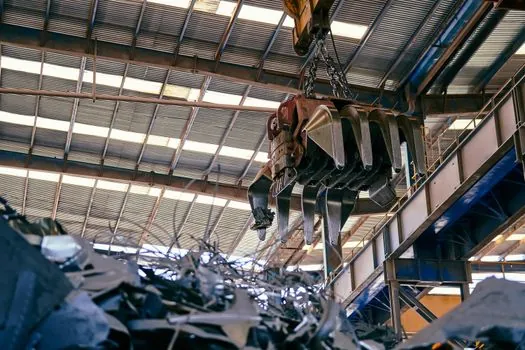
Hebei Yusen, one of the larger dedicated steel-fiber mills, reports annual output above 36,000 tons across its steel-fiber range, with ISO 9001 certification and CE marking in place for export [S2]. Capacity at that scale means a 5,000 m² industrial floor at 35 kg/m³ is roughly 175 t of fiber, well inside single-mill quarterly output and not a long-lead item.
Standard packaging is 25-50 kg bags on pallets; jumbo 1 t bags are used for shotcrete and tunnel pours to keep the dosing cycle uninterrupted. Project references from the same supplier include the Shouyun Iron Mine, the Beijing-Shanghai high-speed railway, the South-to-North Water Diversion, and export work in Pakistan, which gives a usable proxy for which sectors the Chinese export market is already serving at scale [S2].
What steel fiber is NOT for
Steel fiber does not replace structural rebar in beams, columns, or any element where the design relies on bar yield. It replaces mesh and crack-control reinforcement in slabs-on-grade, composite metal decks, shotcrete tunnel linings, and precast elements where the design is governed by post-crack residual flexural strength, not ultimate moment capacity. [S2]
Steel fiber is also the wrong choice for non-ferrous or electrically sensitive service: MRI rooms, copper-mine drainage, aluminum smelters with stray-current risk, and any floor where the spec calls for non-magnetic, non-sparking aggregate. The matrix in those cases moves to polypropylene, PVA, or basalt fiber; reference PVA fiber P1 (2.0 dtex, 6 mm, 11.5 cN/dtex, straight) is an example of the non-metallic substitute a steel-fiber supplier typically carries in the same catalog [S1].
Selection checklist a spec engineer can use on Monday
1. Define exposure: dry warehouse, wet process, chemical splash, or high temperature. This selects carbon vs stainless and, within stainless, 304 vs 316/316L. 2. Pick the geometry: 0.75 mm / 50-60 mm hooked-end for slabs; 0.2 mm / 13 mm stainless for refractory and corrosion-critical thin-wall. 3. Lock aspect ratio: L/D ≈ 65-80 for slabs, L/D ≈ 60-80 for shotcrete. 4. Verify tensile: >1100 MPa for carbon, >1800 MPa for stainless micro. 5. Confirm dispersion: glued collations above L/D 60 to avoid balling at the mixer. 6. Cross-check with structural design: slabs at 20-40 kg/m³, shotcrete at 30-50 kg/m³, refractory at 1.5-3% by volume. [S1]
Steel fiber selection for industrial facilities is governed by the same four numbers every time: wire diameter, length, base material grade, and tensile strength. Get those four right against the exposure class, and the rest of the spec, including dosage, surface finish, and joint spacing, follows from the mix design rather than from the fiber supplier. Trackable signals worth watching next: any move by the major Chinese mills to publish EN 14889-1 / EN 14899 compliance data per batch (one supplier already cites EN 14899 in its certification list) [S2], and any tightening of CE marking scope from the European factory-production-control side, both of which would shift the export-grade selection criteria for European industrial-facility pours.
Component reference pages worth checking: industrial adhesive, industrial borescope, and industrial buzzer.
For related coverage, see Diesel generator set selection: ratings, cooling, and enclosure tradeoffs.