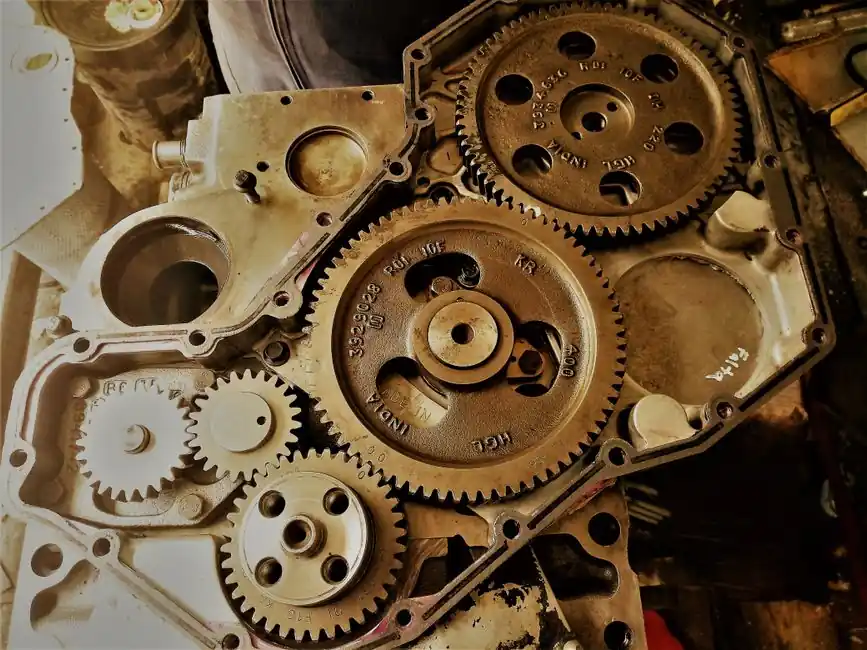
Steel mill gearboxes must be specified for peak torque spikes up to four times motor nameplate, ambient temperatures of 60-80 C near rolling lines (and 150 C or higher at furnace zones), and AGMA service class III (factor 2.0) as the minimum operating margin [S2]. Selecting by motor kW alone, the mistake behind a documented Thailand mill failure where a 600 kW motor upgrade halved the gear's effective margin and dropped service life to 15,000 hours from a 40,000-50,000 hour target [S2].
This guide covers the four gearbox families used in primary and auxiliary mill service, the sealing and contamination thresholds that separate mill-duty from general industrial units, and the alloy-steel grades that survive case-hardening at the torque densities hot strip mills demand [S1][S2][S3][S5]. For a side-by-side view of how these requirements differ from adjacent heavy industries, see the mining gearbox selection: 2026 spec map for helical, bevel, and planetary units.
Steel Mill Service Environment: Temperature, Dust, and Continuous Duty
Ambient temperature near rolling lines runs 60-80 C, and furnace-area equipment can see surrounding temperatures of 150 C or higher, well above the standard industrial baseline that gearbox oil sump designs assume [S2]. Hot strip mill main drives are typically rated 3,000 to 12,000 hp at the motor, and the gears behind them must absorb instantaneous loads well above those nameplate values when the workpiece enters the rolls [S2].
Mill scale, metal dust, and airborne debris act as a continuous abrasive feed. Continuous 24/7 operation removes the thermal recovery periods that intermittent-duty designs depend on, so oil runs hotter for longer than general-industrial ratings anticipate [S2]. The relevant mechanical design context is covered under industrial gear selection fundamentals.
Gearbox Family Comparison: Planetary, Bevel-Helical, Helical, Heavy-Duty Spur
Four gearbox topologies carry most of the load in primary and auxiliary mill service, and they line up against four practical selection criteria: torque density, right-angle capability, efficiency, and tolerance for shock [S1][S4].
Planetary gearboxes deliver the highest torque density in the smallest footprint and are the typical choice for rolling-mill main drives and heavy-duty conveyor heads where space is constrained and torque demand is high; their load-sharing tooth arrangement also gives them a long operational life under continuous duty [S1]. Bevel-helical gearboxes add a right-angle drive capability at high efficiency, which suits cooling-bed drives, transfer conveyors, and other layouts where the motor shaft must sit parallel to the driven shaft [S1].
Standard helical gearboxes provide smooth, low-vibration, quiet power transmission and dominate auxiliary drives such as material handling conveyors and billet transfer tables where shock loading is moderate [S1][S4]. Heavy-duty spur gearboxes remain in service in older rolling-mill main drives where rugged mechanical simplicity outweighs the noise and shock penalties of the parallel-axis, non-helical tooth form [S1]. The relative torque, shock tolerance, efficiency, and right-angle trade-offs are summarised below; engineers should size helical units for the actual peak torque curve, not the motor nameplate, per the helical gear motor sizing for steel mill shock loads methodology adapted to mill duty [S4].
Service Factor and AGMA Service Class: Why 2.0 Is the Starting Point

AGMA defines service factor as the ratio of gearbox rated capacity to the application-required capacity, and for steel mill applications with shock loads a service factor of 2.0 or higher is the starting point, not a luxury margin [S2]. Service class I (1.0) provides no tolerance for peak loads; service class II (1.4) handles moderate variations only; steel mills require service class III (2.0) or higher, which puts them outside the envelope of off-the-shelf general-industrial gearboxes [S2].
Peak torque in a rolling mill can exceed four times the rated motor torque when material enters the rolls, and the spike occurs in milliseconds as the workpiece contacts the roll surface and the drive train absorbs the impact [S2]. A documented Thailand mill upgrade illustrates the consequence: the motor was raised from 300 kW to 600 kW to roll thicker billets, but the gearbox service factor was not recalculated. The helical gear failed after 15,000 hours against a 40,000-50,000 hour target, with failure analysis showing fatigue fracture from excessive contact stress at essentially half the margin required [S2]. Sizing from motor nameplate alone, without the peak-load multiplier, is the single most common error in this duty.
Sealing, IP Rating, and Contamination Control
IP64 (dust-tight plus splash resistance) is inadequate for mill duty; IP65 is the practical minimum and IP66 is specified where high-pressure washdowns are part of the cleaning cycle [S2]. IP65 means fully dust-tight with protection against water jets; IP66 adds resistance to powerful water jets typical of mill washdown routines [S2].
Sealing alone is not sufficient because gearbox housings heat and cool with duty cycle, so pressure cycling must be managed with breathers and oil-expansion chambers sized for the mill's continuous-duty thermal profile [S2]. For a related view on how contamination control changes the duty envelope in adjacent process industries, the industrial ceramic selection for oil and gas: 2026 spec map covers the material side of abrasive service. On the gear-material side, alloy steels rather than plain carbon steel are mandatory where mill scale and metal dust would otherwise accelerate pitting and abrasive wear, per the case-hardening behaviour covered in steel grade selection for industrial gear manufacturing [S3][S5].
Material Selection: Alloy Steel, Case Hardening, and Tooth Fatigue
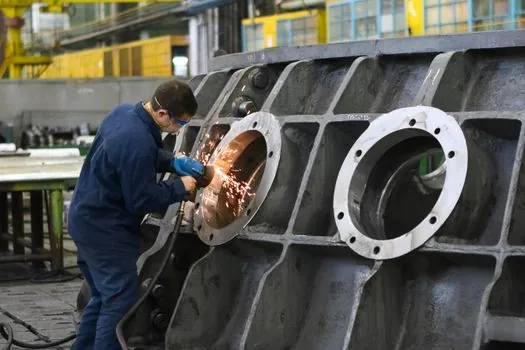
Steel is the dominant gear material because it offers the best strength per dollar and responds well to heat treatment; carbon steel handles general industrial applications but is the weak link in mill duty, while alloy steels (chrome-molybdenum and chrome-vanadium) add the toughness and fatigue resistance demanded by heavy industrial drives [S3]. Case-hardening processes such as carburising or induction hardening are commonly applied to alloy steel gears so the outer layer reaches high surface hardness while the core retains ductility, the combination required to resist pitting and tooth-profile distortion under mill shock loads [S5].
For mill duty specifically, the practical material ladder runs medium carbon steel for moderate loads, alloy steel with chromium-molybdenum for heavy-duty gears, and nickel-alloy steel where high-impact environments push toughness requirements further [S5]. Steel selection must align with heat-treatment capability, since not all grades respond equally to carburising, quenching, or tempering; hardenability depth, surface hardness potential, and post-treatment core ductility all have to be qualified before a blank is committed to a gear cutting run [S5].
Manufacturer Selection and Sourcing Considerations
Nord Drivesystems, Radicon, and other industrial gearbox manufacturers produce gear reducers specifically designed for steel production environments, with high-efficiency helical gearboxes, bevel gear units, heavy-duty industrial housings, and integrated motor-gear units as the standard product lines [S1]. For mill engineers, the supplier-side check is whether the manufacturer publishes a mill-duty rating against AGMA service class III or higher, can document an IP65 or IP66 enclosure on the actual shipping configuration, and supports the alloy-steel, case-hardened gear materials the duty cycle demands [S1][S2][S5].
When comparing vendors, the practical filter is four-fold: published AGMA service class for the specific mill application, IP rating of the supplied enclosure (not the catalogue family), steel grade and heat-treatment route for the gear blanks, and documented shock-load test data at four-times rated torque rather than steady-state thermal rating only [S1][S2][S5]. Two trackable signals to watch are AGMA's next revision of service-class definitions for continuous-duty metallurgical plant, and the broader move among mill OEMs to publish four-times-rated-torque shock test curves rather than thermal-only rating plates, both of which would tighten how planetary and bevel-helical units are specified for hot-strip-mill main drives above 3,000 hp.
Component reference pages worth checking: industrial adhesive, and industrial borescope.