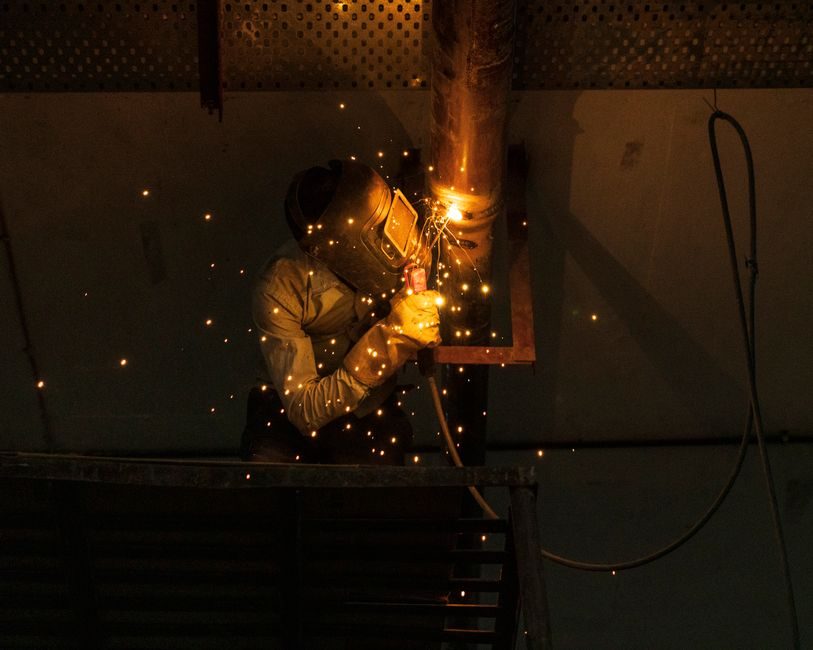
A steel pipe is specified, not bought: NPS (nominal pipe size, the dimensionless designator for nominal bore — e.g. NPS 2 = 2 in), wall schedule (SCH, the dimensionless number setting wall thickness for a given NPS — SCH 40 / SCH 80 / SCH 160), material grade (a defined chemical/mechanical family such as ASTM A106 Grade B, A53 Grade B, API 5L X42/X65, or stainless 304/316L) and the joining/standard target (ASME B36.10M for carbon/alloy, B36.19M for stainless, EN 10255 for threaded medium, EN 10217 for pressure welds) drive every cost and lead-time decision on a piping order [S1][S3].
Specifying starts with three binding inputs — the conveyed fluid, the design pressure and the design temperature — and the supply chain on a 2026-07-09 snapshot runs across mill (Baodely Huaian, seamless and precision) [S1], mill-equipment OEM (TianxiangHao, ERW/HFI/slitting mills) [S2], distributor (Stealth Pipe & Steel, structural/tubular) [S3], and fittings/threaded stockists (Cangzhou Hongxin) [S5]; the right of these four depends on whether the line is process, structural or plumbing [S1][S2][S3][S5].
Carbon seamless vs ERW vs galvanized: process routes that decide price
Carbon steel pipe is sold by manufacturing route, and each route carries a distinct cost and dimensional band: seamless (SMLS, made by hot piercing a solid billet — no weld seam) is the high-pressure choice and is produced as hot-finished (OD 1/2 in to 26 in, wall up to roughly 100 mm) and cold-drawn/precision (OD 6–250 mm, wall 0.5–25 mm) by manufacturers such as Baodely Huaian [S1]; ERW (electric resistance welded — formed strip fused by resistance heat) and HFI (high-frequency induction welded) are the spiral and longitudinal welded routes built by mill OEMs like TianxiangHao and dominate the structural and low-pressure conveyance market on cost alone [S2]; galvanized (zinc-coated) threaded pipe is the plumbing default in EN 10255 / ASME B36.10M SCH 40 and is widely stocked in NPT (National Pipe Taper — a US tapered thread per ASME B1.20.1) thread nipples and sockets for fire, water and compressed-air service [S5].
For a process line running above 250 °C or with a corrosion allowance, the route almost always lands on seamless; for ambient-temperature water, air and structural hand-rail, ERW is the cost floor; galvanized sits between them and is the practical default where painting is impractical. Sourcing-floor spread across the three is wide — seamless runs roughly 2–4× the per-metre price of equivalent NPS/schedule ERW, and galvanized adds only a small premium over plain ERW once the mill is on a zinc line [S1][S2][S5].
Material grade and standard: A53 vs A106 vs API 5L
ASTM A53 covers welded and seamless pipe for general low-to-medium temperature service, in Grade A (min yield 30 ksi / 205 MPa) and Grade B (min yield 35 ksi / 240 MPa), and is the default for plumbing, fire-protection and structural rounds [S3][S5]. ASTM A106 is the high-temperature seamless specification (Grade A 30 ksi, Grade B 35 ksi, Grade C 40 ksi) and is mandatory above roughly 400 °F / 200 °C in most ASME B31.1 / B31.3 power and process work; A106 is not zinc-coated and is delivered black (bare mill scale) [S3]. API 5L is the line-pipe specification for oil and gas transmission, with the most common line-pipe grades being X42, X52, X65, X70 and X80 — each tied to a minimum yield strength in ksi (X42 = 42 ksi min yield) and a chemistry / CE (carbon equivalent) cap that the EPC (engineering, procurement and construction) contractor must verify for sour service (H₂S-bearing) and offshore work [S2][S3].
For stainless, the two everyday picks are 304 (general corrosion, 18 Cr / 8 Ni) and 316L (low-carbon 2–3% Mo variant for chloride resistance and welded fabrications), supplied to ASTM A312 in ASME B36.19M schedules; 316L is the default for pharmaceutical, food and coastal service, with 304 acceptable in dry interior lines where chloride exposure is low [S4]. The spec sheet must show the standard (A53/A106/API 5L/A312), the grade letter or PSL (Product Specification Level — API 5L's quality tier, PSL 1 or PSL 2) and the schedule; a quote that omits any one of those three is not a real quote [S1][S3][S5].
Schedule, wall and pressure rating — the band that is non-negotiable
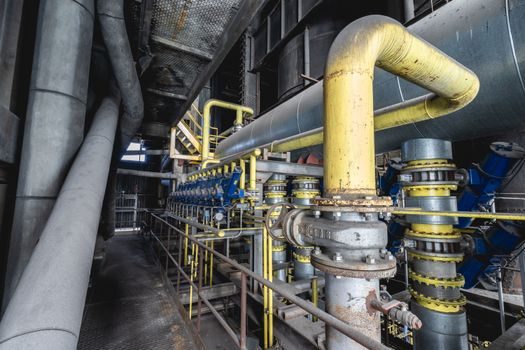
Schedule (SCH) is the dimensionless wall-thickness number stamped against a given NPS, and it is what converts NPS into actual bore and actual pressure capacity: SCH 40 (the most-stocked band) carries thinner walls for low-pressure service, SCH 80 carries thicker walls for higher pressure and mechanical load, and SCH 160 / XXS (double extra strong) covers the high-pressure tail of the catalogue [S1][S3]. For a 2 in NPS line in ASME B36.10M, the OD is fixed at 2.375 in (60.33 mm); SCH 40 wall is 0.154 in (3.91 mm) giving an ID (internal diameter) of 2.067 in (52.50 mm), while SCH 80 wall is 0.218 in (5.54 mm) giving an ID of 1.939 in (49.25 mm) — the schedule step costs roughly 0.5–1.0 kg/m of wall steel and noticeably changes the ID and pressure rating [S3].
Quick read for a 2 in SCH 40 ERW A53-B line: design pressure band for saturated steam is roughly 150–250 psig (≈10–17 bar) depending on the design code and joint type, water and air are higher, and the line still needs hangers / supports at the schedule tabulated by ASME B31.1 / B31.3 — schedule is the spec lever, not a marketing term. Threaded joints cap out at SCH 80 for most services; for anything above that, flanged or butt-welded is the structural choice and the pipe fittings inventory must match the same schedule, grade and standard [S5].
Joining and end finish: threaded NPT, beveled, flanged, grooved
End finish decides what else must be on the order. Plain-end (PE) pipe is the cheapest and is used in welded fabrication, often supplied with square-cut or beveled ends (V-bevel per ASME B16.25, the standard for butt-weld prep) ready for automatic orbital welding; threaded-and-coupled (T&C, NPT threads cut on both ends plus a coupling) is the plumbing default for galvanized and black A53 in SCH 40 / SCH 80, and NPT threads must conform to ASME B1.20.1 [S5]. Grooved ends (Victaulic-style roll-groove couplings) are the speed-build default for fire protection and HVAC; flanged ends (weld-neck, slip-on, blind per ASME B16.5 / B16.47) are specified at equipment nozzles and tie-ins [S3][S5].
Fittings must follow the same grade and schedule: a SCH 80 line cannot be terminated in SCH 40 elbow or pipe clamp without derating the joint, and a stainless 316L run needs 316L fittings and gaskets rated for the same chloride exposure [S4][S5]. For chemical service above 60 °C, the default thread sealant on threaded joints is PTFE tape plus anaerobic paste, not hemp/yarn; for welded joints, the WPS (welding procedure specification) must list the pipe grade, the matching filler (e.g. ER70S for A53/A106 carbon) and a qualified PWHT (post-weld heat treatment) procedure where the service or code requires it [S1][S5].
Where seamless and welded are NOT interchangeable
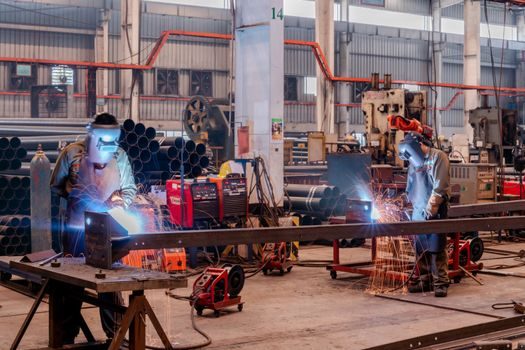
Three classes of service force seamless: (1) high-temperature process lines above roughly 400 °F / 200 °C or any ASME B31.1 power piping — A106-B/C is the default and ERW is excluded; (2) sour hydrocarbon service (NACE MR0175 / ISO 15156 environments, the standard for materials used in H₂S-containing oil and gas) — the heat-affected zone of an ERW weld is a documented cracking risk and seamless or fully normalised welded plate is specified; (3) any service with a mandatory radiographic or ultrasonic examination of the body, where seamless gives a uniform body easier to qualify than a longitudinal weld seam [S1][S2]. Conversely, ERW and spiral HSAW (helical submerged-arc welded) are the cost-floor default for water mains, structural piling, low-pressure air, handrail and fire protection where the design code accepts a longitudinal weld; for structural piling specifically, the dominant North American distributor line is heavy-wall ERW in ASTM A252 grades, supplied cut-to-length with end plates or socketed ends to the piling spec [S3].
Pressure-rated stainless (A312 304/316L) is mostly welded because the cold-drawn seamless route adds cost without clear service benefit below roughly SCH 40S / 10S; the stainless pick is grade-led, not process-led [S4]. The exact same NPS/schedule stainless can move 30–80% on price between 304 and 316L because of the Mo (molybdenum) alloy content, and 316L is the only sensible pick for chloride, marine and pharmaceutical service [S4].
Mill, distributor and trader — picking the right supply tier
Mill-direct orders win on price for full container or truckload orders on a single grade and schedule, but require 4–10 week lead times depending on the route and the mill's rolling cycle [S1][S2]. Distributors carry mixed mill stock, can cut to length, bevel, thread, coat and deliver in days — at a 20–60% premium over mill-direct on matching material — and are the only practical source for maintenance, repair and operations (MRO) [S3]. Trading companies on B2B platforms (AliExpress, Made-in-China) sit below distributor on price for consumer-grade stainless and thin-wall tubing but rarely carry pressure-rated stock with full MTC (mill test certificate, the lot-traced document showing chemical and mechanical test results) traceability, so they are appropriate for non-code furniture, decorative and DIY stainless, not for seamless steel pipe on a process line [S4].
Fitting and threaded stockists (Cangzhou Hongxin and equivalents) carry the NPT nipples, sockets, pipe clamp hardware, elbows and tees that the pipe order is useless without; the MTC must travel with the pipe, and the fittings must be marked to the same standard, grade and schedule to keep the joint inspectable [S5]. For hybrid runs that mix carbon process line and stainless trim, a single steel-plastic composite pipe or PE-coated transition is sometimes the cleanest way to bridge the two material systems and cut cathodic-protection cost at the same time. Trackable signal to watch on the 2026-07-09 snapshot: distributor price for A53-B SCH 40 NPS 2 in 6 m random length; A106-B SCH 40 NPS 2 in 6 m; and 316L SCH 10S NPS 2 in 6 m — those three numbers, quoted on the same MTC, are the cleanest way to grade any vendor on this category.
For related coverage, see Surveillance Camera vs Access Control: Function Split, Spec Layers and Site Selection.