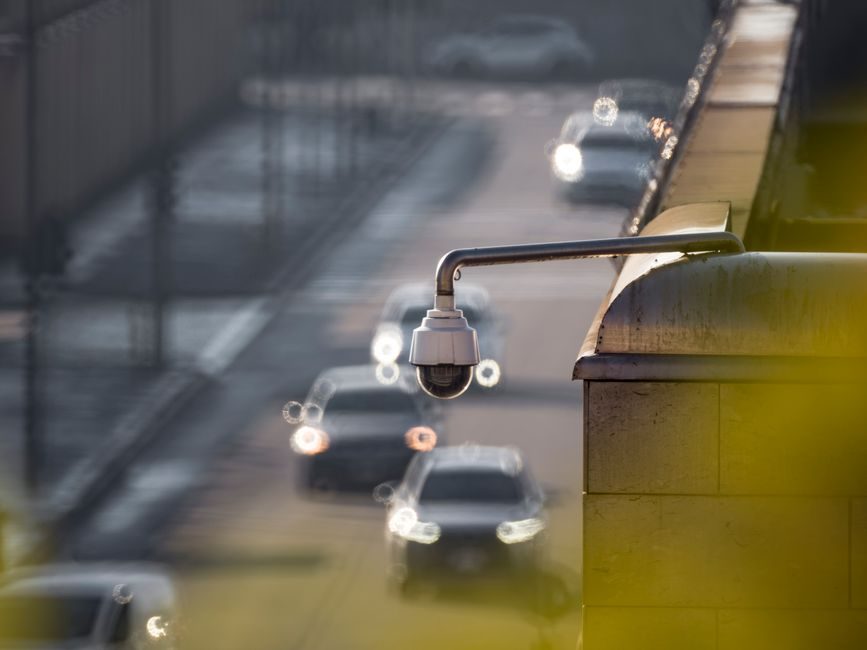
On a 2026 industrial site the surveillance camera is a passive optical sensor — lens, image sensor, encoder, network interface — whose output is a video stream reviewed for evidence or live situational awareness, while the access control system is an active identity-and-permission layer that reads a credential, runs an authorization decision, and physically or logically grants or denies passage [S1][S2].
Both subsystems routinely appear inside the same security architecture — COR Security and Surveillance Secure both market them as a bundle with vehicle gates for commercial, HOA, warehouse and campus deployments [S1][S2] — but the engineering deliverables differ: cameras deliver frames, access control delivers grant/deny events with associated credential IDs, timestamps and door state.
Functional Split: Sensing vs Authorization
A surveillance camera does not authenticate. Even when an industrial camera is paired with onboard analytics such as license-plate recognition or face matching, the decision output is a metadata tag attached to a video frame, not a release command to a door, turnstile or gate relay. [S1]
Access control, by contrast, is a credential-plus-relay chain: card reader, biometric, or PIN pad → controller → door relay or turnstile latch. Surveillance Secure lists gates, turnstiles, flexible credential systems and door access as one combined service line, but the controller-and-relay logic sits on a separate panel from the camera network and is wired to fail-secure or fail-safe per door [S2]. A camera loss degrades evidence; an access control loss opens the perimeter.
Decision Criteria: What Drives a Camera vs an Access Control Buy
For an industrial camera, the dominant selection levers are optical: sensor format (1/2.8" to 1/1.7" CMOS is common across commercial IP lines), minimum illumination (0.0001–0.05 lux for starlight-class units), resolution (2 MP to 12 MP), lens focal length vs scene width, IR range, and an environmental rating such as IP66/IP67 or IK10 vandal resistance for outdoor industrial use. [S2]
For access control, the levers are identity and throughput: credential type (125 kHz prox, 13.56 MHz MIFARE / DESFire EV2/EV3, mobile/NFC via BLE, fingerprint or face biometrics), reader-to-controller wiring (Wiegand or OSDP v2.2 over RS-485), number of doors per panel, fail-secure vs fail-safe lock voltage (12 VDC or 24 VDC typical), and database size — most mid-range panels hold 10,000–100,000 cardholders with offline cache. COR Security markets "integrated access systems" sized for small business and HOA sites rather than enterprise OSDP-class installs [S1].
Use-Case Mapping: When Each One Carries the Load
Surveillance carries the load where evidence, remote situational awareness, or process audit is the goal — perimeter fence lines, production-floor overview, loading-dock safety monitoring, and after-hours motion-driven review. Access control carries the load where unauthorized entry creates immediate loss — server rooms, chemical stores, tool cribs, payroll offices, and any door feeding a controlled zone. [S3]
Integration is the third path: most enterprise sites run both, with access events triggering camera bookmarks (a 5–10 s pre/post clip) and camera tamper or loitering events raising an alarm in the access management software. Surveillance Secure packages cameras, access control and gates into a single quote, which is the typical small-commercial delivery model [S2].
Comparison Table: Side-by-Side Decision View
Compared on four engineering criteria, the two systems do not overlap: [S1]
• Decision authority: camera = none (passive); access control = grant/deny at door/turnstile/gate. • Primary output: camera = H.264/H.265 RTSP or ONVIF Profile S/T stream; access control = Wiegand/OSDP credential read + relay trigger + audit log. • Failure mode: camera = blind spot, evidence gap; access control = door default-unlocked (fail-safe) or default-locked (fail-secure), a direct life-safety choice. • Cabling: camera = Cat5e/Cat6 PoE+ up to 100 m (PoE+ budget ~25.5 W per IEEE 802.3at for PTZ/heater loads); access control = dedicated reader cabling (Wiegand limited to ~150 m at 26 AWG, OSDP v2.2 to ~1,200 m on RS-485), often on a shielded control cable run.
A site that scores the threat as "loss of evidence" is a camera-led project. A site that scores the threat as "loss of control of a specific door" is an access-control-led project. Most industrial sites sit on both sides of that line and need both subsystems sized independently [S1][S2].
Limitations and Failure Modes Engineers Routinely Miss
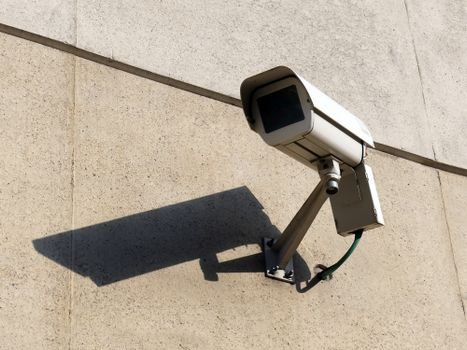
Three failure modes show up repeatedly on post-install audits. First, camera placement assumed face capture for credentialing, but lens height, backlight, and lens focal length drop the face pixel count below the biometrics threshold — face matching must be specified against a known pixel-on-target value, not against a generic "face recognition camera" line on a datasheet. Second, access control panels were specced fail-secure on a fire-rated stair door, trapping egress during a power event; the lock voltage and fail behavior must be set per door against the local fire code, not defaulted panel-wide. Third, both subsystems were placed on a single PoE switch with no UPS, so a single power event wipes both evidence and access logs — cameras and access controllers need independent power and independent network paths. [S2]
Standards, Sourcing Floors and 2026 Channel Notes
Camera-side compliance typically pulls in ONVIF Profile S/T for interoperability, NDAA Section 889 for U.S. federal projects, and an IP66/IP67 or IK10 environmental rating for industrial cabinets. Access control is increasingly specified on OSDP v2.2 (SIA's open supervised device protocol) over RS-485 to replace the older unencrypted Wiegand wiring, with credential readers commonly 13.56 MHz smart cards (MIFARE DESFire EV2/EV3) and BLE mobile credentials. [S3]
Sourcing on the small-commercial side is dominated by regional systems integrators who bundle hardware, cable, brackets and install — COR Security covers San Diego, Temecula and Irvine [S1], Surveillance Secure covers Maryland, DC and Virginia [S2] — and the per-door cost on a turnkey access install typically sits above USD 1,500 once reader, panel, lock, cabling, two-hand control interface where required, and commissioning are stacked. For cable runs between readers and panels, the control cable spec is not interchangeable with generic security cable: shielding, jacket rating (CMR/CMP or riser/plenum), and conductor gauge all change with run length and electromagnetic environment.
On the camera side, a useful pre-purchase pass is the Industrial Surveillance Camera Buying Guide 2026 and the related Control Cable Price Guide 2026 for the cable-cost leg of a multi-camera install. The cable choice on a long reader-to-panel run follows a separate set of bands covered in Shielded Cable vs Control Cable — pick the wrong shield type and you debug noise on a credential read for months.
Specifying the industrial camera and the control valve side of the same process plant also bleeds into access control when the controlled valve is on a hazardous-area door, since ATEX/IECEx zone rating and the two-hand control logic both attach to the same door state — those standards have to be solved together, not in sequence.
Trackable signal: ONVIF Profile M (metadata) is gaining traction in 2026 deployments for camera-to-access metadata sharing; OSDP v2.2 Secure Channel is now the default bid line on most U.S. federal and large-enterprise access projects. Next verification pass on the sourcing side should watch whether the regional integrators [S1][S2] publish a 2026 H2 price list or whether site work is shifting toward OSDP-native panels with mobile credential support.