Steel-plastic composite pipes merge a welded steel skeleton with an inner plastic liner — typically PE, epoxy resin, or PP-R — to give water, gas, and chemical service lines the pressure rating of steel and the corrosion resistance of plastic, in sizes spanning DN15 through DN1200 with wall thickness 2.2–8.0 mm [S5].
China-based OEM LESSO frames the product as an urban water-supply default, citing its PE or epoxy powder inner layer, hot-dip galvanised outer steel, and small fluid resistance that resists scale buildup in municipal networks [S1]. Suppliers in Hebei list conformance to GB/T 28897-2012 alongside API, ASTM, BS, and DIN reference standards for export jobs [S5].
Structural Makeup and Liner Materials
The pipe is a sandwich: a carbon-steel pipe (ERW or seamless per duty) carries pressure and mechanical load, while a bonded plastic liner — PE for cold water, epoxy powder for hot/chemical service, PP-R for hot potable — handles the fluid interface. Liner choice is the dominant spec gate. [S3]
LESSO's steel-plastic composite pipe uses polythene or epoxy resin powder as the inner layer, both certified to state standards for domestic water conduit duty and rated nontoxic, tasteless, and non-polluting to potable water [S1]. The ChemicalBook registry lists steel-plastic polypropylene composite pipe (CB31162380) as a separate variant supplied by Wuxi City Steel Equipment, where PP-R is the inner liner for higher-temperature hot-water runs [S2]. Buyers should treat PE-lined and PP-R-lined variants as distinct SKUs with different temperature ceilings, not interchangeable items.
Verified Performance Benefits
Four OEM-stated benefits carry through every datasheet: corrosion resistance, mechanical strength, sanitary potability, and low flow resistance. Each maps to a measurable operating gain. [S1]
Corrosion resistance: LESSO states the inner plastic layer is strongly adhesive and compact, and explicitly outperforms hot-dip galvanised steel pipe in acid environments where zinc alone fails [S1]. Mechanical strength: the steel skeleton preserves the impact, bending, and pressure rating of a galvanised steel pipe, so the composite behaves like steel under external load [S1]. Sanitary: PE/epoxy liners meet state domestic-water-conduit standards for nontoxicity and taste neutrality [S1]. Hydraulic: smooth inner wall plus small friction coefficient keeps the line scale-free and avoids the flow loss seen in unlined steel [S1], a useful parallel to FRP/GRP composite pipe's low-friction attribute documented in fiberglass-wound product data [S3].
Quantitative Specs and Size Envelope
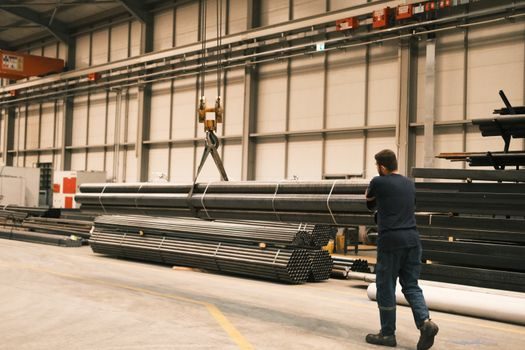
Hebei manufacturer listings give the working envelope: outer diameter 15–1200 mm, wall thickness 2.2–8.0 mm, technique ERW, non-alloy, PE-coated, epoxy-coated, or galvanised surface, certified to GB/T 28897-2012 with API, ASTM, BS, DIN, and JIS compliance for export orders [S5]. This range lines up with general steel pipe sizing but adds the bonded liner as a separate process step.
For larger-diameter chemical and seawater service, fiberglass-wound GRP/FRP pipe remains the alternative: DN400–DN4000 diameter, PN0.25–PN2.5 MPa pressure class, double O-ring sealing joint, and a stated service life of more than 50 years with low friction coefficient [S3]. A steel-plastic composite pipe spec is the right pick when the duty is municipal water or building risers in the DN15–DN300 sweet spot, not bulk seawater outfall where FRP dominates the size class.
Working Limits and Failure Modes
Plastic-lined composite pipe inherits the temperature ceiling of its liner. PE liners cap continuous service around 60–80 °C depending on grade; PP-R extends that to roughly 70–95 °C for hot-water risers but loses to crosslinked PEX or metal alloys in sustained high-heat service. Exceeding the liner rating delaminates the bond and ruins the corrosion barrier. [S1]
UV exposure degrades the outer plastic sheath on PE-coated variants; outdoor runs need protective sleeving or paint. Joint integrity is the other soft spot: threaded, grooved, and flanged connections must use gaskets and sealants compatible with the liner chemistry, or the joint becomes a leak path that bypasses the corrosion advantage. For buyers comparing PVC-U pipe TCO and service-life math against composite, the PVC-U option wins on raw material cost and chemical inertness but loses on impact tolerance and temperature ceiling — the PVC-U pipe TCO analysis lays out the cost stack that pushes engineers toward composite when impact or hot-water duty enters the spec.
Comparison: SP Composite vs Adjacent Pipe Families
Four decision axes — temperature ceiling, corrosion behaviour, impact/pressure rating, and lifecycle cost — sort the main options for water and light-chemical service. [S3]
Steel-plastic composite: temperature limited by liner (≤95 °C PP-R, ≤60–80 °C PE); corrosion resistance from the bonded plastic; impact and pressure rated like the underlying carbon-steel pipe; cost sits between plain steel and full FRP/GRP. Hot-dip galvanised steel: higher temperature tolerance but zinc fails in acid or aggressive water; cheaper upfront. PVC-U: best chemical inertness and lowest cost, but lower impact strength and limited temperature window — a plastic pipe baseline. FRP/GRP composite: best size scalability (DN400–DN4000) and 50-year service life, but higher unit cost and more demanding joint assembly [S3]. Engineers specifying seamless steel pipe for high-pressure steam should stay with unlined seamless; lining that line with PE or epoxy is wasted on a duty the steel can already handle.
Application Fit and Where to Avoid
Recommended service envelopes per the OEM data: civil and industrial water supply, fire-fighting risers, sewage transport, communication and optical-fibre conduit, coal-gas distribution, foodstuff processing, and pharmaceutical/mechanical plant — the full LESSO application list [S1]. The Hebei listing extends to irrigation, electric-power auxiliary water, and chemical engineering at moderate temperatures [S5].
Avoid: sustained steam service above the liner rating, strong UV outdoor exposure without sleeving, hydrocarbon/solvent lines that swell PE or PP-R, and any application where the steel skeleton will see external corrosion the liner cannot protect (e.g. buried in aggressive soil without coating or cathodic protection on the steel side). Buyers sourcing from regions with mature FRP manufacturing should weigh a FRP composite line for DN400+ chemical outfall, where the size and pressure class of steel-plastic variants thins out.
Track GB/T 28897-2012 revision activity and the Hebei export-channel compliance bundles (API/ASTM/BS/DIN/JIS) as the next spec check before issuing a PO on a DN300+ run.