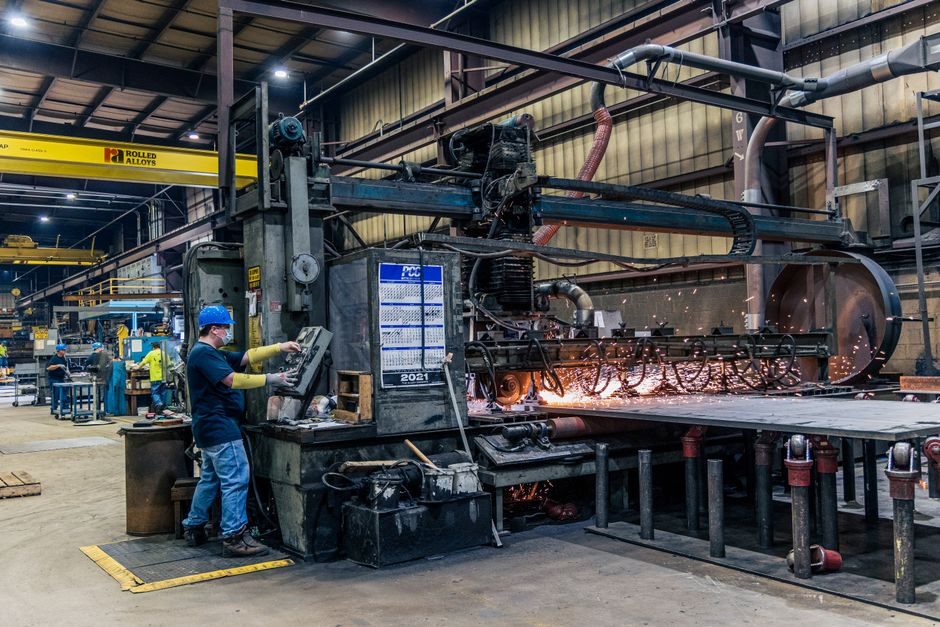
Steel plate procurement collapses to five engineering gates — grade, thickness/tolerance, finish, certification, and dimensional format — and missing any one of them forces a re-quote or a field rejection at receiving [S1][S2].
Metline Industries (ISO 9001:2015 certified) and Delaware Valley Steel both position themselves as full-line plate distributors covering 200, 300, 400 series stainless plus carbon and alloy plate, and both publish the same upstream reality: the mill, not the distributor, sets the chemical and mechanical envelope the buyer must accept [S1][S2].
Gate 1 — Lock the Material Grade Before Anything Else
ASTM A240 governs chromium and chromium-nickel stainless plate, sheet and strip for pressure and general service, and is the default call-out when a buyer says "stainless plate" without naming a UNS number [S1][S4]. The 200 / 300 / 400 series split is not aesthetic — 300-series austenitic grades (304, 304L, 316, 316L) carry the corrosion and formability envelope; 400-series ferritic/martensitic grades (e.g. 420) trade corrosion resistance for hardness and wear [S4][S5].
Carbon and alloy plate live under a different rule set: ASTM A36 covers carbon structural plate, ASTM A516 covers pressure-vessel plate (Grades 55 through 70), and ASTM A572 covers high-strength low-alloy structural grades up to 65 ksi yield [S2]. For sour service, NACE MR0175 limits the hardness and chemistry of plate used in H₂S-bearing environments and is the constraint that overrides base ASTM selection. Buyers who pick a grade by price-per-kg first, and metallurgical envelope second, eat the cost twice — once at RFQ and again at weld qualification.
Gate 2 — Thickness, Tolerance and the Hot-Rolled vs Cold-Rolled Decision
Stainless plate is conventionally split by thickness into thin plate (0.5–4 mm) and thicker plate (above 4 mm), and by manufacturing route into hot-rolled (HR) and cold-rolled (CR) — the route drives surface, tolerance and mechanical property [S4][S5]. HR plate ships with a scaled surface and looser thickness tolerance (ASTM A480 +/- tolerance tables); CR plate ships closer to gauge with a brighter finish and tighter flatness, at a price premium of typically 8–20% over HR equivalent gauge [S1][S5].
Common plate-format thicknesses on stock programs at service centers run 3, 4, 5, 6, 8, 10, 12, 16, 20, 25 mm; non-stock gauges trigger mill-mill minimums (often 5–10 tonnes or one coil/master plate) and 4–8 week extensions to lead time [S1][S2]. Buyers should write thickness as a nominal value with an ASTM A480 tolerance class (e.g. "6 mm, ASTM A480 Table A1") rather than a free-form "+/- 0.1 mm" — mills accept the standard tolerance band and reject bespoke tolerance unless the order is mill-supported [S2].
Gate 3 — Finish, Edge and Format That Match the Weld / Form Operation
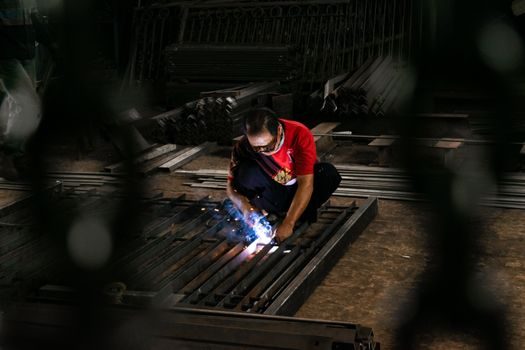
Finish drives cost as much as grade. No. 1 (HR, annealed, pickled, scaled) is the cheapest mill finish and is the right call for heavy fabrication, structural and pressure-vessel work where the surface will be removed or coated; 2B (CR, annealed, pickled, skin-passed) is the standard cold-finish for general fabrication and food/pharma service; No. 4 (brushed, 120–180 grit) and BA (bright annealed) are downstream polishes at progressively higher cost [S1][S4].
For format, buyers must distinguish plate (>= 4 mm, >= 1219 mm width typical) from sheet (< 4 mm) and from coil/slit coil — service centers like Delaware Valley Steel routinely cut coil back to plate or sheet on cut-to-length lines, which lets a buyer order "12 mm x 1500 mm x 6000 mm cut from 1500 mm coil" instead of mill-master-plate [S2].
Gate 4 — Standards, Certifications and Traceability That Survive Receiving Inspection
Mill test certificate (MTC) to EN 10204 3.1 is the baseline for any plate going into a pressure-bearing, structural or PED/ASME-stamped assembly; 3.2 (independent witness) is required where the fabrication code or end-market demands third-party sign-off [S2]. The plate must arrive with a traceable heat number, batch number and the certified chemical + mechanical results — without these, MTR review at receiving inspection fails and the heat is rejected regardless of paperwork cleanness [S1][S2].
Forged and wrought steel plate shipped to process industries typically also needs ASTM A6 / A6M supplementary requirements (Charpy V-notch impact testing, vacuum degassing, restricted sulfur) called out on the purchase order, not assumed by the distributor. Buyers should specify whether they need ASME-grade plate (with full traceability to a named plate standard) versus commercial-grade plate (often dual-certified A36/A572) — the two are not interchangeable in a U-stamp or CE-marked assembly [S2].
Gate 5 — Dimensional Format, Packaging and Logistics That Match the Shop Floor
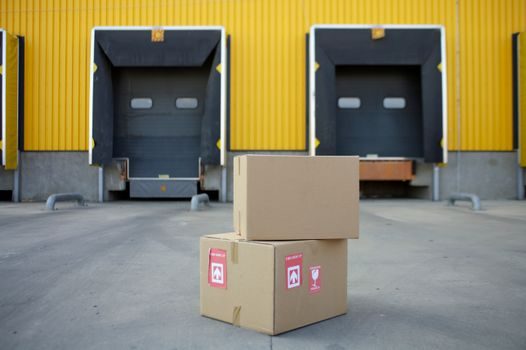
Plate ships in master sizes (typically 1500 x 6000 mm, 2000 x 6000 mm, 1524 x 3048 mm) or in coil that is cut to length. Choosing a master size that aligns with the buyer's blank nesting diagram eliminates 5–15% scrap that an off-size master will generate, and that scrap number is bigger than any mill price concession on the same heat [S2]. A buyer ordering carbon steel plate in non-standard width is, in practice, paying for the mill to set a special roll or to slit a master — both routes lengthen lead time and reduce the chance of a single-heat single-test certificate chain [S2].
Packaging matters: export sea-freight plate is normally bundled with steel straps, wrapped in waterproof kraft, and loaded on fumigated wooden pallets or directly in container; inland truck delivery is often bare bundle. Heavy-gauge plate (> 6 mm, single-piece > 2 t) often needs a flatbed with crane-offload, and that crane-side cost is what turns a "lowest $/kg" quote from a remote distributor into the highest landed cost on the buyer's desk [S1][S3]. The stainless steel coil route, conversely, is appropriate when the buyer runs a cut-to-length + slitting line and can absorb master-coil MOQ (typically 5–20 t per grade/finish/gauge) [S1].
Selection Criteria Compared: Carbon, Alloy, 300-Series Stainless, 400-Series Stainless
The four plate families trade off across four criteria. Carbon plate (ASTM A36 / A516) is lowest cost and the right call for structural and non-corrosive pressure-vessel service. Alloy plate (ASTM A387, A514) covers elevated-temperature and high-strength service at 2–4x the carbon price. 300-series stainless (304/304L/316/316L) is the default for corrosive and hygienic service and typically runs 5–10x carbon plate on a $/kg basis. 400-series stainless (e.g. 420) is a wear-and-hardness play, not a corrosion play, and is selected only when the application needs a hardened surface or magnetic response [S4][S5].
For buyers who want a single rule of thumb: select 316/316L only when chloride, acid or hygienic service rules out 304/304L; select alloy steel plate only when carbon plate cannot meet the design temperature or strength; and never select 400-series stainless where 300-series was specified — the corrosion delta is an order of magnitude and cannot be welded around with procedure changes [S4][S5].
For related process-equipment sourcing in adjacent material families, see this wire rod vs embedded part sourcing map for the upstream billet-to-rod chain that feeds rebar, fasteners and embedded plates, and this welded steel mesh 2026 buying guide when the project moves from plate to mesh reinforcement on the same job.
Trackable signals for the next procurement cycle: (1) whether the buyer's drawing call-outs reference ASTM A480 thickness tables or free-form tolerances, and (2) whether the MTC chain on receiving survives a 3.1 vs 3.2 audit — both are leading indicators of whether plate selection was actually driven by engineering or by the lowest quote on a sourcing portal [S1][S2].