
Hospitals are heavy, vibration-sensitive, MRI-restrictive buildings, and the prestressed concrete that forms their floor plates, transfer beams, and long-span lobby roofs carries those constraints straight down to the steel strand. 7-wire low-relaxation prestressing strand in 12.7 mm and 15.2 mm diameters, produced to ASTM A416 / GB/T 5224, remains the default for healthcare slabs, with coated grades specified where corrosion, MRI fringe fields, or de-icing salt exposure is a concern [S2][S3].
Selection is driven by four engineering axes: structural duty (span, slab thickness, live load), corrosion exposure (parking, sterilization rooms, coastal location), MRI and electromagnetic compatibility, and code compliance (ACI 318, Chinese GB 50010, BS EN 1992-1-1, ASTM A416). Capstone Steel alone runs more than 500,000 mt/year of strand capacity across 15 production lines, so hospital-scale tonnage is a routine order for the major Chinese mills [S1].
Standard Diameters, Grades, and What They Actually Buy You
Three diameters cover roughly 90% of healthcare prestressing work: 12.7 mm (0.5 in) strand at 1860 MPa nominal tensile strength, 15.2 mm (0.6 in) at 1860 MPa, and 15.7 mm (0.62 in) at 1860 MPa for export projects following BS 5896 or Indian IS 6006 patterns. Capstone, Tianjin Wasungen, and Tenghai all supply PC strand, and per Capstone's product page the coils typically weigh 2.5–3.5 t, allowing 8–10 coils per 20 ft container.
For long-span hospital corridors, operating-theater slabs over basements, and helipad transfer beams, 15.2 mm is the workhorse because it carries ~30% more force per strand than 12.7 mm at the same drape, so the number of tendons and anchor zones drops. 12.7 mm is preferred where duct curvature is tight (small-radius ramps, localized slab thickenings) and where tendon spacing is dense, such as post-tensioned transfer slabs. 15.7 mm and 17.8 mm appear in heavy bridge-type transfers and in mining-style anchorage zones, not typical hospital floors [S3].
Coating Options: Plain, Galvanized, Epoxy, Unbonded
Plain (bare) low-relaxation strand is correct for interior bonded tendons inside sound concrete cover, where the alkalinity of the grout (pH ≥ 12.5) keeps the steel passive. Tianjin Wasungen lists plain, indented, hot-dip galvanized, epoxy-coated, and unbonded PC strand as separate catalog families, each with its own 12.7 mm and 15.2 mm SKU, and 15.7 mm in epoxy-coated form [S2].
Hot-dip galvanized PC strand (zinc coating typically 300–610 g/m² depending on class A/B per ASTM A475) is the right pick for hospital parking decks, exposed canopies, and any element that sits in a wet/dry cycle or receives chloride exposure from de-icing salt tracked in on wheels. Epoxy-coated strand, with a fusion-bonded 0.13–0.30 mm epoxy layer per ASTM A882, is specified where the design life pushes past 75 years or where stray-current risk is high (light-rail beneath the hospital, impressed-current cathodic systems in the car park). For unbonded monostrand slabs (typical in residential towers), Wasungen offers 12.7 mm unbonded with PE sheathing and grease; for hospitals, bonded (grouted) systems are usually mandated for fire and redundancy reasons, so unbonded is restricted to specific retrofit or addition work [S2].
Hospital-Specific Stress Points: MRI, Vibration, Sterilization

MRI suites are the most over-specified corner of a hospital and the place where strand choice is most often mishandled. Non-ferromagnetic austenitic stainless stainless steel strand or non-metallic FRP reinforcement is mandated inside the Faraday cage, but outside the scan room, in the floors that cantilever over the suite or in transfer beams carrying MRI loads, standard carbon steel strand is acceptable because the static magnetic field does not couple to pre-tensioned tendons. What does matter is vibration control: hospital floor systems are designed to a higher damping and stiffness floor (typically 8–10 Hz minimum for operating theaters vs 5 Hz for offices), and the higher the prestress, the stiffer the slab, which is one of the reasons 1860 MPa strand is preferred over lower grades [S2].
For Central Sterile Services Departments (CSSD) and pharmaceutical-grade cleanrooms, the slab is typically a post-tensioned flat plate to minimize ceiling penetrations and cleanable surface area. Epoxy-coated strand is often specified at slab edges and around column heads where cracking control is tightest, because epoxy blocks the carbonation/chloride pathway even if cover is reduced at a column head. Wasungen's "filled" 15.2 mm epoxy-coated strand (where the inter-wire voids are filled with epoxy before overcoating) is the right call for those high-risk edges because it eliminates the capillary path that lets moisture reach the bare steel between the outer wires [S2].
Comparison: Which Strand for Which Hospital Element
The table below maps the four most common hospital structural elements to the strand type and diameter that experienced specifiers actually use, with the controlling standard for each combination. [S1]
Element → Strand choice:
1. Post-tensioned floor slabs (ORs, inpatient wards, lobby) → 12.7 mm or 15.2 mm plain low-relaxation, 1860 MPa, bonded (grouted), ASTM A416 Grade 270 / GB/T 5224. Reason: densest tendon grid for crack control, lowest unit cost.
2. Transfer beams over basements and helipads → 15.2 mm or 15.7 mm multistrand tendons (4 to 37 strands per duct), ASTM A416 / BS 5896. Reason: force per tendon is high enough to reduce anchor count in heavily congested rebar zones.
3. Exposed parking decks and ambulance ramps → 12.7 mm or 15.2 mm hot-dip galvanized, zinc ≥ 300 g/m², ASTM A416 with ASTM A475 galvanizing. Reason: chloride resistance where de-icing salt is tracked in.
4. Slab edges, column heads, and pool / hydrotherapy decks → 15.2 mm filled epoxy-coated, ASTM A882. Reason: sealed strand for the highest exposure / lowest cover zone.
What to Verify on the Mill Test Certificate
Capstone and Wasungen both publish their in-house lab capability and reference their raw material (e.g. 82B wire rod from Rockcheck) as the starting point for traceability, which is the right place to push the audit [S1][S2].
For imported lots into the EU, the CE marking under EN 10138 and the DoP (Declaration of Performance) are mandatory; for the U.S., ACI 423.7 governs unbonded single-strand tendons and ACI 318 Chapter 20 governs design. In China, GB/T 5224 covers the strand itself and GB 50010 the design. Cross-check the standard printed on the MTC against the spec, and reject any coil without a heat-traceable test certificate tied to a specific coil ID [S1][S2][S3].
Storage, Handling, and Site QA
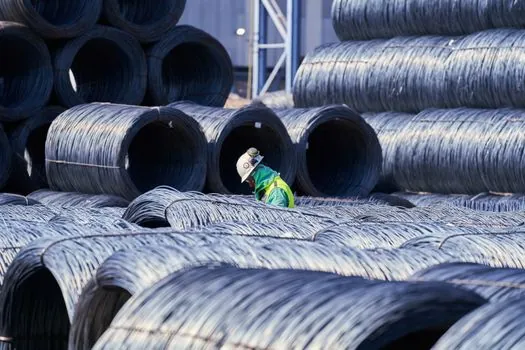
Strand arrives in coils weighing 2.5–3.5 t, banded with 8 steel straps and wrapped in waterproof cloth on a wood pallet (Capstone's standard export pack). On site, coils should be stored off the ground on timber dunnage, under tarp, and uncoiled with a power-driven decoiler rather than by hand-snatching, because surface scoring from improper uncoiling is the single most common cause of fatigue-initiated tendon failure in service [S1].
For epoxy-coated strand, nylon slings (not chains) are mandatory because chain contact chips the epoxy and any chip larger than ~5 mm² is a repair, not a pass. Galvanized strand tolerates chain handling but should still be lifted with webbing where possible. Indented strand (Wasungen's 12.7 mm and 15.2 mm indented product) is used where mechanical bond to grout must be higher than smooth strand provides, for example at anchor zones and at construction joints in post-tensioned slabs; the indentation is roughly 0.06–0.10 mm deep, controlled by EN 10138 [S2].
Common Spec Errors and Failure Modes
The three mistakes I see repeatedly on hospital projects are: (1) specifying unbonded monostrand in a fire-rated slab, where the grease and PE sheathing melt and the tendon loses pre-stress in a fire event, (2) ordering plain strand for a coastal or de-iced parking deck and then expecting 75-year design life, and (3) substituting 1570 MPa "cheaper" strand for 1860 MPa without re-running the tendon profile, which changes the number of strands per duct and can violate minimum reinforcement ratios in ACI 318. Each of these shows up in forensic reports years later as either tendon failure, slab cracking, or both. [S2]
A second class of errors is procurement-side: ordering from a mill without a current ISO 9001 certificate, accepting a 2.1 "type test" MTC in place of a 3.1 lot-traceable certificate, or specifying 15.7 mm when the project actually needs 15.2 mm because the anchor sets on site are 15.2 mm. Each of these is a preventable field problem. For prestressing strand sourced from a mill that also runs alloy steel wire rod (such as 82B), the heat-traceable MTC is what ties the chemistry to the mechanical properties and is the document that the structural engineer of record actually relies on [S1][S2][S3].
Sourcing and Procurement Workflow
For a 30,000–60,000 m² hospital tower, total strand demand is typically 1,500–4,000 t depending on the post-tensioning ratio, so the order is well within a single mill's monthly output (Capstone's 500,000 mt/year capacity is roughly 40,000 mt/month, Tenghai's 200,000 mt/year is 16,000 mt/month) [S1][S3]. Lead time from PO to first coils on site is normally 30–45 days for plain strand, 45–60 days for galvanized, and 60–90 days for filled epoxy-coated because of the coating line bottleneck.
On the buy side, the audit sequence is: confirm mill ISO 9001 and product certification (ASTM A416 / EN 10138 / GB/T 5224 as applicable), request recent third-party test reports for the exact diameter, place a trial order of 50–100 t, witness the MTC and dimensional check at the mill if possible, then release the bulk order. Independent labs in Singapore, Dubai, and Rotterdam are commonly used for pre-shipment inspection by buyers who cannot travel to the mill [S1][S2].
For an even more systematic spec-first approach to industrial procurement that parallels the logic above, see this data center sourcing from China spec-first buyer map for a comparable multi-thousand-ton, standard-driven buy. For buyers also specifying rotating equipment in the same hospital plant room, the servo drive spec-first selection guide uses the same criteria-driven logic.
Trackable Signals for the Next Buying Window
Two concrete signals to watch into Q4 2026: (a) updates to ASTM A416 and ASTM A882 revision cycles, which historically tighten the relaxation class II definition and the epoxy coating thickness tolerance, and (b) post-tensioning contractor capacity in the Gulf and Southeast Asia, where hospital build-out is concentrated and strand supply is increasingly booked 90+ days out. Any change in either will reset the optimal ordering pattern. [S2]