
For houses, low-rise multifamily, and mid-rise residential slabs, "steel strand" almost always means 7-wire prestressing strand made to ASTM A416 in Grade 270 (1860 MPa nominal tensile) or, less often, Grade 250 (1725 MPa); the most-used diameters are 9.53 mm (3/8 in), 12.7 mm (1/2 in), and 15.24 mm (0.600 in), with 12.7 mm as the residential default [S2].
Outside post-tensioned slabs, the same strand family also shows up as reinforcement in precast hollowcore planks, lintels, and floor beams, while a second, lighter product, hard-drawn steel wire for prestressed concrete to ASTM A421, is used in smaller precast elements such as residential piles and thin floor panels [S2].
Grades, Diameters, and Mechanical Floors
Relaxation behavior matters for residential slabs because strand is usually stressed to about 70-80% of GUTS (guaranteed ultimate tensile strength); A416 offers "Stress-Relieved" (Relaxation Class 1, max 2.5% loss at 1000 h, 70% GUTS, 20°C) and "Low-Relaxation" (Class 2, max 1.5% loss), with low-relaxation being the default for residential post-tensioning in North American practice.
Diameter choice drives both tendon capacity and concrete cover. Typical residential slab-on-ground tendons use 12.7 mm strand in plastic-sheathed ducts with minimum concrete cover of 25-40 mm; thinner toppings or pile caps step down to 9.53 mm strand, while transfer beams and longer spans step up to 15.24 mm strand, with profile heights held below the slab depth plus 6 mm tolerance.
Bonded vs Unbonded Strand in Houses
Unbonded post-tensioning (monostrand wrapped in HDPE sheathing with grease) dominates residential slab-on-ground work because it allows flexible tendon profiles, faster stressing, and simpler repair; the strand itself is still ASTM A416 but is supplied pre-coated as an "unbonded tendon" system, typically greased and HDPE-extruded to a finished outside diameter of 15-18 mm for 12.7 mm strand.
Bonded strand inside grouted metal or plastic ducts is more common in residential transfer beams, podium slabs, and any element where future restressing or corrosion exposure is a concern; the strand is the same A416 product, but the assembly is tested for watertightness and grout-filled after stressing, with grout meeting ASTM C881/C1107-equivalent requirements depending on local code.
For precast residential products (hollowcore planks, double tees, lintels), strand is pretensioned in the casting bed and released after concrete reaches the required release strength, typically 20-30 MPa; strand spacing in hollowcore planks usually ranges from 25-50 mm center-to-center near the bottom, with 5-12 strands per plank depending on depth and span.
Corrosion, Cover, and Code Constraints

Residential strand lives in two corrosion regimes: protected concrete (alkaline, pH ~12.5, passive) and damp/soil contact (foundations, garage slabs, coastal). Unbonded tendon sheathing provides a first barrier, but field damage during concrete placement is a frequent cause of long-term tendon failure, which is why ACI 318/ACI 301 typically require damaged sheathing to be repaired with tape and water-tightness tested before pour. [S4]
In aggressive soils (chloride > 500 ppm, sulfate > 1500 ppm, or pH < 5.5), specifying epoxy-coated strand to ASTM A882 or, increasingly, stainless-steel-clad strand (316L sheath over carbon-steel core) buys decades of service life; A882 Type B coated strand, for example, has a minimum coating thickness of 0.18 mm and must show no cracking after mandrel bend testing at 4°C.
Comparison of Common Residential Strand Options
Engineers weighing 9.53 mm vs 12.7 mm vs 15.24 mm strand, and bonded vs unbonded, usually balance four decision criteria:
2) Concrete cover and profile height: 9.53 mm strand lets the engineer keep a low slab profile (150-175 mm) for residential floor plates, while 15.24 mm strand usually requires 200-250 mm slab depth and more aggressive chair heights, raising dead load by roughly 15-25%.
3) Corrosion exposure: unbonded HDPE-sheathed 12.7 mm is the default for protected interior slabs, epoxy-coated or stainless-clad versions step in for garage slabs, foundation mats, and coastal builds, and grouted bonded strand is preferred where future inspection or restress is plausible.
4) Cost and lead time: bright (uncoated) 12.7 mm A416 low-relaxation strand is the cheapest and shortest-lead-time option; epoxy-coated or stainless-clad versions carry a 2-4x cost premium and 4-8 week longer lead times in most North American markets.
What Steel Strand is NOT For in Residential Work
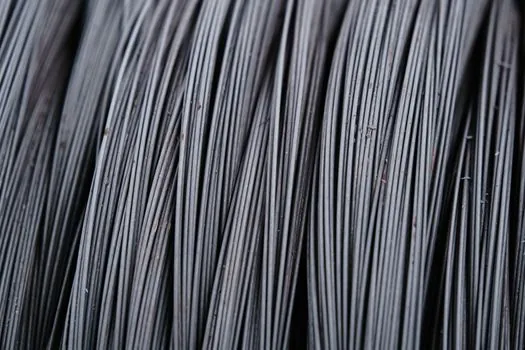
ASTM A416 strand is not a substitute for structural rebar in beams, columns, or shear walls, where deformed bars to ASTM A615/A706 are required for bond and crack control; strand's smooth, hard-drawn surface and small cross-section make it a poor bond reinforcement outside the pretensioning/stressing context. [S3]
Galvanized or bright wire rope to ASTM A475 is sometimes confused with prestressing strand, but it is a Class A strand for guy cables, not a high-tensile prestressing product, and should not be used in residential post-tensioned slabs; the minimum breaking strength is far lower and the relaxation behavior is uncontrolled for sustained loads.
Stainless 316 prestressing wire exists for special architectural applications, but for the bulk of residential slabs the cost is unjustified; epoxy-coated A882 is the more typical upgrade when corrosion is the real concern, and the same applies to carbon steel strand in mild environments where uncoated A416 with intact sheathing and 25-40 mm cover is sufficient.
Inspection, Stressing, and Acceptance Tests
[S3]
Detensioning in precast yards follows a strict sequence: strands released gradually once concrete reaches the required release strength (commonly 25-30 MPa for 12.7 mm strand at 70% GUTS), with the sequence designed to avoid sudden shock to the casting bed and to limit prestress losses from elastic shortening, which for residential hollowcore planks typically lands at 3-5% of the jacking force.
Long-term losses in residential slabs (relaxation, shrinkage, creep) are usually estimated at 12-18% of initial prestress for low-relaxation strand over the first 5 years, with the design assuming 15-20% total losses to set the final service stress; this is one reason engineers favor low-relaxation over stress-relieved for any new residential build.
Tooling and Consumables That Travel With the Strand
Strand selection is only useful if the framer or post-tensioning sub can run it: standard monostrand jacks handle 12.7 mm strand at 70% GUTS with 70-100 MPa hydraulic pressure, and most residential crews run pneumatic or electric construction tools sized for one strand at a time, with chair heights set by laser and chairs spaced 600-1200 mm depending on slab profile. [S1]
Anchorage hardware (wedge plates, wedges, pocket formers) is matched to the strand diameter: a 12.7 mm anchor typically uses a 100x100 mm or 130x130 mm pocket former, a 15.24 mm anchor a 130x130 mm or 150x150 mm plate, and 9.53 mm a 90x90 mm plate; mismatched anchors are a common field error that splits wedges or slips under load.
For repair or addition work, rebar couplers sometimes get confused with strand couplers, but the two product families do not interchange: strand couplers for A416 are specifically designed for 15.24 mm or 12.7 mm prestressing bar/strand and use a button-head or swaged barrel, not a rebar-threaded sleeve.
Next step for specifiers: lock the strand spec (A416 Grade 270 LR, 12.7 mm, unbonded HDPE-sheathed) on the structural notes, then add a corrosion upgrade line (epoxy-coated or grouted bonded) only where the geotech or exposure warrants it; track the July 2026 NSC Magazine update and the SCNZ Specification Toolbox for any 2026 revisions to residential PT detailing examples.