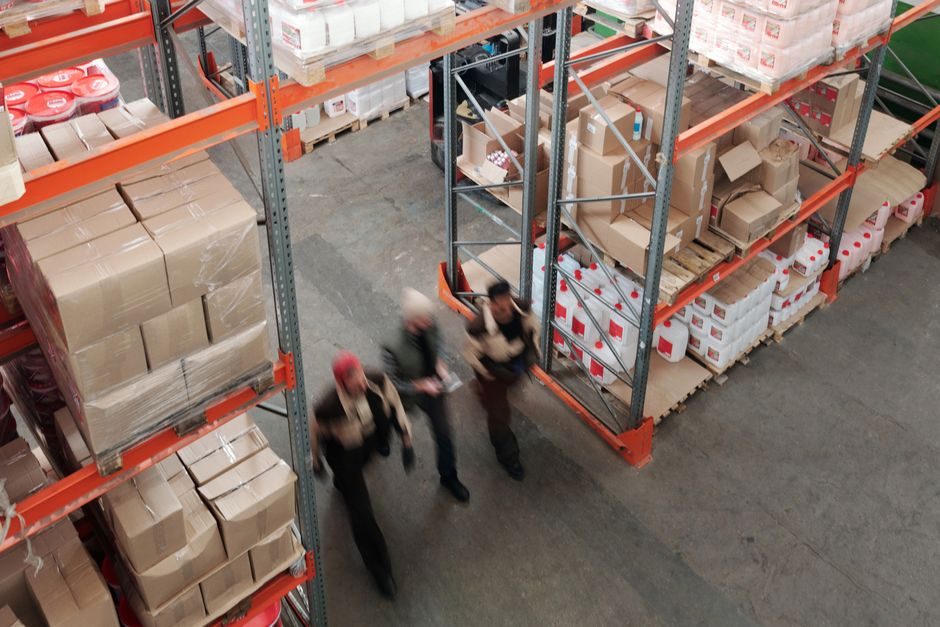
Total cost of ownership for a wire-mesh storage cage runs well past the unit price on the quotation: a 1,200 kg-load welded-mesh unit that lands at a warehouse dock for a low four-figure sum can accumulate two to three times that figure over a 5-year service life once damage, re-galvanising, handling labour, and end-of-life scrap are booked in [S2].
This piece maps the cost drivers that actually move a cage's TCO — material, finish, capacity tier, duty cycle, and disposal — and lines the four main cage families (light-duty stackable, heavy-duty stackable, pallet-compatible base, and collapsible returnable) up against four decision criteria so a procurement engineer can pick by numbers, not by catalogue photo [S2].
What TCO actually means for a metal storage cage
TCO is the sum of acquisition, ownership, operating, and end-of-life costs over a defined service window, and its value is that it surfaces the line items a purchase-order approval never sees — inspection labour, repair welding, container-handler time, and lost cage availability during refurbishment [S2][S3]. A storage cage is a long-lived returnable asset, so the most useful service window is 5 years; below 3 years the depreciation curve has not flattened, beyond 7 years the mesh fatigue and zinc-coating loss make the numbers unreliable [S2].
For a 1,200 kg-rated welded mesh unit, the four cost buckets to track are: (1) acquisition — unit price plus inbound freight plus initial inspection; (2) ownership — cage depreciation, capital tied up in idle stock, and insurance; (3) operation — fork-truck handling time per move, repair welds, panel replacements, and hot-spot re-galvanising; (4) end-of-life — scrap steel recovery credit less disposal labour [S2][S3].
Cost driver #1: Steel substrate, wire diameter, and mesh opening
Wire diameter and steel grade set the mass of steel in the cage, and steel mass is the single largest variable in unit price — a jump from 5 mm to 6 mm vertical wire on a 1,200 × 1,000 × 1,200 mm cage adds roughly 15-22% to the wire-mass bill and a similar step to the finished price [S3]. Q235 (yield ~235 MPa) remains the default for general warehouse duty; Q355 (yield ~355 MPa) is specified where the cage routinely sees impact from pallet jacks or where double-stacking is mandated by racking audits, but adds 8-14% to the material cost [S3].
Mesh opening is a quiet cost multiplier. For most warehouse storage, 50 × 50 mm is the lower bound because anything wider lets small parts migrate and breaches the visibility test many safety audits apply to a storage rack mesh panel.
Cost driver #2: Surface finish — galvanising, powder coat, and hot-dip

Finish choice is where most procurement arguments are won or lost, because the finish sets both the upfront price and the 5-year repaint/refurb cycle. Electro-galvanised zinc coating (8-12 µm typical) is the warehouse-default finish on light-duty stackable cages and keeps the unit price low, but in a damp or coastal site the zinc can be locally consumed inside 24-36 months [S3]. Hot-dip galvanising after fabrication (typical coating 50-85 µm on a 5 mm wire) adds 25-45% to the unit price but pushes the first refurbishment out to 7-10 years in the same environment [S3].
Powder coating over a galvanised substrate (duplex system, typically 60-80 µm powder over galvanising) is the spec where the cage will sit in a wash-down area, a cold store, or a chemical store; it carries the highest finish premium (often 35-55% above plain hot-dip) but combines corrosion defence with colour-coding for segregated inventory zones, which removes a separate labelling step [S3]. The TCO decision is therefore not "which finish is cheapest" but "which finish pushes the next repair event past my planned service window".
Cost driver #3: Volume tier, freight, and supplier MOQ
Volume tier moves unit price more aggressively than almost any spec change. Order quantities of 20-49 units typically attract the headline price, 50-199 units unlock a 8-15% tier discount, 200-499 units a 15-25% tier discount, and 500+ units a 25-35% tier discount on standard welded-mesh SKUs in most Asian and Eastern European OEM catalogues (2025-08 baseline). Inbound freight on a 1,200 mm-tall cage is volumetric rather than weight-bound — a 40 ft high-cube container fits roughly 150-200 collapsed units, and a freight surcharge of 10-18% applies for low-volume LCL shipments that miss the container cut.
Minimum order quantity is the hidden lever: a small order below the supplier's MOQ (often 20-30 units for an OEM line) can carry a 5-12% surcharge or be filled from a more expensive stock line, eroding the saving a low headline price looked to offer. The TCO move here is to consolidate one annual cage requirement across sites rather than issue per-site POs, which usually drops the effective unit cost into the next volume tier without changing the spec [S2].
Cost driver #4: Duty cycle, fork-truck damage, and repair exposure
Duty cycle is the operational multiplier on TCO, and the metric to track is damage rate per 100 moves. A well-trained fork-truck fleet on a 1,200 kg cage typically records 0.3-0.8 damage events per 100 moves (bent base runners, deformed verticals, sheared stack-locator pins); a high-turnover 3PL operation with mixed driver experience can push that to 1.5-2.5 per 100 moves, and each event costs roughly 4-9% of the unit price to repair on-bench (cut-out, re-weld, re-galvanise patch) [S3].
Repair exposure scales with cage geometry. A storage rack with bolt-on base runners can have a single runner swapped in 20-30 minutes; a welded-in base that cracks forces the whole cage off-line for a section cut and stitch weld. The TCO rule is to specify the highest-risk wear components (castor plates, stack-locator cones, fork-truck entry rails) as bolt-on or replaceable sub-assemblies from the OEM, even if the headline unit price is 3-5% higher, because each avoided full-cage repair pays for the upgrade inside one damage event [S2].
Criteria comparison: four cage families on cost drivers
Lining the four common families up against the four most procurement-relevant criteria — unit price index, 5-year maintenance cost index, stack density (cages per 40 ft HC container), and typical service life — gives a single comparison a category manager can take into a sourcing meeting. Indices are normalised to light-duty stackable = 100. [S2]
Light-duty stackable (wire 4-5 mm, 50 mm mesh, electro-galv): unit price 100, 5-year maintenance 100, stack density 100, typical service life 4-5 years. Heavy-duty stackable (wire 5-6 mm, 50 mm mesh, hot-dip galv): unit price 130-150, 5-year maintenance 60-75, stack density 90-95, typical service life 7-10 years. Pallet-compatible base cage (wire 5-6 mm, 50 mm mesh, fork pockets, hot-dip): unit price 140-160, 5-year maintenance 55-70, stack density 60-70, typical service life 8-10 years. Collapsible returnable (wire 5-6 mm, 60 mm mesh, hot-dip, fold-down side panels): unit price 170-200, 5-year maintenance 45-60, stack density 220-260 (when collapsed), typical service life 10-12 years. A side-by-side read of this table shows why collapsible returnable cages win the empty-leg back-haul lane despite the highest headline price: collapsed density alone can save a 30-40% freight line item in a closed-loop pool, which directly offsets the acquisition premium [S2].
Total cost of ownership: a 5-year worked example

Take a single 1,200 × 1,000 × 1,200 mm, 1,200 kg-rated, hot-dip galvanised welded-mesh cage in a 2-shift distribution centre. Acquisition: unit USD 380 + freight USD 35 + initial inspection USD 5 = USD 420. Ownership over 5 years: depreciation USD 280 (assuming 70% recovery at disposal on scrap value), capital charge at 5% on residual book value averaging USD 95, insurance USD 15 = USD 390. Operation over 5 years at 0.6 damage events per 100 moves and 4 moves/shift × 2 shifts × 250 days = 2,000 moves/year, so 60 damage events in 5 years × USD 25 average repair = USD 1,500 — this is the line that surprises most first-time TCO modellers. End-of-life: scrap credit USD 90, disposal labour USD 20 = net credit USD 70. Five-year TCO = USD 420 + USD 390 + USD 1,500 − USD 70 = USD 2,240, of which acquisition is 19% and operation is 67% [S2][S3].
This is the kind of inversion that a purchase-only cost comparison never shows, and it is why TCO belongs in the spec memo, not just in the procurement folder [S2].
Failure modes and constraints that punish a low-spec cage
The three failure modes that show up in almost every TCO post-mortem are: (1) zinc-coating loss at the weld heat-affected zone, which on an electro-galvanised cage can punch through to base steel in 18-30 months in a wash-down or cold-store environment; (2) base-rail deformation from chronic fork-truck over-travel, which on a welded-in base forces full-cage retirement; (3) stack-locator pin fatigue on cages double-stacked 4-high under a dynamic load, which on a single-shot cast pin typically fails around 60-80% of rated cycles [S3]. Each failure has a spec counter-measure: pre-galvanised wire with post-fabrication cold repair of the HAZ, a bolt-on base-rail channel, and a through-hardened pin with a documented cycle rating. None of these add more than 4-7% to unit price, and each cuts the 5-year operation line by 15-30%.
Who TCO modelling is for, and where it is overkill
TCO modelling is for any cage fleet above ~50 units, any cage that moves more than twice per week, and any cage specified for a 5+ year service life in a corrosive or high-impact environment — the operation line grows with frequency and exposure, so the same model that is a rounding error on a 10-unit static store is a procurement document on a 500-unit pool [S2]. It is overkill for a one-off cage on a project site, for a cage that will be retired inside 24 months, and for any specification where the unit price is below the labour cost to even run the model. The TCO framework also makes little sense where the cage is a consumable — disposable flat-pack units that ship to a customer and do not return belong on a unit-price spec, not on a TCO spec [S2][S3].
Sourcing signals to watch on 2026-07-27
Two trackable signals will move the numbers above in the next two quarters. First, Q235 and Q355 wire-rod price settlements out of Asia, which reset monthly and feed directly into the wire-mass line — a 5% wire-rod move typically shifts finished-cage price by 2.5-3.5%. Second, hot-dip galvanising bath capacity in the EU and Türkiye, where energy-cost pass-throughs in Q2 2026 have pushed some smaller galvanisers to add 6-10% surcharges on small-batch orders; large-volume buyers (500+ units) are still holding pre-surcharge terms, which widens the gap between small-order and consolidated-order TCO. The next internal cage TCO review should re-pull both inputs before the next volume-tier negotiation lands. [S1]
The underlying component specifications are covered under total station.
Background reading: Frame Scaffolding vs System Scaffolding: 2026 Spec & Sourcing Map.