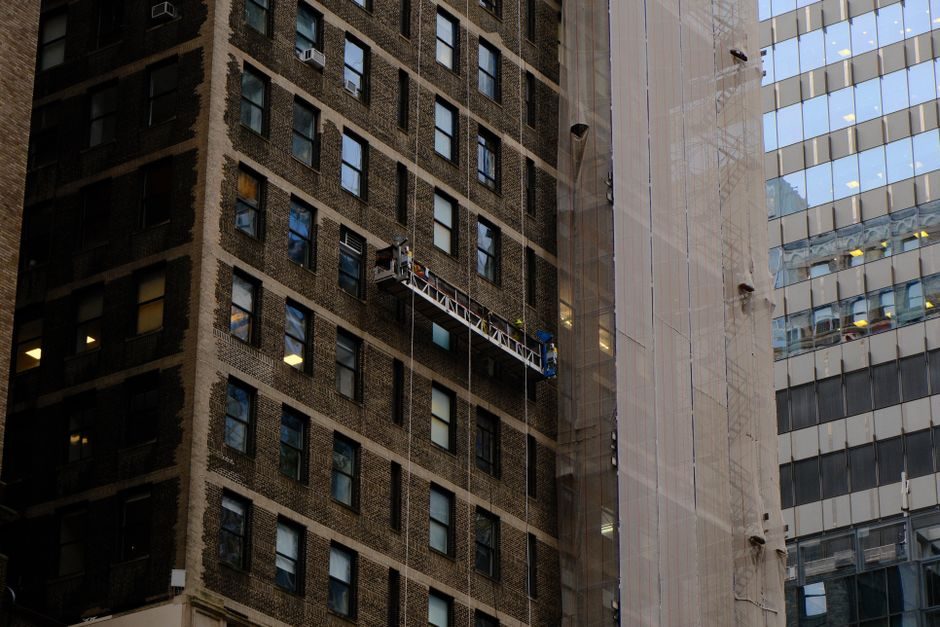
Frame scaffolding, in its 914×1700 mm H-frame geometry built from Q235 tube, dominates the low-rise facade and short-cycle trades at a 2026-05 Tianjin-port price band of US$13-25 per set at 200-piece MOQ, climbing to US$40-80 for fittings at 50-set MOQ [S5][S7].
Modular system scaffolding (ringlock, cuplock, kwikstage) covers the rest: irregular geometry, shoring, and industrial work above 30 m where the welded rosette or cup-lock node replaces the cross-braced H-frame. The two product families ship out of the same Tianjin and Linyi export cluster [S1][S6], and the build site, not the brochure, is where the line is drawn.
Frame Scaffolding — Geometry, Steel, and the 914×1700 mm Reference Build
Frame scaffolding is a welded assembly of two H-frames linked by cross braces, with a fixed 914 mm bay width and a 1700 mm lift height in the reference Q235 build published on 2026-05-16: 42×2.2 mm main-frame tube, 25.4×1.8 mm vice-frame tube, painted or hot-dip galvanized, MOQ 500 sets [S4]. That 42/25.4 mm dual-tube wall-thickness pattern (2.2 mm / 1.8 mm) is the practical fingerprint of a Chinese export frame — it is what you measure on receiving inspection to confirm you got Q235 commodity frame, not a thinner residential-grade substitute.
Fixed (non-mobile) steel frame is the bulk of Made-in-China.com listings, with customizable variants and steel as the standard material at the same US$13-25 / 200-piece MOQ band [S7]. The trade-off is rigidity per kilogram: a welded Q235 H-frame has higher point-load capacity than a tube-and-clamp build of the same weight, but it cannot reconfigure to a non-rectangular footprint. Mobile variants add 125-200 mm casters and are listed separately under Steel Structure Platform for warehouse and indoor rolling work [S3].
System Scaffolding — Ringlock, Cuplock, and the Modularity Premium
System scaffolding uses vertical standards with welded rosettes (ringlock) or cup-and-blade nodes (cuplock) every 500 mm, with horizontal ledgers and diagonal braces locked into the node without loose couplers. The node replaces the cross brace, which is why system scaffolds handle non-rectangular facades, vessel wraps, and curved industrial structures that defeat the H-frame's orthogonal geometry. Linyi-based export houses carry frame, ringlock, and matching safety access gates in the same product line, with the gates shipped as an accessory compatible with both systems [S1].
For shoring and formwork support above 30 m, system scaffolding — not frame — is the typical specification, because the rosette node gives redundant load paths at every 500 mm level and accepts tie patterns that a welded H-frame cannot. The cost premium is real: per set, system components run 30-80% above equivalent frame mass, but erection labor drops because there are no loose couplers to torque. That labor math is what flips the decision on industrial sites where the geometry is not a flat rectangle.
Frame vs System — Decision Matrix on Four Criteria
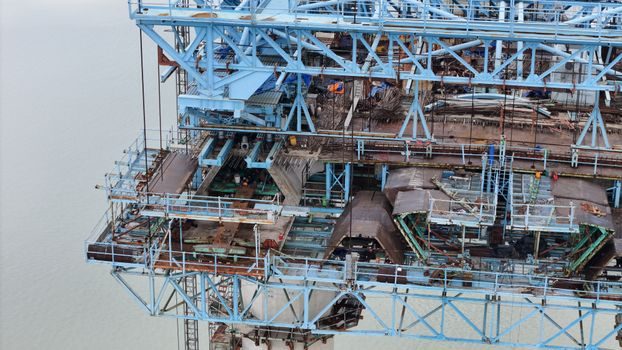
On cost per square metre of facade access, frame scaffolding wins on materials while system scaffolding wins on labor — a 4-storey brickwork job on a flat wall in 2026 still goes to frame because the wall is orthogonal, the cycle is short, and the crew knows the H-frame. On geometry flexibility, system scaffolding is the only answer for circular tanks, vessel domes, and any facade with bay offsets greater than the 914 mm frame width. On height, frame scaffolding is typically specified up to about 30 m (roughly 8 lifts × 3 m working height) when properly tied; above that, system scaffolding or tube-and-coupler is specified because frame braces become the weak link under accumulated dead load. [S1]
On reuse and lifetime, hot-dip galvanized Q235 frame scaffolding rated for 5-8 years of cyclic site use compares against galvanized system components rated 10+ years, because the rosette is a thicker forged node that survives drops better than a welded H-frame corner. Procurement language worth copying: "Q235, 42×2.2 mm main tube, 25.4×1.8 mm vice tube, hot-dip galvanized, 914×1700 mm, MOQ 500 sets, FOB Tianjin" [S4]. The same supplier network ships standard scaffolding at 3-tonne MOQ and 1000-tonne monthly capacity through Tianjin [S6] — useful for buyers scaling from sample to project volume.
Matching System to Build Type
Apartment and villa facade, plaster, paint, EIFS, brickwork, short-cycle maintenance under 30 m: frame scaffolding, ideally hot-dip galvanized Q235 with the 42/25.4 mm tube pattern [S4]. This is also the Linyi export cluster's bread and butter, with average daily scaffold-board capacity of 1000 pieces and container-load direct shipping from Chinese factories [S1]. The Linyi supplier's customer base spans 100+ countries and includes dedicated Italy distribution via FIXY & HTN GROUP, which is a useful data point for European buyers who need a stocked EU warehouse rather than direct FOB Tianjin orders [S1].
Industrial plant turnaround, petrochemical vessel access, shipyard, curved or stepped facades, shoring above 30 m, and any site with non-rectangular geometry: system scaffolding, with ringlock or cuplock selected on regional preference (ringlock dominant in Europe and the Middle East, cuplock strong in Australia and Southeast Asia, kwikstage common in North America). Mobile frame on casters is a separate sub-category for warehouse and indoor rolling work, listed under Steel Structure Platform on Made-in-China.com with portable rolling-tower configurations [S3]. For related industrial sourcing context beyond scaffolding, see this 2026 spec map for IE4 high-efficiency motors and motor graders, which uses the same criteria-driven selection logic for rotating equipment.
Failure Modes, Mis-specifications, and What to Check on Receipt
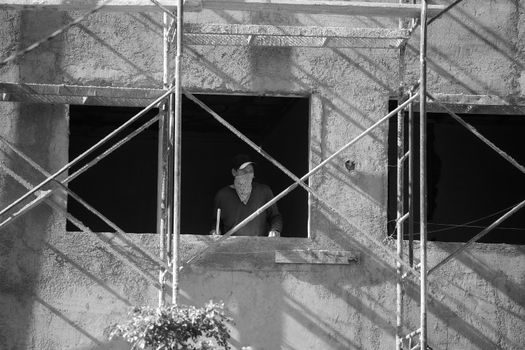
Frame scaffolding fails in three predictable ways: tube-wall under-thickness (sub-2.0 mm on a 42 mm tube, common on residential-grade frames), inadequate tying above 2 lifts, and mixed-material frames where the vice tube is Q195 instead of Q235. The first shows up as visible flex on the first lift; the second as progressive sway; the third as a corrosion cell between dissimilar tubes within one season. Receiving inspection should confirm the 42×2.2 / 25.4×1.8 mm wall pattern with a caliper at the tube ends, magnetic-test the galvanizing thickness, and reject mixed-lot deliveries [S4].
System scaffolding's failure modes are different: rosette weld cracking on low-quality imports (visible as a hairline at the standard-to-rosette junction after 6-12 months), ledger-blade deformation from over-torque, and node galling on hot-dip galvanized components stored wet. The mitigation is supplier audit on weld procedure and a sample test of 3-5 rosettes per container. For buyers cross-sourcing adjacent industrial safety equipment, the explosion-proof lighting vs control-station spec map and the hardness tester vs dye-penetrant kit guide use the same receiving-inspection discipline applied to ATEX enclosures and NDE equipment.
Standards, Sourcing Signals, and Where to Watch in 2026
Frame scaffolding exported from China is typically manufactured to EN 12810/12811 for European buyers, AS/NZS 1576 for Australia/NZ, and OSHA 1926.452 for North American buyers; the same Q235/42 mm tube pattern satisfies all three on geometry, with the variation in tie-pattern, access-deck spec, and toe-board geometry. Always request the test report keyed to the destination standard rather than the supplier's generic "export standard" — this is the single highest-leverage line in any frame-scaffolding RFQ in 2026 [S1][S4].
Two trackable signals for the rest of 2026: first, watch Tianjin and Linyi export pricing on galvanized Q235 frames — if the US$13-25 / 200-set band [S7] softens below US$12, suspect sub-2.0 mm tube wall and inspect on receipt. Second, watch the safety-access-gate accessory market, where EU contractors are specifying heavy-duty steel gates compatible with both frame and ringlock [S1] — a small line item that signals which scaffolding families are winning European site tenders. For an industrial cross-reference on spec-driven sourcing patterns, the manganese ore 2026 lumpy-vs-sands map and the phosphate rock producer map use the same criteria-first, price-band-second discipline that should be applied to any 2026 scaffolding procurement.
The underlying component specifications are covered under scaffolding, pressure transmitter, and flow meter.