
Selective pallet rack remains the default pick-facility system because every pallet position is independently accessible from a 2.7-3.2 m aisle, which keeps forklift reach predictable; the trade is floor density, because the same aisle that serves a single SKU also consumes roughly 35-45% of the gross footprint that a drive-in or storage rack system would otherwise use [S1].
For a process engineer sizing a new build or retrofit, the decision is not "rack vs no rack" but which combination of beam profile, upright gauge, aisle width, and crane/shuttle layer matches the SKU count, throughput, and fire-code envelope on the site — every option below is a different point on the floor-area × capex × pick-rate × damage-rate curve.
Selective Pallet Rack: the Low-Risk Baseline
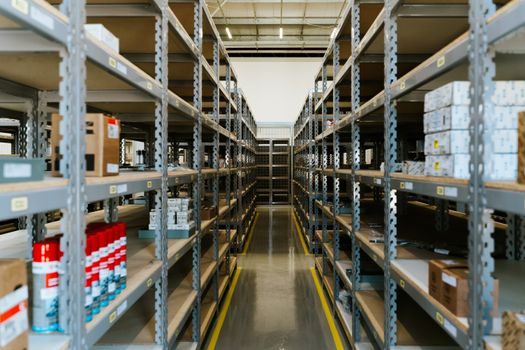
Selective configurations use roll-formed teardrop uprights (typical 76-102 mm column, 2.0-2.5 mm steel) carrying 2.4-3.6 m beams rated 1000-4500 kg per pair; a standard 2700 × 1100 mm EUR pallet on 100 mm beam connectors clears the next level with 75-100 mm vertical pitch [S1]. Damage rate is the lowest of any high-density system because every pick is a single-pallet lift, but operators must respect the 1:1.5 (load-to-beam-length) deflection limit, and column protectors (plastic or steel) are mandatory in the first 600 mm above floor per most RMI/EN 15635-compliant sites.
The downside is real estate: 4 selective bays across a 12 m wide x 30 m long footprint use roughly 95 m² of aisle, and each aisle needs a Class I counterbalanced or reach truck with a 8-12 m lift mast to realise vertical capacity — anything below 8 m of clear ceiling throws away the capex benefit of going tall.
Drive-In and Drive-Through: Density vs Selectivity
Drive-through adds a second opening so pallets flow FIFO instead of LIFO, but every added depth multiplies the worst-case recovery time after a forklift impact.
Damage rate climbs sharply: the rack itself takes the abuse, not the pallet, and a single fork puncture on the front column can unload four uprights of stored product. Drive-in is the wrong choice for SKUs with more than 2-3 pallet loads each (low SKU velocity) and absolutely wrong for mixed-SKU operations, because the Last-In-First-Out (LIFO) discipline forces full block rotation just to reach the back pallet.
Radio Shuttle and Four-Way Shuttle: Compaction with Throughput
A four-way shuttle adds the ability to traverse between lanes at the same level, which is what enables multi-layer shuttle systems above 10 m without requiring a stacker crane for every aisle.
The catch is mechanical: shuttle carriers carry LiFePO4 battery packs rated for 6-10 hours of continuous cycling, and the lane floor must stay within ±2 mm/m flatness for the optical or mechanical guidance to hold; any deviation outside that window starts producing jam-fault events that idle the carrier. Shuttle racks outperform drive-in on pick rate (typically 40-80 pallets/hr per lane vs 20-30 for drive-in) but the carrier fleet is a working capital line that depreciates faster than the steel.
Automated Storage and Retrieval Systems (AS/RS): When the Capex Justifies
AS/RS configurations stack unit-load or mini-load loads 20-40 m high on rack-supported buildings, served by stacker cranes travelling at 60-180 m/min horizontal and 30-60 m/min vertical with ±5 mm positioning accuracy; throughput per crane is 20-100 dual-cycle (in+out) moves per hour depending on lift height and bay count [S1]. The system cuts labour to a WMS/WCS interface and one or two recovery operators, and it is the only option that delivers 85-95% gross-volume utilisation on a footprint where a selective build would peak around 35-40%.
Capex is the discriminator: a 10,000-pallet-position unit-load AS/RS routinely lands in the USD 8-25 million band before racking-supported building costs, and the building itself must be designed to the rack as primary structure per FEM 9.831 / RMI — concrete mezzanines are not a substitute. Downtime is binary: a single crane outage removes one of usually two redundant aisles' worth of throughput, and the recovery path is a manually operated service lift, not a forklift.
Structural and Code Constraints Most Spec Sheets Bury

Every rack above 2.5 m that is accessible to forklifts or pedestrians is engineered to EN 15635 in the EU or RMI/ANSI MH16.1 in North America, with seismic design per ASCE 7 (US) or Eurocode 8 (EU) where local ground acceleration exceeds ~0.1 g; the upright gauge, base-plate thickness, and anchor pattern all derive from this, not from a vendor's "heavy duty" marketing line [S1].
Fire-sprinkler interaction is the silent failure mode: in-rack sprinklers require 150-460 mm of clear vertical space between the top of the load and the deflector, and adding a beam level often forces the sprinkler contractor to redesign the density/area curve. Cross-aisle longitudinal flue spaces (typically 150 mm minimum) must be maintained at all times, or the rack loses its sprinkler classification and the insurance carrier's fire impairment rating kicks in.
Decision Matrix: Match Rack Type to Operation
For cold storage or any build above 12 m, the comparison shifts hard toward AS/RS because the forklift heat load, ventilation, and operator lighting dominate operating cost; the comparison echoes the build-vs-buy logic a process team uses when choosing between a precision filter cartridge change-out schedule and a self-cleaning alternative. [S1]
For a 3-5 SKU, full-pallet warehouse with predictable inbound and outbound volumes, drive-in or drive-through delivers the best pallets-per-square-metre figure and the simplest WMS interface; shuttle systems sit in the middle, and the relevant tie-break is whether the operator base is forklift-trained (drive-in) or WMS-trained (shuttle, AS/RS). Damage-rate assumptions should also be sanity-checked against the same trade-off logic used for a ball valve spec — a cheaper body class costs more in unplanned downtime than the per-unit savings justify.
Trackable signals for the next planning cycle: SE-BEAM-style teardrop connector patent expiries opening Asian OEM teardrop supply, FEM 9.831 rack-supported-building annex revisions, and the EU Machinery Regulation 2023/1230 transition dates that affect CE-marking on new racking installations. A reliable capex benchmark is to ask each vendor for the per-pallet-position price broken out by rack steel, anchors, and installation labour — figures that vary by a factor of 2-3 across otherwise comparable quotes.
The underlying component specifications are covered under storage cage.