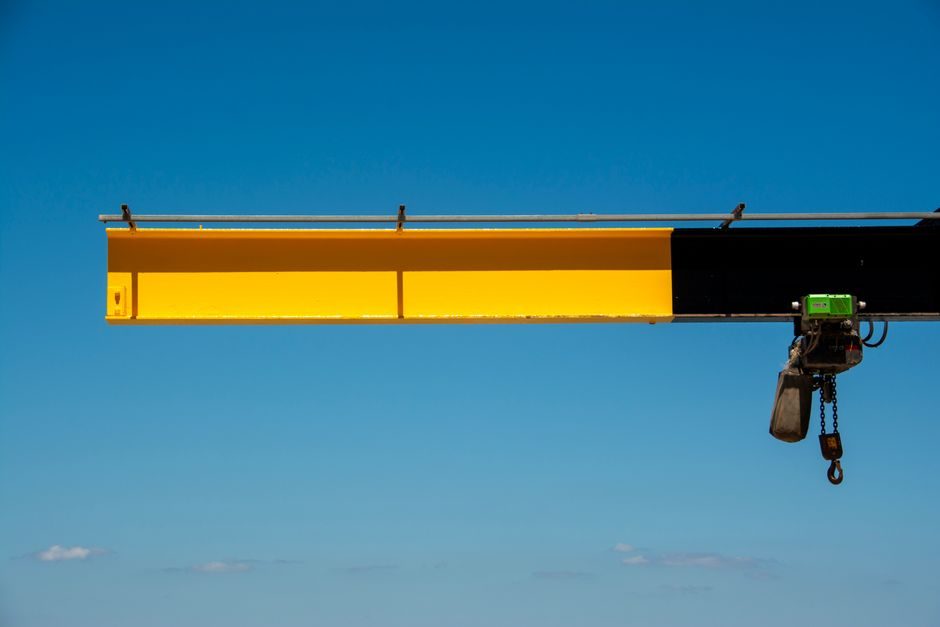
Single-girder overhead cranes pair one load-bearing bridge girder with an under-slung or top-running hoist, with current OEM datasheets showing working-load envelopes from 2,000 kg (VERLINDE EUROSYSTEM ALD aluminium/steel profile) up to 6,300 kg (GIS AG single-girder traveller) per the product pages indexed on DirectIndustry [S1][S2].
The configuration is the default choice for light-to-medium workshop, assembly, and warehouse duty, and the single-girder crane format is the lightest, lowest-headroom member of the overhead bridge family when compared against a gantry crane or a mobile crane for the same lift.
Where a Single-Girder Crane Wins on Spec Sheet
Lower dead weight is the headline number: a single main girder plus a lighter hoist trolley means smaller runway beams, smaller end-carriages, and lower wheel loads on the building column — directly translating to lower crane weight per metre of span and a smaller foundation/column reaction at the runway rail. [S4]
VERLINDE markets the EUROSYSTEM ALD as a "new generation of hollow profile handling systems" that "combines the advantages of conventional steel and aluminium hollow profile", with the two materials usable together in the same bridge, and a 2,000 kg (4,409.2 lb) listed load on the catalogue entry [S1]. Headroom is the second win — under-slung hoists (top-running on a lower flange) sit inside the girder depth, recovering 200–400 mm of hook approach versus an equivalent top-running double-girder, which is the reason this format dominates low-bay workshops.
Where the Single-Girder Format Reaches Its Limit
Span and capacity are coupled in a single main girder, so the deeper the section needed for a long span or heavy hook, the more the headroom advantage erodes — which is why IMMA Global's catalogue lists the single-girder form within a range that also covers double-girder, explosion-proof, grab, and heavy-duty variants reaching 100 t (110.2 us ton) [S3]. Above roughly 10 t, or with spans beyond 25–28 m, deflection, fatigue, and trolley stability push the design toward a double-girder layout, where the hoist rides on rails between two girders.
Single-girder bridges are also a poor match for high-duty classifications (FEM/ISO M5–M8, CMAA Class D/E/F): the main girder carries both bending and local hoist-wheel loads, and high cycle counts (≥ 120,000 starts/year) concentrate wear on a single welded plate or box section. For hazardous-area zones, the same IMMA line explicitly adds an "explosion-proof" option, but the single-girder envelope still constrains the hoist family — large explosion-proof hoists become too tall to fit under a shallow single girder, forcing a switch to double-girder low-headroom arrangements.
A second limitation is hook approach and service access: with the hoist under-slung, mechanic access to the hoist, cable reel, and festoon is restricted, and any in-service bearing or rope change typically requires removing the hoist from the girder rather than working on it from a catwalk — a practical reason single-girder bridges are paired with low-duty rope or chain hoists rather than the heavier industrial wire-rope units seen on crawler crane erection duty.
Single-Girder vs Double-Girder: A Four-Criterion Cut
Capacity, span, headroom, and lifecycle cost are the four decision lines that drive the single-vs-double call. On capacity and span, double-girder wins from roughly 10 t upward and from 25 m+ spans, where the second girder lets the main sections run shallower for a given stiffness and keeps the deflection ratio inside FEM/ISO 1/500–1/750 limits. [S3]
On headroom, the single-girder under-slung hoist (or low-headroom top-running) wins, typically by 200–400 mm of hook travel — decisive in existing low-bay factories where raising the roof is not on the table. On lifecycle cost, single-girder wins up to about 10 t and 25 m; beyond that the heavier hoist, larger end-carriages, and longer runway of the double-girder are offset by lower deflection, fewer fatigue-sensitive welds, and better access for the maintenance crew.
Hoist compatibility is the fifth, often-missed line: chain hoists and small rope hoists up to ~6,300 kg fit cleanly under a single girder (matching the GIS AG product envelope [S2]), while larger double-girder designs accept big drum hoists, magnet beams, and grabs — which is exactly the capability mix that pushes IMMA's combined single/double catalogue toward 100 t for bulk-handling and heavy-duty variants [S3].
Who Should Buy a Single-Girder, and Who Should Not
Buy single-girder when the application is workshop tool handling, small-parts assembly, machine loading, or warehouse pallet/stillage moves in the 1–6 t band with spans under ~20 m, low building height, and light-to-medium duty cycle — conditions where the 2,000 kg aluminium/steel EUROSYSTEM ALD [S1] or the 6,300 kg GIS single-girder traveller [S2] are typically quoted.
Avoid single-girder for steel-coil handling, scrap-yard grabs, foundry ladle work, and any hazardous-area zone with a heavy explosion-proof hoist; in those duty cycles, and above roughly 10 t SWL, the format does not give the operator a workable hook approach or the maintenance crew safe access to the hoist mechanism. For a procurement-side TCO lens, a gantry crane TCO 2026 review reaches the same conclusion from the ground-up side: the steel and erection savings disappear once duty class, span, and hoist weight all rise together.
Selection Specs and Sourcing Channels to Watch
The data points that should sit on every single-girder RFQ in 2026 are: SWL, span (S), hook approach (C dimension), duty classification (FEM/ISO group, e.g. 2 m / ISO M4), hoist type and lift (L), trolley speed, bridge travel speed, power supply (festoon or conductor bar), and runway reaction per wheel — together they fix the girder section, the end-carriage size, and the building column load. [S3]
On sourcing, Chinese OEM catalogues such as Zhejiang Xiecheng Crane Machinery's product line list "Single Girder Crane, Double Girder Crane, European Style Crane" in the same product tree, with European-style single-girder as a separate sub-line — a useful indicator that the global single-girder market is now a two-block supply chain (European low-headroom designs and Chinese volume production) rather than a single regional pattern [S4]. Picking a hoist is its own spec problem; for capacity/accuracy trade-offs at the load-side, the force gauge vs crane scale split lays out the weighing-instrument side of the same decision.
Failure Modes and Maintenance Constraints
Single-girder bridges fail in three predictable ways: girder fatigue cracking at the end-carriage splice or at the hoist-rail weld; trolley derailment caused by rail misalignment or wheel flange wear; and hoist-related rope/cable fatigue accelerated by high duty cycles — the last of which is why FEM/ISO 2 m / M4 (or lighter) is the practical ceiling for most under-slung single-girder designs. [S3]
Safe access for inspection is itself a constraint: a single-girder bridge usually has no dedicated maintenance walkway, so the OSHA/EN 15011-style statutory inspection interval forces either a shutdown (full bridge lowered onto stops) or a rope-access plan, both of which add to lifetime cost. A planned-preventive schedule of monthly visual, quarterly operational, and annual structural inspections, plus a five-yearly load test, is the typical minimum for installations outside the heaviest duty classes.
Track two signals in the coming quarters: (1) whether EU and US OEM datasheets extend the upper SWL of the single-girder line above 10 t by using hybrid aluminium/steel hollow sections (the EUROSYSTEM ALD direction [S1] is the live experiment), and (2) whether Chinese exporters push the single-girder format further into European-style low-headroom SKUs and crowd the European low-bay segment, given that the same Xiecheng catalogue already groups "European Single Girder Crane" with its other double-girder and suspension lines [S4].