
A single-girder overhead travelling crane is the default pick for workshop lifting between 125 kg and roughly 10 t when the existing building steel can carry the runway [S1][S5]. For heavier duties up to 60 t, a kit-based or double-girder configuration is supplied, with the girder fabricated locally and the balance of components shipped as a tested package [S3]. Selecting the support scheme — hanging from the roof, free-standing on floor columns, or a semi-gantry on one leg — is the first installation decision and dictates foundation, anchor, and electrical routing [S1][S4].
Aluminum-profile lightweight systems stay in the 125–1,500 kg SWL band and trade span for ergonomics; steel profiles extend span and load to the upper end of the single-girder range [S2]. The cross-reference page on single-girder crane classifications maps which type maps to which SWL and span envelope, useful before locking the building interface.
Ceiling-Hung vs Free-Standing: Picking the Support Mode
TAWI specifies its hanging single-girder as the workhorse when existing roof structure carries the runway, with a 1,250 kg SWL example from ABUS EHB confirming the same ceiling-mounted topology for light-duty area-coverage [S5]. ABUS pairs this with a 10 t / 15 m semi-gantry (EHPK) where one rail sits on a floor column and the other on the building, useful against a free wall or outdoors against an existing structure [S4]. Switching to floor-mounted freestanding columns becomes mandatory when the ceiling is rated below the runway reaction load, when the roof is uneven or obstructed, or when the facility is open-air with no roof at all [S1]. The pillar-supported layout also relocates more easily because the arches are bolted, not welded, to the slab — a practical reason shops in leasehold buildings pick it.
For spans up to roughly 15 m and SWL up to 10 t on a semi-gantry, the high-level end carriage runs two drive motors plus thruster rollers with obstacle detection and rotating beacons fitted at the OEM stage [S4]. That obstacle detection is not optional in busy aisles; it is the single add-on that consistently prevents end-carriage collisions during commissioning hand-overs.
Aluminum vs Steel Profiles: Weight, Span, and Sanitation
Aluminium profiles are the cost-effective pick per square meter for SWL up to 125 kg, with the upper end of the lightweight line reaching 1,500 kg when paired with a steel track [S2]. Steel profiles are required when bridge span or SWL pushes beyond the aluminium envelope; combined aluminum-track / steel-bridge systems let one runway serve mixed workstations without forcing every bay into the heavier structural class [S2]. Stainless steel is the variant to specify in food, pharma, and wash-down areas — TAWI lists it as the sanitation-prioritised option in the same product family [S2].
Low self-weight on the aluminium bridge is the lever that lets operators push the trolley by hand without the crane drifting after release; that ergonomic gain disappears the moment the bridge is over-dimensioned, so right-sizing the profile to the actual load spectrum matters more than nominal capacity headroom.
Hoist Integration and the OMIS Kit Approach
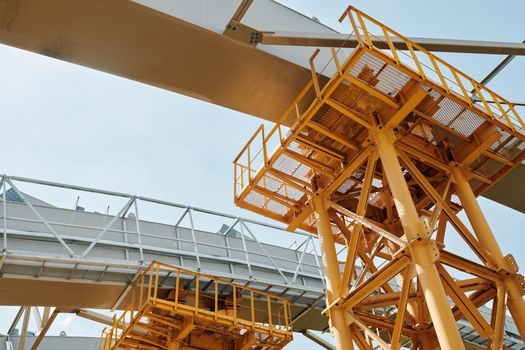
OMIS ships its single-girder bridge crane as a kit covering every part except the main girder, which the local builder fabricates from supplied drawings [S3]. The kit includes end carriages with gear motors and girder connection flanges, hoist or open-barrel (open-winch) lifting unit, electrical panel, festoon system with trolleys and supports, push-button strip, and limit switches, all factory-tested before pack-out [S3]. This split keeps the largest, cheapest component (the girder plate) out of the container and lets the user source it domestically, which is the cost lever for small manufacturers and distributors in distant markets [S3].
The hoist itself is the part most often mis-specified at install: SWL must equal or exceed the bridge rating, hoist duty class (FEM / ISO) must match the cycle count, and the trolley gauge must match the lower flange width of the girder, not the nominal SWL. Cross-check the festoon cable loop radius against the lowest expected hook height; a loop that binds at full lift is a recurring commissioning complaint.
Acceptance Tests and Pre-Load Checks
Static overload test at 1.25 × SWL and dynamic test at 1.1 × SWL remain the field acceptance baseline for overhead cranes per common FEM/ISO practice; the kit documentation explicitly notes that all shipped components are "carefully tested" and that user-friendly assembly is engineered to ensure they work together once mounted [S3]. For the ceiling-hung EHB and EHPK variants, the two-motor end carriage with thruster rollers needs a no-load creep test across the full runway before the SWL dynamic test, because skew between the two motors only shows up under power [S4][S5].
For an installation overview of the broader overhead bridge crane family — including double-girder and gantry siblings — the 2026 spec map lays out SWL, span, and duty-class envelopes side by side, which is the right reference when the duty creeps above the single-girder ceiling.
Failure Modes Seen at Commissioning
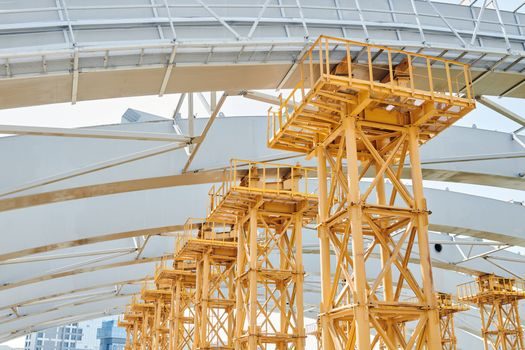
The recurring single-girder installation faults fall into four buckets. First, runway reaction miscalculation: ceiling-hung systems are often specced before the building steel is verified, which is exactly the case TAWI's free-standing range is built to rescue [S1]. Second, profile over-spec: heavier steel bridges than needed, which kills the ergonomic push-by-hand advantage the aluminium line exists to provide [S2]. Third, hoist/girder mismatch on kit installations where the locally fabricated girder is rolled to a flange width that does not match the trolley gauge supplied in the kit [S3]. Fourth, end-carriage skew on dual-motor drives that only manifests under full-span travel, which is why the no-load creep test must cover the full runway, not just the bay at the operator station [S4].
When any of these show up post-install, replacement rather than field-fabrication is almost always cheaper: a mismatched trolley gauge on a 10 t semi-gantry is a re-kit, not a shim, and a ceiling deemed structurally inadequate is a column retrofit, not an anchor upgrade.
Sourcing Notes and Service Coverage
Chinese OEM channels continue to push electric single-girder workshop cranes in the 1–20 t SWL band, with manufacturer-direct pricing that undercuts European brands on bare crane but rarely includes on-site commissioning [S8]. NUCLEON (Xinxiang) lists the full service chain — free design, installation and commissioning, operator training, and 7×24 technical support — alongside the product, which is the line item to confirm before purchase on a cross-border order [S10]. Domestic Chinese makers such as Zhejiang Xiecheng package the European-style single-girder alongside suspension, jib, and gantry variants on a single product line, simplifying spares and control-protocol consistency for mixed fleets [S9].
Track for the next revision: a published installation walkthrough from NUCLEON HD surfaced in mid-2024 covering the new-design electric single-girder, useful as a visual complement to the spec sheets above [S6]. Field engineers commissioning a 1–10 t single-girder should also reference the gantry crane encyclopedia entry when the install shifts from ceiling-hung to ground-supported, since the support logic and end-carriage geometry differ even though the hoist and electrical content are largely shared.
Detailed specification references: single girder crane, and linear guide.