
PP strapping band at 9-19 mm width and 0.5-1.0 mm thickness covers roughly 60-380 kg break-strength and ships in 1-roll MOQ from Chinese export lines at US$ 14-20 per roll, with SGS-audited supply concentrated in Inner Mongolia, Ningbo, and Xiamen clusters [S1][S2][S5].
PET strapping band, produced on lines adapted from Korean and Japanese extruder designs with downstream winder control via touch-screen HMI, is the heavier-duty alternative for unit loads and replaces steel strap in most non-sharp-edge applications [S4][S7].
Material Selection: PP vs PET vs Steel Cross-Reference
PP strapping band is widely used for hand and semi-automatic pallet strapping and is available in economic grades with competitive pricing, though its high elongation absorbs shock during transport, which limits retained tension on rigid loads [S1][S3].
PET strapping band, with 9-19 mm width options and break-strength commonly 200-600 kg on production lines built from Korean and Japanese extruder technology, replaces 12-19 mm steel strap in many warehouse applications while cutting weight by roughly 1:6 versus steel of equal break-strength [S1][S4].
Steel strapping remains specified for hot-coil, plate, and timber-bundle applications with sharp edges, but its weight and operator-safety overhead push most general warehouse users to PET, and the strapping machine tooling for friction-weld or heat-seal PET has largely displaced seal-and-crimp steel tools in new installs [S1][S3].
Pre-Install Inspection: Roll Quality, Tension, and Surface
Roll inspection at goods-in should check three quantitative gates: width tolerance within ±0.3 mm of nominal, thickness within ±0.05 mm, and a clean transverse cut with no fused bead that will misfeed the strapping machine track [S3][S7].
Surface contamination by oil, water, or release-agent will drop friction-weld PET joint strength by 20-40% in field reports, so wiping the seal zone with isopropyl before friction welding is standard practice on battery-powered tools [S3].
Installation Procedure: Tension, Seal, and Acceptance Criteria
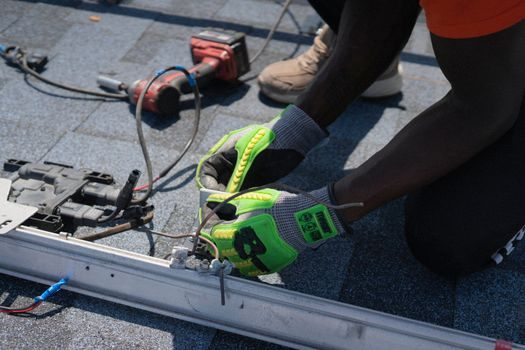
Set tool tension to roughly 40-60% of nominal break-strength for PP and 25-40% for PET on compressible loads, and 60-80% for PET on rigid loads such as bricks or steel coils, then cycle the tool to verify consistent seal pull-strength on the first 5 straps before running production [S3].
Acceptance gate for friction-welded PET joint: the joint must hold 75% of parent-strap break-strength and show a uniform weld flash 1-3 mm wide on both sides; a one-sided flash or gap >0.5 mm indicates insufficient weld pressure or a worn weld die and the strap must be re-sealed [S3].
Heat-sealed PP joints on 12-19 mm band should hold 60-70% of parent break-strength and show a clean melt-bead across the full band width; if the bead is glossy and glassy with a thin neck, the heater element temperature is too low and the joint will fail in drop tests [S3].
Common Failure Modes and Corrective Action
Strap that splits longitudinally during tensioning is almost always a tooling mismatch: the sealer anvil is worn or the tension gripper is over-crimped, and the corrective action is to replace the gripper jaw and recalibrate tension to within 5% of setpoint [S3][S7].
Joint slip on PET is the most reported installation fault and traces to three root causes: insufficient weld time (under 1.5 s on 16 mm PET at 25 °C), contaminated seal zone, or weld-die misalignment; the corrective action ladder is to increase weld time in 0.2 s steps up to 3.0 s, clean the strap, then recheck die parallelism [S3].
Strap that loosens within 24 hours of application on compressible loads such as corrugated or shrink-wrapped pallets indicates PP elongation recovery rather than under-tensioning, and the corrective action is to switch to PET or add a second strap rather than over-tensioning PP, which causes edge crush on the load [S1][S3].
Equipment Compatibility and Tooling Selection
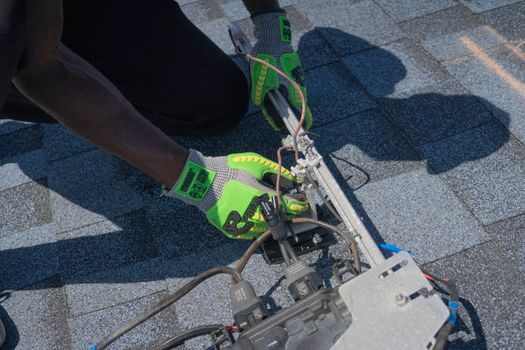
Hand tools for PP 9-12 mm band run at 80-150 N tension and 1.0-1.5 s seal time on commodity-grade PP, while battery tools for PET 12-19 mm run 1,500-3,500 N tension and 1.5-3.0 s friction-weld time; using a PP tool on PET will under-tension and over-heat the joint [S3].
Automatic strapping machine heads cycle at 25-35 straps/minute on 12 mm PP and 18-25 straps/minute on 16 mm PET, and any seal-time or tension drift above ±5% from setpoint usually traces to a worn cam or heater element, not strap variability [S3][S7].
Full-automatic PET/PP strap production line winders in current OEM builds use touch-screen HMI and can hold coil diameter tolerance to ±2 mm, which directly controls the strap payoff tension on the machine head and reduces misfeed alarms during long shift runs [S7].
Standards, Sourcing Signals, and Cost Benchmarks
Inner Mongolia and Ningbo OEM clusters show 2 and 6 audited strapping-band factories on the Made-in-China supplier index, with 6 and 18 products respectively, indicating Ningbo as the higher-variety cluster for buyers needing multiple width and colour SKUs in one shipment [S2][S5].
Commodity PP band export pricing on the 2026 Made-in-China trade listing is US$ 14.00-20.00 per roll at 1-roll MOQ with SGS factory audit, and OEM/ODM production is widely available in 5 mm width — the narrowest in current production and offering up to 7,000 m of strap per roll for high-volume low-break-strength lines [S1][S3].
For buyers comparing full packaging lines, the Stretch Film Types and Classifications spec map pairs directly with PET strapping for pallet stabilisation, and the strapping band encyclopedia entry gives the material property reference for sourcing specs.
Spec-level background on the components involved: linear guide.