
Specifying a strapping machine begins with three measurable load facts: package weight, bundle footprint, and required cycles per shift — these drive strap width (typically 1/4" to 5/8" for PP, 1/2" to 3/4" for PET), tension range, and the choice between semi-automatic bench units and fully automatic inline heads [S5].
The ULINE H-959 polypropylene bench unit, for example, dispenses up to 17 straps per minute at 110 V, accepts 8" × 8" or 9" × 8" cores, and tensions 10–100 lb packages on strap widths from 1/4" through 5/8" [S5]. For higher throughput, automatic inline systems such as the ISG Pack Speed Strap 505P-509P-512P series are specified for logistics, cardboard, parcel, magazine, newspaper, and metal-strap applications, sitting inside end-of-line packaging cells [S1].
The practical decision is rarely "which brand" — it is whether the unit is standalone bench, integrated inline, or a with-press arch system, because each tier changes the architecture of the upstream conveyor and the downstream palletizer. A bench unit like the polypropylene strapping machine only needs a 110 V outlet and a hand feed; a fully automatic inline head must handshake with the line PLC and the sealer/heat-weld station [S4][S5].
Load, Footprint and Throughput Inputs
Package weight drives the tension specification directly: light parcel work below 30 kg is usually covered by PP strap at 1/4"–3/8" width, while pallet loads above 500 kg shift the spec to PET at 1/2"–3/4" with correspondingly higher break-strength ratings. ULINE publishes a 10–100 lb tension window for its H-959 PP bench machine, which aligns with the typical break-strength window of 12 mm PP strap [S5].
Bundle footprint dictates arch size on automatic machines. DirectIndustry's "strapping machine with press" category lists 33 products across 15 manufacturers, with arch interiors sized to the largest carton face plus 50–100 mm clearance for strap feed [S2]. The magazine/newspaper category narrows the search to 20 products from 6 manufacturers, where narrow-profile arches match the small footprint of printed bundles [S3].
Throughput separates the tiers cleanly: bench semi-automatic units run 10–17 cycles/min on operator-paced work, while inline automatic heads in the Speed Strap 505P-509P-512P range are rated for continuous line operation with cycle times governed by strap path length, not operator feed [S1][S5]. For plants that need a side-by-side read on tension, seal type, and arch geometry, the strapping band reference covers material grades and break-strength ranges that feed the tension selection.
Strap Material, Width and Seal Method
Polypropylene (PP) is the default for light-to-medium carton and parcel work: it heat-welds without metal seals, runs on 1/4"–5/8" widths, and feeds from 8" or 9" cores on machines such as the H-959 [S5]. PET (polyester) is specified where higher break strength and retained tension under load are required — typically pallet loads, brick bundles, and lumber — and uses 1/2"–3/4" widths.
Seal type is a hard constraint, not a preference. PP strap heat-welds via a heated jaw, eliminating the consumable metal seal; the H-959 explicitly notes "heat weld — no seals required" [S5]. PET and steel strap generally use a notch-weld or metal-buckle seal, which adds a consumable cost line and a different maintenance interval for the sealing head.
Strap path geometry is a separate spec: the Illinois Tool Works patent on a strap path access guide describes a feed assembly, chute, and strapping head arranged so two courses of strap can be positioned, tensioned and sealed around a load, which is the architecture that any inline strapping machine head still follows in 2026. When the spec calls for metal strap on profiles or extrusions, the strap path must be sized for the larger coil diameter and the heavier tensioner.
Automation Tier and Line Integration
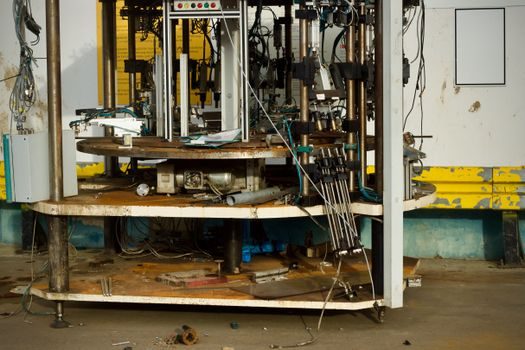
Semi-automatic strapping machines are controlled by a single-chip microcomputer and run standalone, so they have no upstream communication requirement — an operator places the package, hits the cycle start, and the machine tensions, seals, and cuts [S4]. These are the right tool for low-volume dispatch areas, batch work, and any cell where the operator already handles the package multiple times.
Fully automatic strapping machines are designed for inline production cells and need a defined communication interface with the line PLC, the infeed conveyor, and the downstream bundle handling. The coordination problem is linkage of multiple devices, not just a cycle start signal — cycle initiation, strap-low detection, head-fault, and seal-temperature interlocks all need to be visible to the cell controller [S4].
Integration drives the spec: a packaging line that already runs a coding machine and a stretch wrapper usually specifies a fully automatic arch with press, which is the "with press" sub-category on DirectIndustry covering 33 products from 15 manufacturers [S2]. Plants that bundle printed products such as magazines and newspapers narrow the search to 20 specialist machines from 6 manufacturers, where the arch and feed geometry are matched to the small bundle face [S3].
Comparison of Strapping Machine Types
Four decision criteria line up the three dominant types for a quick selection read: tension range, cycle speed, footprint, and integration depth. [S1]
Semi-automatic bench units (e.g. ULINE H-959) deliver 10–17 straps/min, tension 10–100 lb, accept PP 1/4"–5/8" strap from 8" or 9" cores at 110 V, and need no PLC link — suited to operator-paced dispatch cells [S5]. Automatic inline arches (e.g. ISG Speed Strap 505P-509P-512P) deliver higher continuous cycle rates, accept PP or PET across the standard width range, and require PLC handshake for line integration [S1]. With-press arch systems add a compression platen for soft or unstable loads and cover the 33-product, 15-manufacturer space on DirectIndustry [S2]. Magazine/newspaper specialist machines narrow the arch and feed geometry to printed bundles, covering 20 products from 6 manufacturers [S3].
For most general logistics work the bench-to-inline step is the right axis; the with-press option only earns its premium when the load is compressible and the bundle settles during transit.
Application Fit and Industry Use
Strapping machines hold boxes, packages, and bundles tight for shipping, and the end-use industry dictates the spec branch: corrugated shippers, newspaper and magazine stacks, lumber and brick bundles, metal profiles, and palletized consumer goods all use the same core mechanism but different arch sizes, strap widths, and tension ranges [S6].
ISG Pack's Speed Strap 505P-509P-512P series explicitly targets logistics, cardboard, cartons, parcel, books, packaging, clothing, boxes, production lines, paper, magazines/newspapers, profiles, and metal-strap work — a list that maps almost the full industrial strapping market onto a single OEM's lineup [S1]. Humboldt Verpackungstechnik, Transpak, DONGGUAN Xutian, Qingdao Ausense, Shandong Dyehome, Jangzin, Jerpackungstechnik, and Reisopack round out the manufacturer set in the press-fitted and standard automatic categories [S2][S3].
Plants that already run CNC workcells or gantry crane handling should treat the strapper as one node in a larger material-flow spec — a CNC machine price trend and 2026 outlook read or a gantry crane selection exercise touches the same duty-class and cycle-rate logic, even though the equipment is different. A bundle leaving the strapper feeds directly into a palletizer or stretch wrapper, so the upstream machine's cycle time is the binding constraint, not the strapper's nameplate rate.
Limitations, Failure Modes and Sourcing Signals
Three failure modes dominate field reports. First, heat-weld temperature drift on PP heads — the seal cools below spec and the joint slips under tension; the cure is a thermocouple check and jaw replacement at the 6-month service interval that ULINE publishes as standard [S5]. Second, strap path misalignment on inline heads — the Illinois Tool Works access-guide patent exists specifically because misalignment between the feed assembly, chute, and sealing head causes jams and mis-seals. Third, communication dropouts on fully automatic lines when the PLC handshake is underspecified; semi-automatic units sidestep this entirely [S4].
Sourcing signals to track in 2026: manufacturer count in the with-press category is steady at 15 with 33 products, and in the magazine/newspaper niche at 6 with 20 products — flat supplier bases mean lead times follow strap and motor component supply, not OEM capacity [S2][S3]. The ISG Pack Speed Strap family and the H-959 PP bench unit are both actively listed with 2026-dated product pages, indicating current production rather than legacy stock [S1][S5].
Track the next two nodes for a verifiable re-read: (1) the strapping band material-grade page for break-strength vs temperature behavior, and (2) any 2026 update to the Speed Strap 505P-509P-512P cycle-rate figures as ISG Pack refreshes the product sheet.
For component-level specifications, see linear guide.