A 10-year total cost of ownership model for an industrial strapping machine line is dominated by recurring spend — strap consumables, energy, preventive maintenance, and unplanned downtime — not by the headline capital outlay of the machine itself [S1][S5]. Procurement teams that price only the equipment invoice typically underestimate lifecycle cost by a wide margin because strap, service hours, and lost throughput are booked to separate cost centers.
Scope of this analysis: PP and PET arch, side-seal, and bottom-seal machines in the 10–60 cycles-per-minute class, plus the matching strapping band consumables, applied to bundling, palletising, and corrugated-line duty. The model below aligns with the four-cost-driver framework used in related equipment TCO work, including wrapping machine TCO studies.
Four Cost Drivers That Move the 10-Year Number
Capital cost, strap consumables, energy and air, and service labor are the four line items that move the 10-year number; a fifth, often hidden, is downtime cost per stop [S5]. EAM-Mosca positions its ROMS-6H strapping line as a "lowest-total-cost supplier," claiming a customer case at 300 cabinets per eight-hour shift with output-per-employee running ten times the prior baseline — a productivity delta that dwarfs the equipment invoice [S3]. The point is structural: capex is one line among five, and on a busy line it is rarely the largest.
The USPS TCO framework used for capital planning defines TCO as "the total cost incurred over the life cycle of an item, encompassing purchase, use, maintenance, support, and disposal" and explicitly states that "a TCO analysis exposes the hidden costs easily overlooked during budget planning" [S5]. That definition maps cleanly onto a strapping line: purchase = machine + installation, use = strap + energy + air, maintenance = PM kits and wear parts, support = service contracts, disposal = end-of-life strip-down. METTLER TOLEDO's TCO methodology adds the discipline of separating acquisition, operation, and quality/compliance costs to prevent silo budgeting [S1].
Cost-Driver Breakdown: What Actually Moves the Number
Driver 1 — Strap consumables: machine-grade PP and PET strap is the single largest recurring line, sized by strap width, thickness, meters-per-bundle, and cycles-per-shift. Polyester is specified for higher-tension, sharp-edge, or load-bearing pallet applications; polypropylene covers general bundling at lower cost-per-meter. The strapping band choice is therefore a TCO decision, not a packaging decision, because mismatch between arch tension class and strap grade drives both strap waste and seal failures [S3].
Driver 2 — Energy and compressed air: heat-seal and friction-weld heads draw peak kW on every cycle; pneumatic machines add compressed-air load sized in liters per cycle at line pressure. A 30-cycle-per-minute heat-seal unit running two shifts at 4,800 hours per year is a measurable line on the energy bill. This line scales with duty cycle, so a spec that doubles output without a matching air-compressor upgrade quietly inflates operating cost [S1][S5].
Driver 3 — Maintenance and wear parts: belts, seal-heater elements, cutting blades, and guides are scheduled-replacement items. EAM-Mosca cites "toolless guides" and reduced parts-replacement frequency as design choices that lower maintenance cost over the cycle [S3]. The qualitative pattern: machines with modular sub-assemblies and accessible wear zones drive lower service hours per year than fully enclosed architectures with proprietary cartridges.
Driver 4 — Service labor and contracts: vendor field-service rates vary by region; the cheaper the capex quote, the more carefully the regional service-coverage map needs auditing. METTLER TOLEDO frames service as a TCO line item that should be evaluated on response time, parts availability, and calibration cadence, not on sticker price [S1]. Downtime cost is the bridge: every hour of unplanned stop on a high-throughput line has a throughput-equivalent value that easily exceeds an entire year of service-contract fees [S5].
Spec-to-Cost Map: Arch Type vs Application vs Cost Profile
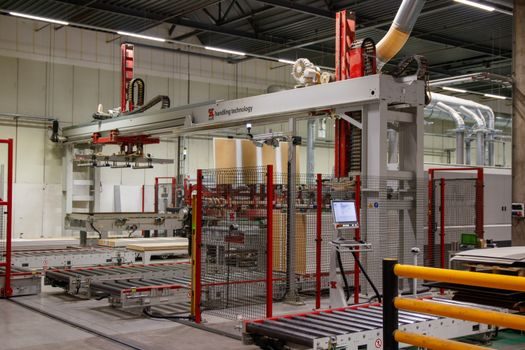
Arch strapping is sized by arch opening (W × H) and tension class; side-seal and bottom-seal machines trade arch access for footprint and tension uniformity. Throughput class, seal method (heat-seal vs friction-weld), and strap grade together fix the TCO curve: a heat-seal PP arch on a corrugated bundling line is the low-capex, moderate-consumables profile; a friction-weld PET arch on a pallet line is the high-capex, low-strap-waste profile [S3].
For buyers comparing options against a 10-year horizon, the spec-to-cost map reads approximately as: (a) manual or semi-automatic PP arch — low capex, high labor cost per bundle, suited to low-volume bundling; (b) automatic PP side-seal — mid capex, mid consumables, suited to mailroom, print, and e-commerce fulfillment; (c) automatic PET pallet arch — high capex, low consumables-per-pallet, suited to load-secure applications. EAM-Mosca's "lowest-total-cost supplier" claim sits in the third bucket, where the capex premium is recovered over high cycle counts [S3].
Selection rule: do not let capex pick the machine. Pick the strap grade and arch opening that match the product, then read the consumables-plus-energy line over the planned 10-year cycle. That single inversion usually moves the winner off the cheapest quote.
Options Compared Against Decision Criteria
Four machine families on four decision criteria: PP arch (semi-auto) vs PP side-seal (auto) vs PET arch (auto) vs PET pallet ring. Capex ranking: lowest to highest in the order listed. Strap-cost-per-bundle: PP is roughly half PET per meter, but PET uses fewer straps per pallet at higher tension — net strap-cost per secured unit is application-dependent [S3]. Energy/air: heat-seal PP draws less peak kW than friction-weld PET; pneumatic PET systems add the largest air load. Service hours per year: lower on modular arch designs with documented wear-part kits, higher on proprietary-cartridge architectures [S1][S3].
For high-throughput pallet securement, the PET arch with a regional service footprint typically wins on 10-year TCO despite higher capex, because strap efficiency and downtime cost dominate the model. For low-throughput bundling, the semi-auto PP arch wins because labor and capex are the binding constraints. The middle of the market — automatic PP side-seal — is where capex and consumables are most often mis-priced against each other; this is the segment where the strapping machine selection most often goes wrong.
Who TCO Modeling Is For — and Who Should Skip It
TCO modeling pays off for any line running more than one shift, any application with sharp-edge or high-tension requirements, and any buyer whose strap and maintenance budgets live outside the capex approval chain. The structured framework published by USPS — "exposes the hidden costs easily overlooked during budget planning" — is built precisely for these cross-cost-center decisions [S5].
Skip the formal TCO exercise when the line is single-shift, low-volume, and the strap grade is already standardised. For a one-shift bundling cell on commodity PP, a capex-only comparison plus a 5-year strap spend estimate is sufficient. The cost of running the full model exceeds the savings at that scale.
Limitations, Failure Modes, and Common Mistakes
The dominant failure mode in TCO modeling for strapping is mis-mapping duty cycle: buyers specify a 30-cycle-per-minute machine and run it at 45 cycles because the upstream conveyor feeds faster. Energy, wear-part life, and service intervals all derate non-linearly above the rated cycle, so the actual TCO exceeds the model. A second failure mode is ignoring strap-grade compatibility: PET strap run through a heat-seal-only head wastes strap and produces unreliable seals; PP strap run through a friction-weld head set for PET produces weak joints. [S3]
Common spec mistakes: under-sized arch opening (forces operators to hand-feed, which adds labor cost and defeats the machine's purpose); mismatched seal method to strap grade; undersized air supply on pneumatic machines; service contract priced on capex percentage rather than response-time SLA. The METTLER TOLEDO TCO discipline of separating acquisition, operation, and quality costs is the cleanest defense against all four [S1].
Standards, Sourcing Discipline, and Trackable Signals
No single ISO or ASTM standard governs "strapping machine TCO" as a number; the discipline is built from equipment specs, strap-grade data sheets, vendor service terms, and site energy/air measurements. Track the inputs: arch opening, tension class, cycles per minute, seal method, strap grade, strap width and thickness, peak kW, L/cycle at line pressure, regional service response time, and PM interval. The outputs follow from the inputs plus the duty-cycle assumption [S1][S5].
Trackable signals over the next procurement cycle: vendor-published service-coverage maps (posture changes are public), strap-grade price index moves on PP and PET resin, and any new regional service-parts depots. The EAM-Mosca public line — "lowest-total-cost supplier" framed around "lower maintenance costs, minimize parts replacement, improve productivity" — is a marketing claim to test against your own duty cycle, not a TCO number to import [S3]. For reference, the structured approach used in pile driver TCO modeling applies the same four-cost-driver logic to a different machine class and is a useful cross-check on the method.
The underlying component specifications are covered under total station.