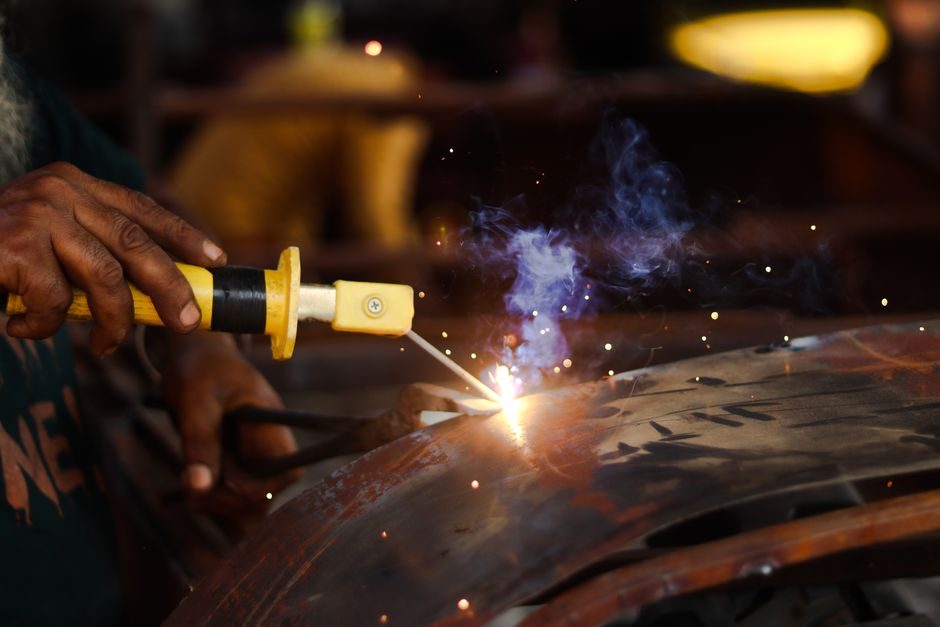
Stud welding selection starts with the stud diameter range and base-material combination the process must serve, because a machine rated for M6 draw-arc studs on mild steel will not survive a production mix that includes M16 stainless shear connectors.
Once diameter and base material are fixed, duty cycle and process family (drawn-arc, short-cycle, capacitor-discharge or stud welding basics) drive every downstream cost — from gun weight and operator fatigue to rectifier sizing and stick-out tolerance on the shop floor.
Gate 1 — Stud diameter, base material and process family
Capacitor-discharge (CD) stud welds are limited to roughly M3–M10, low-carbon and zinc-coated steels with weld times under 10 ms; the same CD gun cannot reliably set a M12 structural stud on ASTM A36 plate stud welding process family.
Short-cycle drawn-arc lives in the M4–M12 window and is the usual compromise when the floor needs thinner base metal than full DA allows.
Cross-reference the stud material chemistry against the base-material allowables up front: austenitic stainless studs on hot-dip galvanised plate need a ferrule-grade and gas program that plain-carbon stud-on-A36 does not. If the production mix includes aluminium or dissimilar-metal studs, the stud welding process family narrows further and the gun, chuck and gas-cup layout must be re-validated.
Gate 2 — Duty cycle, weld time and rectifier sizing
Stud welder duty cycle is stated as a percentage of a 10-minute window at a given current; a 20 kVA DA unit rated 400 studs/hour at M12 sits well above a 12 kVA unit's continuous current at the same stud, and the difference shows up as thermal trip during back-to-back shift work.
Weld time on drawn-arc is typically 200–1500 ms depending on stud diameter; CD welds at 1–10 ms. Longer weld times demand tighter stick-out control (usually 1.5–3 mm for DA), so the gun suspension, leg length and counterbalance become part of the spec, not accessories.
For high-mix, low-volume fabricators the duty-cycle headroom matters less than the range of programmable current and time profiles; for shipyards and bridge shops the headroom is the spec, because a thermal trip on the third bay is a schedule slip, not an inconvenience.
Gate 3 — Power supply, control and monitoring

Modern stud welding power supplies are inverter-based, programmable in current and time over a touchscreen, and log the last 10,000+ welds with current, time and voltage traces; the welding power topology and TIG-style arc-control language used in modern inverter supplies is the same control vocabulary an audit inspector expects on a PWHT traceability sheet.
For hazardous-area or coated-steel work, the stud welding control cabinet must be sited outside the hazardous zone, with only the gun and stud feed in the classified area; ATEX 2014/34/EU and IECEx certification paths are the two routes most European and Middle East EPCs accept, and the certification scope must cover the gun and chuck, not only the cabinet.
Open-architecture control also lets the same machine run DA, short-cycle and CD with a weld-program change, which is the difference between one flexible asset and three dedicated ones on the shop floor.
Gate 4 — Gun ergonomics, chuck range and consumables
Gun weight above roughly 2.5 kg with a loaded stud turns a full shift into a productivity problem; pistol-grip CD guns for sheet-metal work sit at 0.8–1.5 kg, while DA guns for M16+ shear studs land at 3.5–6 kg before the leg and foot ring are fitted.
Chuck range must cover the full stud diameter mix without an adapter change per shift — a chuck that takes M6–M12 directly saves 30–60 seconds per changeover and several kA of misalignment risk on the next weld.
A 50,000-stud annual programme burns through ferrules as a line-item cost, not a consumable rounding error.
Comparison: CD vs short-cycle DA vs full drawn-arc
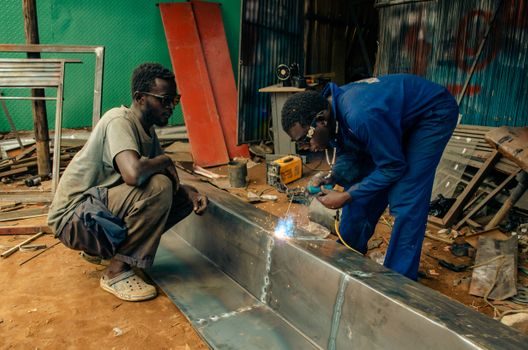
Across the four decision criteria the three main process families line up as follows. CD wins on thin sheet (≤4 mm), short weld time and minimal heat tint, but loses on stud diameter ceiling and base-material range. Short-cycle DA covers thin-to-medium plate and M4–M12 studs with or without gas, sitting between the two extremes. Full DA owns the structural range (M6–M25) and the broadest material envelope, at the cost of higher capital, heavier guns and ferrile consumables.
For plants mixing sheet-metal cabinets with occasional structural shear studs, an inverter supply with both CD and short-cycle programs is usually the right balance. For pure structural fabrication — bridges, ship hulls, electroslag pressure-welded heavy sections where shear studs are added later — full DA is the only honest answer.
Limits, failure modes and standards anchors
The dominant failure modes on a stud welding line are insufficient current (cold welds, low torque), excessive current (burn-through, porosity, base-metal distortion) and misalignment of the stud (poor fillet, low tensile strength). Each of these shows up in the weld-log trace as a current or time excursion, which is why a programmable inverter with logging is no longer optional on structural work.
AWS D1.1 structural welding code and AWS C5.4 cover stud welding acceptance criteria, including torque testing and bend testing of production welds, and the corresponding ISO 14555 framework is the European reference most EPC specs cite. For sour-service or offshore work, NACE MR0175 applies to the stud material selection, not the welding process itself, and that gate must be cleared before the stud supplier is even contacted.
Use cases, who it is FOR and who it is NOT for
Stud welder selection is FOR fabricators running repetitive stud-to-plate joints at volumes above roughly 5,000 welds per year, EPCs needing PWHT-traceable weld logs for structural work, and maintenance crews attaching wear plates, insulation pins or grounding lugs in the field.
It is NOT for one-off prototype welds where a handheld TIG or TIG welder covers the same joint without the tooling overhead, and it is not the right process for fatigue-critical lap joints where the design code calls for full-penetration welds rather than stud fasteners.
The Stud Welder Buying Guide 2026 lays out process-family and duty-cycle selection in matching detail, and is the natural companion read when a spec engineer is building a side-by-side comparison sheet for procurement.
Track these signals before the next PO: published weld-log retention policy in the OEM datasheet, ATEX/IECEx certificate scope (gun plus chuck, not just cabinet), and a written consumable cost-per-stud figure that includes ferrules, gas and tips at the actual duty cycle the line will run.