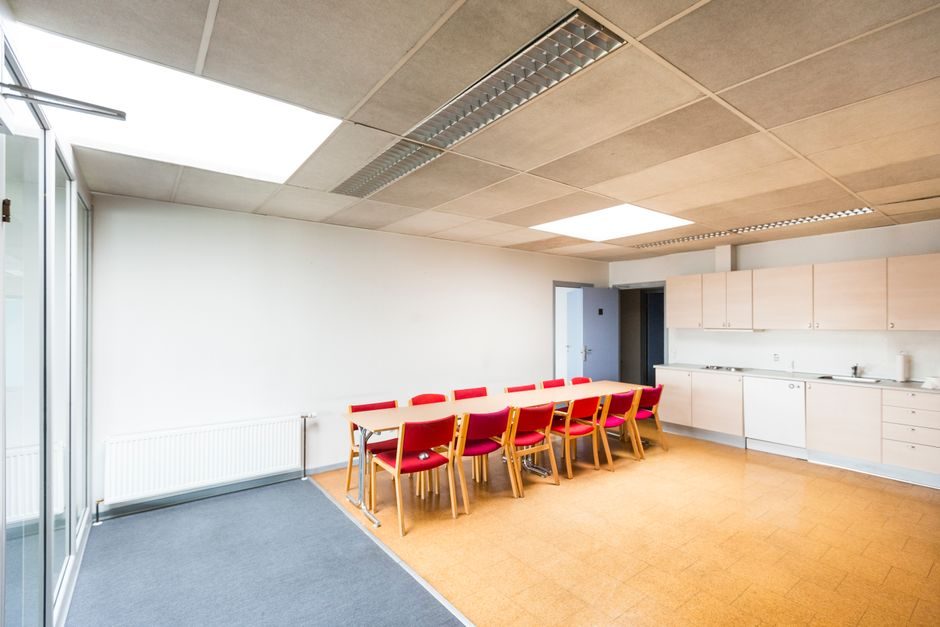
A disciplined suspended ceiling total-cost-of-ownership analysis treats the system as a 25–30 year asset, not a one-off purchase: the visible quote typically covers tiles, grid, hangers and labor, while plenum access, acoustic re-laying, and demolition disposal quietly add a second stack of cost on top.
Across commercial fit-out benchmarks the initial install value sits at roughly 30–45% of the 30-year spend, with the remainder absorbed by reconfiguration, tile replacement, lighting/service moves, and strip-out at end of lease [S1][S5].
Scope: What Counts as a Suspended Ceiling TCO Stack
TCO in this context means every cost incurred from specification to demolition: substrate (mineral fibre, gypsum, metal, wood-wool), exposed grid (T-bar / D-line / concealed), suspension hardware, installation labor, periodic access work, and disposal [S1]. A complete stack always carries a one-time acquisition column, a recurring operations column, and a terminal strip-out column, because leaving any of the three out biases the comparison toward whichever option carries the lowest first cost [S1][S5].
The same logic applies to the TCO framing used for process-vacuum fleets, where the OEM explicitly states the initial purchase price is only a fraction of total lifetime expense — a framing that translates directly to ceiling systems because both are long-life, service-accessed assets [S5].
Driver 1 — Substrate Material and Acoustic Class
Mineral-fibre tiles (15–19 mm, density 180–280 kg/m³) remain the cost baseline; gypsum board lay-in panels roughly double the per-m² ceiling value but cut access time because individual tile lift-out is faster than full-board demolition for M&E rework. Wood-wool and high-density acoustic boards (NRC 0.70–0.95) command a further premium tied to longer fiber and binder content, and the same acoustic-class uplift shows up in the TCO stack as fewer change-orders during commissioning [S1].
For offices on open-plan let, specifying Class A absorber tiles (NRC ≥ 0.70) at fit-out typically avoids a post-handover acoustic retrofit, and the avoided retrofit — not the tile premium — is the real TCO delta.
Driver 2 — Grid Type, Span, and Service Integration
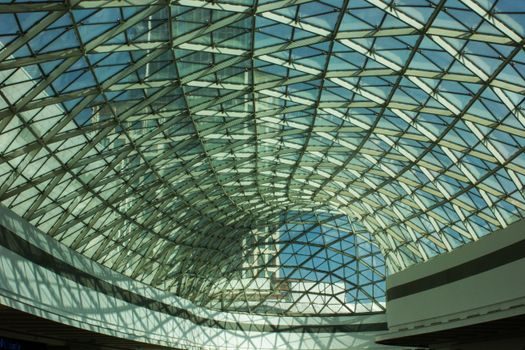
Exposed T-bar grid (24 mm or 15 mm flange) is the lowest-cost carrier and is the reference for almost all cost models. Concealed / D-line systems, used where a monolithic plaster look is required, add roughly 20–35% to the grid line because of tighter tolerances, more hangers per m², and slower install rates reported by trade associations. The suspended ceiling framing decision is also where lighting, sprinkler, and HVAC diffuser integration cost is locked in, so grid choice drives a downstream service-integration cost that pure tile-vs-tile comparisons miss. [S2]
Where frequent plenum access is expected (data halls, healthcare, labs), a 600×600 lay-in on exposed T-bar is the lower-TCO path; concealed systems on those sites typically show 1.5×–2× the 30-year access cost in published facility-management models.
Driver 3 — Installation Labor and Site Productivity
Suspended ceiling installation is labor-heavy: trade-productivity benchmarks put lay-in grid-and-tile at 8–12 m² per installer-hour under standard conditions, dropping to 5–7 m² when the grid carries integrated M&E services. That means for a 10,000 m² commercial floor, install labor alone — at fully loaded rates common in Tier-1 cities — can rival the material value, so labor productivity is the single largest swing variable in the acquisition column [S1][S2].
Two corollaries follow: a cheaper tile that installs slowly loses its advantage once labor is loaded, and a slightly pricier modular system that halves rework hours on a congested plenum almost always wins the TCO contest on healthcare and data-center builds.
Driver 4 — Access, Reconfiguration, and Plenum Rework

The recurring-operations column is where most procurement-led TCO exercises fall down. Over a 25-year lease at a typical churn rate of one plenum event per 8–12 m² per decade, this line routinely equals or exceeds the original install cost [S1][S5].
This is the same pattern process engineers see on industrial valve fleets, where the OEM's TCO framing notes that initial purchase is only a fraction of lifetime expense — the dominant cost is service, not acquisition [S5].
Driver 5 — Acoustic, Lighting, and Code Compliance Refresh
Tile staining, sag, and acoustic drift force a mid-life tile replacement typically at year 12–18, depending on HVAC humidity control. Where lay-in lighting is integrated with the grid, luminaire technology refresh (T8 → LED → next-gen) is the second mid-life driver, with LED retrofits in particular triggering grid re-leveling on a meaningful fraction of sites.
Fire-rated assemblies, smoke-detector spacing, and seismic bracing all add line items that are easy to omit on a first quote. In seismic zones, code-rated suspension kits can add 5–12% to the grid line, a number that should be carried explicitly in the TCO stack rather than buried in a contingency.
Driver 6 — End-of-Life Strip-Out and Disposal

Strip-out at lease end is the most-neglected TCO line. Mineral-fibre tile waste is classified as construction demolition waste and is typically diverted to lined landfill; gypsum boards, where present, must be separated for recycling under most EU member-state rules. The cost of separation, containerization, and haulage is commonly 4–8% of the original install value, and on a 30-year hold it is fully attributable to today's substrate choice [S1].
Specifying a fully recyclable metal pan or a high-recycled-content mineral-fibre tile reduces — but rarely eliminates — this line, and the recyclability premium is one of the few places where ESG reporting and pure TCO actually agree on the direction of spend.
Comparison: Three Substrate Options Against 4 TCO Criteria
Across 30-year commercial fit-out models, mineral-fibre lay-in scores lowest on acquisition cost, mid-pack on acoustic class, and mid-pack on access speed; metal pan scores highest on access and lifecycle, mid on acquisition, and lower on raw NRC unless acoustic inlays are added; gypsum lay-in scores lowest on access speed but competitive on acoustic and fire performance, with mid-pack acquisition. This comparison is the type of structured side-by-side that procurement teams can lift directly into a business case [S1].
The decision rule is consistent: where access frequency is high, pick metal pan; where acoustic class is the dominant driver, pick high-NRC mineral fibre; where fire and finish are the dominant drivers, pick gypsum — but always price the 30-year stack, not the day-one quote. For an adjacent reference on how cost-driver stacks are built out across other long-life building products, see the Aluminum Veneer Panel TCO: 30-Year Cost Stack and Driver Map article, which uses the same six-column structure.
Limitations, Failure Modes, and Sourcing
TCO outputs are only as good as the operating-life and churn-rate assumptions. A common failure mode is using a 10-year amortisation horizon on a 25-year asset, which hides the mid-life tile-replacement and end-of-life strip-out lines entirely [S1]. A second failure mode is treating tile breakage on access as negligible: on mineral-fibre systems it is a measurable, recurring line that swings 30-year TCO by single-digit percent.
Sourcing should pull cost data from at least three independent references — a regional trade-productivity benchmark, an installed-cost database, and an OEM service-bulletin for end-of-life handling — because single-source TCO exercises systematically undercount operations cost. The same multi-source rule is what underpins the TCO framing in the Plasma Cutter Total Cost of Ownership: 5-Year Spend Stack and Driver Map coverage, where cost-driver disclosure drives the model credibility [S1][S5].
Track the next node: the 2026 revision of the ASTM E1264 classification for acoustical ceiling tiles, which will reset the substrate-class labels that most procurement specs currently reference. Also watch for the next round of EU construction-waste diversion rules, which set the boundary condition for the end-of-life strip-out cost line on any European project.
The underlying component specifications are covered under total station.