
For low-rise masonry, a hydraulic work platform such as the LISSMAC MAB 1201 carries 1,200 kg, lifts between 0.48 and 1.99 m, and runs on 230 V or 400 V single-phase / three-phase power at a rated speed of 1.5 m/min [S1].
For facade masonry on mid- and high-rise buildings, two-point adjustable suspended scaffolds (swing stages) typically span 12 to 40 feet and rate 500 to 1,000 lb of payload, suspended from outrigger beams with counterweights [S2]. Selection must balance these two equipment families against building height, roof anchor capacity, and the compliance regime in force (EN 1808 in the EU, OSHA 1926.450-454 in the US) [S3][S4].
Equipment Families: Hydraulic Masonry Platforms vs Rope-Suspended Stages
A masonry work platform is a ground-riding, scissors- or cylinder-lifted deck that climbs with the wall, optimised for laying block and brick on houses, industrial buildings, and structural frames; the MAB 1201 weighs 590 kg, measures 1.32 m wide x 1.85 m long (3.6 m with extendable side catwalks), and maintains constant load capacity over its full lifting stroke thanks to a symmetrical double-acting hydraulic cylinder [S1].
A suspended scaffold is a rope- or cable-hung deck whose height is set by hoists on the platform, used where ground-riding access is impossible (occupied facades, narrow streets, tall buildings) [S2]. Two-point systems are the workhorse for masonry restoration and stucco work, single-point platforms handle one- or two-worker spot repairs, and multi-point suspended platforms span wide facades on buildings with uneven parapet lines [S2][S4]. A mast climbing work platform (MCWP) is a third option, ground-supported but climbing a fixed mast; for very tall structures it competes with suspended systems on base-footprint availability and lateral load capacity rather than on raw lifting height [S4].
Selection Criteria: Height, Load, Rigging, and Site Footprint
Below roughly two storeys of working height, the hydraulic masonry work platform wins on speed, cost, and simplicity: the MAB 1201 sets up quickly, moves with the wall, and needs no roof anchor; per Machinery Directive 2006/42/EC, it must always be operated with railings fitted [S1]. Above the first few floors, rope-suspended platforms become the only practical access because the masonry deck cannot economically climb beyond its cylinder stroke and the building's roof can carry the rigging.
Load drives the spec sheet: 1,200 kg on the MAB 1201 is enough for a pallet of blocks plus two masons and mortar tubs, while a 500-1,000 lb swing stage covers two workers with hand tools and small materials only [S1][S2]. A deck rated per worker at 150 kg per extraction point (MAB 1201's per-point figure) tells you how concentrated the load can be on each support [S1]. Material choice then narrows: an aluminium suspended platform cuts dead weight to ease roof rigging, whereas a modular steel industrial platform scales up for heavier payloads and longer spans [S4].
Rigging feasibility often decides the call. Two-point suspended scaffolds need outrigger beams projecting past the parapet, locked back with counterweights or through-bolts; the host structure must be engineered for the dynamic load, and a controlled access zone or sidewalk shed is required at grade [S2][S4]. Where the roof cannot take the reaction, the mast climbing work platform becomes the fallback because it loads the ground, not the building [S4].
Compliance Frameworks: EN 1808 and OSHA 1926 Subpart L
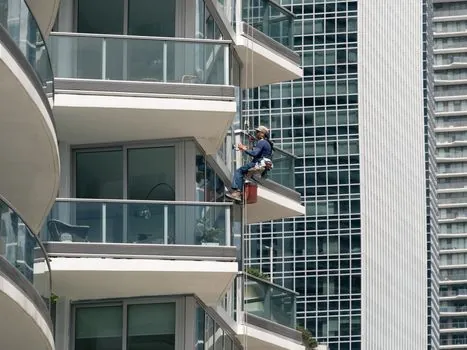
Suspended access equipment in the EU is governed by EN 1808, which covers safety requirements for suspended access equipment and the related machinery directive compliance; in the US, OSHA 1926.450-454 (Subpart L) governs scaffolds, with Subpart M (fall protection) layered on top [S4]. Daily safety inspections, redundant fall-arrest systems, structural calculation reports, and third-party certifications are baseline requirements any reputable manufacturer should provide [S4].
The Machinery Directive 2006/42/EC governs the masonry work platform on the European side and is the reason railings are non-optional on the MAB 1201, including for in-plant use and for any platform sold into the EU [S1]. Local code (municipal facade-maintenance rules, US state OSHA-approved plans, GB 19154 in China) may add wind-speed cut-offs, rated rope diameters, or secondary brake requirements; the specifier must stack them, not pick one.
Comparison: Main Platform Types Against Decision Criteria
The three realistic options for masonry work line up as follows: a hydraulic masonry work platform (MAB 1201 class) handles 0 to ~2 m lift heights, 1,200 kg load, 1.5 m/min speed, 230/400 V supply, and zero roof rigging; a two-point suspended swing stage covers 5 to 100+ m working heights, 500-1,000 lb (about 225-450 kg) load, variable rope speed, and full EN 1808 / OSHA compliance plus outrigger rigging; a mast climbing work platform sits in between, climbing a fixed mast from a ground base, with greater payload and lateral capacity than a swing stage but a larger ground footprint [S1][S2][S4].
Use the hydraulic masonry deck when the building is low, the site has slab space at grade, and the work follows the wall upward. Use the two-point suspended stage when ground space is constrained, the building is mid- or high-rise, and the roof can be engineered for outrigger reaction. Use the mast climber when the building is too tall for scaffolding but the roof cannot accept rigging, accepting a larger ground footprint in exchange [S4].
Use Cases and Failure Modes
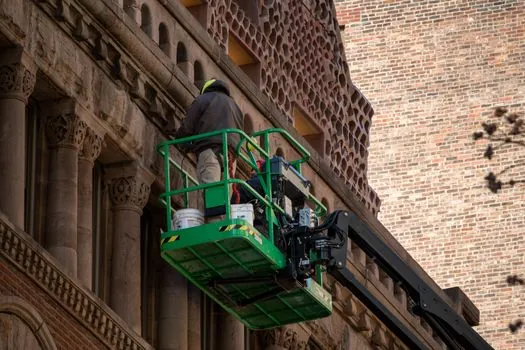
Masonry restoration on a 12-storey occupied facade is the canonical suspended-platform job: the two-point swing stage gives crews continuous vertical access without blocking the sidewalk, and 12-40 ft deck lengths are sized to the bay width being repointed [S2]. For new house construction the MAB 1201 follows the masons up the wall, extending to 3.6 m with side catwalks to reach past window openings and corners without dismantling [S1].
The dominant failure modes are roof-side, not platform-side: inadequate outrigger counterweight, parapets not engineered for the reaction load, and missing or undersized secondary brakes on the hoist [S2][S4]. Ground-side failure on hydraulic platforms is mainly instability from uneven slab and missing railings, which is why the MAB 1201 ships with non-slip chequer plate and the railings are mandatory, not optional [S1]. Wind cut-offs and rated rope diameters (commonly 8-10 mm wire rope for two-point stages, with redundancy and a safety factor of 5x or more) are spec-line items, not afterthoughts [S4].
Procurement Reality Check
Vendor vetting should weight structural calculation reports, third-party certifications, and site-specific engineering support over headline rental price, because re-rigging a suspended system after a failed inspection costs more than any upfront saving [S4]. For a masonry work platform on a housing site, ask for the load-capacity curve over the full lift height, the per-point extraction rating, and the EU Machinery Directive 2006/42/EC declaration of conformity before signing the PO [S1].
Two trackable signals into the next quarter: any update to EN 1808 Annex revisions covering multi-point suspended platforms, and the rate at which modular aluminium suspended platforms displace steel units on jobs above 30 m, where the dead-weight saving translates directly into smaller counterweights on the roof [S4]. For related rig-side logic on demolition jobs, see Suspended Platforms for Demolition: Load, Lock, and Anchor Logic; for ground-based lift equipment that pairs with rope platforms, the Suspended Platform Selection for Road Maintenance piece covers the working envelope and rope spec path.
Detailed specification references: suspended platform, masonry insulation, and suspended ceiling.