Interior finishing on a high-rise façade is almost always a ZLP-series temporary suspended working platform (gondola cradle or swing stage), with the four most-quoted 2026 models ZLP500, ZLP630, ZLP800 and ZLP1000 covering 500 kg to 1000 kg rated load at 8.0 to 9.3 m/min lifting speed [S4]. On a 30-storey office project, a 6 m aluminium 6061-alloy platform solved the access problem in place of ground-supported scaffolding, which would have blocked the street and consumed the staging area [S1].
The scope of "interior finishing" here is façade-adjacent, not overhead ceiling grid work: paint, plaster and skim-coat crews, window cleaning, curtain-wall and stone-cladding installation, plus atrium and elevator-shaft soffit work where a compact cradle is the only practical access [S2]. Specifying a cradle starts with four numbers in this order: payload (kg), platform length (m), suspension height (m), and the governing standard (EN 1808 for EU, OSHA 1926.451 for US, GB/T 19155 for China) [S3].
Load Class and Crew Sizing for Finishing Trades
ZLP-series single-basket cradles cluster around 250 kg, 500 kg, 630 kg, and 800 kg nameplate ratings, with the 630 kg class the most quoted mid-range SKU for façade and curtain-wall work, and ZLP1000 reserved for stone panels and heavy glazing carts [S3]. The published 2026 parameters from Wuxi and Okorder datasheets align cleanly: ZLP500 lifts 500 kg at roughly 9.3 m/min with a 1.1 kW hoist motor, ZLP800 lifts 800 kg at 8.0 m/min, and ZLP1000 reaches 1000 kg in the same family [S4].
For a 4-man plastering gang at 100 kg per person plus 80 kg of render, ZLP800 is the minimum credible nameplate; the 1.5x safety margin on crew + materials + tools is the rule, not a marketing line, and dropping to ZLP630 on a 480 kg live load leaves no headroom for the render pallet and the spray rig [S4]. For 2-person crews plus tooling on low-rise façade paint, ZLP500 is the right tool; for 3 to 4 person window-cleaning or plastering gangs the ZLP630 and ZLP800 are the working defaults.
Platform Length Modules and Atrium Geometry
Suspended platforms are built from bolted modules in three stock lengths of 1.3 m, 1.5 m and 1.7 m that combine to spans of 2.6 m up to about 12 m without intermediate suspension cables [S5]. The 1.3 m module exists for elevator shafts, atrium soffits and any location where the working face is broken up by columns or window mullions, which is exactly the interior-finishing geometry on most commercial towers [S5]. Most façade projects fall in the 6 m to 9 m band because that is where the deflection of a standard 3-section deck stays under the 1/500 span limit that EN 1808 considers acceptable for a loaded platform [S5].
Standard modular platform lengths run 1 m, 1.5 m, 2 m, 2.5 m, 3 m, 5 m, and 6 m, joined by bolted end-frames so a contractor can extend from a 2 m window-cleaning basket to a 6 m plastering cradle in the field [S3]. A common spec mistake on interior work is to specify one continuous 9 m platform where three short modules could ride two independent suspension rigs, halving the load on each parapet anchor [S5]. Maximum deck width scales with rated load: a 630 kg cradle typically accepts a 0.7 to 0.8 m deck while a 1000 kg twin-hoist unit can be widened to 1.0 m for masonry-panel crews [S3].
Hoist Class: LTD5, LTD6, LTD8 and the 1.5 kW to 2.2 kW Band
The hoist is the single most expensive replaceable unit on a suspended working platform and the part stamped with a serial plate that cannot be fudged at audit. Catalog data from the 1.7 m platform series maps the hoist to the rated load tier: LTD5 platforms are paired with 5 kN-class hoists, LTD6 with 6 kN-class units, and LTD8 with 8 kN-class units, all driving a single 1.5 kW to 2.2 kW motor at roughly 8 to 9 m/min lifting speed [S5]. Electric wire-rope hoists in the 1.5 kW to 2.2 kW class (LTD-series or equivalent) are the workhorse, pulling the working rope at roughly 8 to 10 m/min; pneumatic and manually operated hoists appear where spark-free or power-free sites dictate the choice [S3].
Selection rule: pick the hoist class first, then the platform length, never the reverse, because the platform and the hoist are CE-typed as a unit under EN 1808 and mixing a 1.7 m platform with an LTD5 hoist will fail a third-party conformity audit [S5]. For ZLP500 the 1.1 kW motor is the published fit; for ZLP800 and ZLP1000 the higher-kW dual-hoist layouts are the published fit, and the platform and hoist are CE-typed as a single assembly under EN 1808, so the configuration must match the type-test dossier [S4][S5].
Suspension Rig: Parapet, Trolley, Davit
The suspension rig is the part buyers most often under-engineer on interior-finishing projects. Three families dominate 2026 catalogs: (a) counterweighted parapet beams in 1.2 m and 1.5 m outreach, which transfer the live load back through ballast blocks of 600 kg to 1,000 kg per side; (b) roof trolleys running on fixed rails for buildings with permanent track cast into the parapet coping; and (c) davit arms with wall-plate anchors for narrow rooftops where counterweight is impossible [S5]. For projects where the platform rides a permanent rail along the parapet coping, the relevant reference architecture is the platform trolley layout, and the wider aerial work platform family covers adjacent working-at-height decisions.
Each rig type interacts with the platform length above it: a 9 m platform on a 1.2 m parapet beam with 800 kg ballast is fine on a 200 mm concrete parapet but will overturn a 100 mm slab [S5]. Suspension height is the vertical drop from the outrigger or parapet support to the working deck, and most catalog suspended platforms are rated for 100 m, 150 m, or 200 m maximum free-hanging height with two independent wire ropes (one working, one safety) [S3]. Standard 100 m lifting height is quoted on Wuxi OEM sheets; for taller buildings a reeving or mid-tie reconfiguration is needed, and the 1.0 m deck on a ZLP1000 must still respect the same parapet-moment check as a 6 m basket [S4].
Wire Rope, Safety Devices, and Standard Compliance
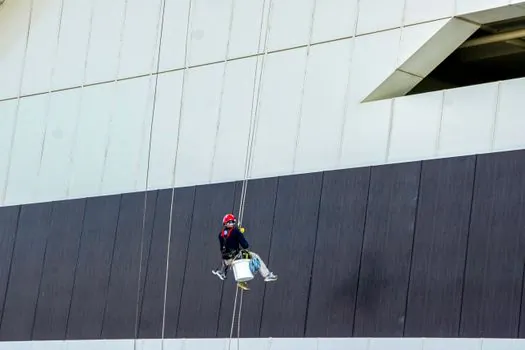
Wire rope diameter sits at 8.3 mm or 9.1 mm for the working line and a matched 8.3 mm safety line on most ZLP units, both terminated with thimbles and safety shackles at the suspension beam [S3]. Required safety devices on any compliant unit include two independent braking systems, an upper-travel limit, a slack-rope device, and a manual descent fallback on the safety line; the integrated anti-tilt safety lock (LTD type) engages within 100 mm of free fall when the suspension rope tension drops [S3][S10]. For the cradle-side rigging that handles the rope termination and the suspension beam geometry, the suspended platform reference is the right starting point.
EN 1808 governs rope-suspended access equipment in the EU and is the reference cited by European OEMs (GEDA, Fixator, ACCESUS, CTI Systems) for the type-test and daily-inspection regime, including the anti-tilt safety device, overspeed governor, and bottom limit switch behaviour [S3]. GB/T 19155 covers the equivalent Chinese market and is the standard Powerston and Jiangsu Shenxi publish against for export documentation [S3]. On US projects the same hardware is referenced under OSHA 1926.451 (scaffolding) and ANSI A92.9 (suspended platforms), with a 5000 N (approximately 510 kgf) minimum design load per platform end the common lower bound [S3]. Control voltage on modern suspended platform systems is 36 V (SELV) at the operator's pendant, fed from a 380 V / 50 Hz three-phase or 220 V single-phase main supply depending on the hoist class [S3].
Material Choice, Power, and 2026 Documentation Pack
The primary structure of the ZLP-series platform is high-strength aluminium alloy, finished in a galvanized silver-gray coating for corrosion resistance, and engineered to support substantial personnel and equipment loads with high stability [S2]. CE marking against the Machinery Directive plus an ISO 9001 factory certificate is the minimum documented pack on most 2026 export shipments, and Okorder's ZLP-series listing is explicitly marketed as "CE & ISO Certified" for the ZLP500/630/800/1000 family [S4]. Phase protection, over-load cutoff at 110% rated load, and an upper/lower travel limit switch round out the electrical spec band that buyers should see stamped on the data plate [S10].
Reference FOB pricing on Made-in-China sits around US$22,000 per platform for a painting-duty configuration as of April 2026, and Chinese OEM capacity is large and visible, with Wuxi Watsond listing a 1,000 set/month supply ability and Shandong Haoke advertising ZLP500, ZLP630 and ZLP800 lines out of an ISO 9000-registered factory [S4]. Reference architecture for the cradle hardware itself, including the suspension beam and the hoist frame, is documented in the suspended working platform encyclopedia entry, while finishing-trade context (paint, plaster, coatings compatibility with the deck surface) maps onto the finishing material reference. For adjacent project profiles on cradle work, the suspended platform selection for road maintenance spec sheet applies the same load, height and rope logic to bridge and overpass work.
Trackable signals for the next buying cycle: (1) Jiangsu Shenxi has been in continuous production of rope-suspended platforms since 1988 as a single-product-focus supplier, which makes its published GB/T 19155 documentation a useful baseline to cross-check against any 2026 EU or US shipment [S3]; (2) Kingboon's showroom lists a dedicated "Suspended Platform for Wind Power Generators" SKU, signalling that some Chinese OEMs maintain a separate EN 1808 / wind-turbine variant outside the standard ZLP range, and the same modular logic will start appearing on atrium and data-centre façade jobs through 2026 [S4].