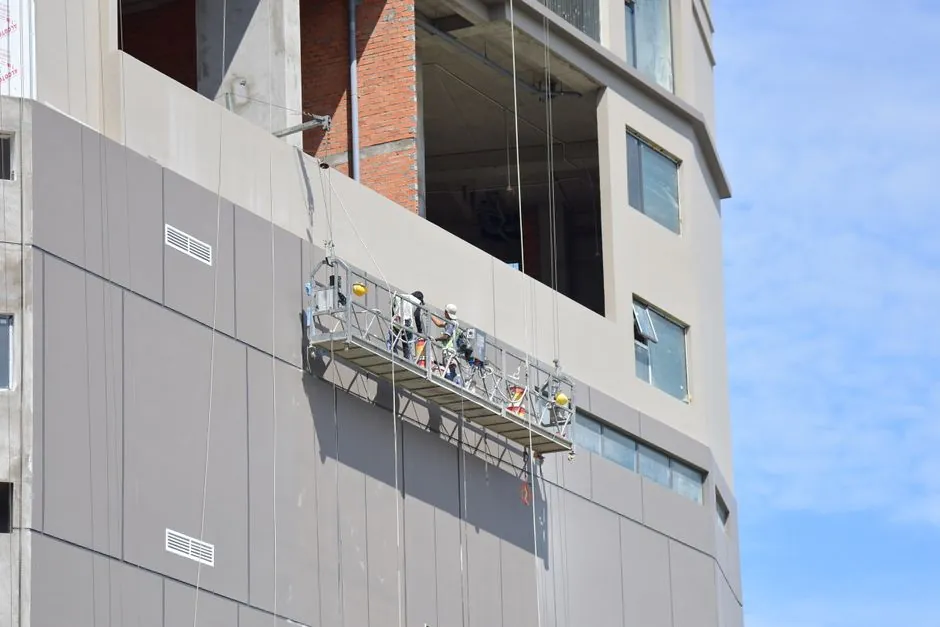
For demolition façades, a ZLP630 or ZLP800 suspended platform with a 30 kN LSB30 safety lock, 8.3–8.6 mm wire rope, and 1.5–2.2 kW hoist typically meets the load, reach, and overspeed-braking envelope, provided the roof rig ties back to structural steel or concrete and not to parapet walls or glass rails [S1][S3].
The scope below applies to temporary suspended work platforms assembled on a building or structure for specific tasks and dismantled on completion, the canonical definition used by manufacturers and regulators for swing-stage operations [S1][S4].
Demolition-Specific Load and Reach Envelope
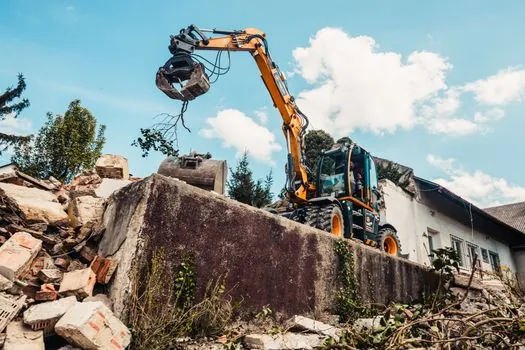
Demolition crews push a platform harder than façade-cleaning crews: a breaker or hydraulic demolition hammer tool adds 15–30 kg of dynamic load per operator, plus falling debris striking the deck. The standard ZLP500 platform, rated at 500 kg with a 1.1 kW LTD5 hoist, is undersized for most masonry or concrete strip-out work; ZLP630 (630 kg, 1.5 kW, 6.17 kN lift) or ZLP800 (800 kg, 2.2 kW, 7.84 kN lift) is the realistic floor for two-person demolition crews with tooling [S1].
Wire rope specification is the second non-negotiable. ZLP630 uses 8.3 mm 4×31SW+FC rope, while ZLP800 upgrades to 8.6 mm 6×19+IWS construction for higher abrasion resistance against rough concrete edges [S1]. The mandatory safety factor on the suspension rope is 10× the rated load, and any rope showing more than 6 broken wires per lay length must be pulled from service, which is a hard discard rule [S3].
Safety Lock and Overspeed Braking: 30 kN, 0.1 s, 0.8 m/s
The LSB30 safety lock specified across ZLP500 through ZLP1000 platforms is rated for a 30 kN impact force and must trigger within 0.1 s when descent speed exceeds approximately 0.8 m/s, locking the platform to its suspension rope to prevent free fall [S1][S3]. That overspeed trigger is the single most cited figure in EN 1808, the European harmonised standard for suspended access equipment, and in GB 19155-2017, the mandatory Chinese national code [S3].
For demolition, where shock loads are routine, the lock must remain certified and unmodified; safety locks cannot be field-disassembled, re-shimmed, or jumpered to clear a fault, and any lock that has arrested a fall is removed from service until factory re-certification [S3]. Daily visual inspection of the lock pawl, centrifugal governor, and cable guide is part of the operator's pre-shift routine.
Standards Map: ISO 18081, EN 1808, ANSI A92.2, GB 19155
The core international and regional standards covering design, manufacturing, installation, operation, inspection, and maintenance of suspended platforms align on safety factor and braking logic even where wording differs: ISO 18081 (international), EN 1808 (Europe), GB 19155-2017 (China), ANSI A92.2 (USA), and AS/NZS 1891.4 (Australia) [S3].
Overload protection is uniform across these standards: electric and hydraulic platforms must cut off lifting power when the load exceeds 110% of the rated capacity, typically via a load cell or pressure transducer at the hoist sheave [S3]. Brakes are dual-system, electromagnetic plus mechanical, and are inspected daily for wear; a single-brake system is non-compliant for any demolition-rated suspended platform [S3].
Roof Rig and Anchor Logic for Demolition Sites
The roof rig must tie to the building's primary structural members, roof beams, reinforced concrete slabs, or purpose-installed davit sockets, with suspension mechanisms carrying a minimum safety factor of 2.5 against bending or shear failure [S3]. Counterweighted outriggers are acceptable on flat roofs with verified dead-load capacity, but the suspended platform itself is never anchored to parapet walls, masonry copings, glass railings, or any non-structural cladding [S3].
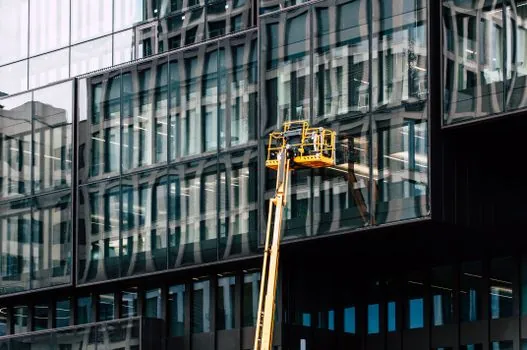
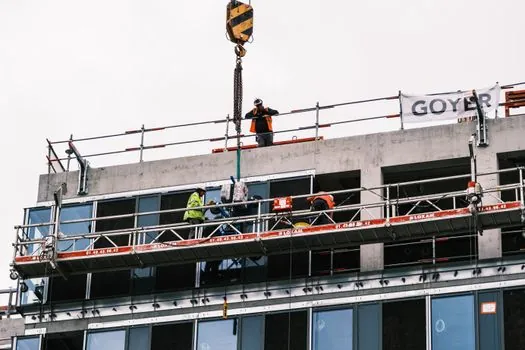
For demolition where the upper structure is itself being dismantled, engineers often shift to a suspended platform configuration suspended from a crane or a purpose-built mast, which removes the dependence on a building roof that may be losing structural capacity during the work. Where a self-climbing alternative is preferred, a mast climbing work platform or aerial work truck gives ground-based anchoring and is worth comparing against a swing-stage when the roof structure is unreliable.
Weather, Clearance, and Operator Limits
Operation is prohibited when wind speed exceeds 12 m/s, in heavy rain, fog, or thunderstorms, because high winds cause platform sway and tip loads on the rig that the 30 kN lock is not designed to arrest [S3]. The platform must be installed with a tilt angle of 3° or less, and a clearance of at least 200 mm maintained between the platform and the building wall to prevent collision and pinching during descent [S3].
Only trained and certified operators are permitted to run the platform, wearing a full-body safety harness with the lanyard tied to a fixed anchor, not to the platform itself or its handrail [S3]. Standing on railings, lifting tools outside the rated load, and overloading are explicitly prohibited behaviours; the 110% overload cut-off is a backstop, not a permit to push the platform to its limit [S3].
Selection Comparison: ZLP630 vs ZLP800 vs ZLP1000 for Demolition
On four decision criteria, the three mid-range ZLP platforms separate cleanly for demolition work. Rated capacity: ZLP630 at 630 kg suits two-person crews with hand tools; ZLP800 at 800 kg covers crews with hydraulic breakers and debris bins; ZLP1000 at 1000 kg is reserved for heavier façade-section removal or paired work decks [S1]. Hoist power and lift force: 1.5 kW / 6.17 kN, 2.2 kW / 7.84 kN, and 3.0 kW / 9.8 kN respectively, which sets the maximum working height because lifting speed slows as the rope payload accumulates on longer drops [S1].
Platform length scales from 6 m (ZLP630) to 7 m (ZLP800 and ZLP1000), which matters for façade strip-out where a longer deck reduces the number of re-rig moves; however, longer platforms need more counterweight on the roof rig and a wider clear working corridor below [S1]. Lifting speed sits at 9–11 m/min for ZLP500 and ZLP630, dropping slightly to 8–10 m/min for the larger ZLP800 and ZLP1000 as the motor trades speed for torque [S1]. For typical demolition cycles of 40–80 m façade height, ZLP800 is the most common pick in the field because it balances 800 kg payload, 7 m deck, and 8.6 mm 6×19+IWS rope against a manageable 2.2 kW power draw on standard 380 V / 50 Hz site supply [S1].
Emergency Descent, Daily Checks, and Failure Modes
Every electric suspended platform must carry a manual emergency descent device, a hand crank or hydraulic release valve, so the platform can be lowered under controlled speed during a power outage or motor failure, rather than relying on the safety lock as a parking brake [S3]. The dual electromagnetic-plus-mechanical brake system is what holds the platform in normal parked position; if either subsystem shows wear beyond the manufacturer's gauge, the hoist is locked out until brake pads or the electromagnetic coil are replaced [S3].
The most common failure modes in demolition service are rope abrasion against rough concrete edges, weld cracks at the platform frame toe-rail after repeated debris impact, and safety-lock pawl contamination from dust and slurry; each maps to a specific daily inspection step and a discard criterion in the operating manual [S3]. For broader comparison with adjacent access equipment and how they pair with suspended ceiling or platform scale integration on the same site, the selection logic overlaps with general temporary-works engineering.
Track the next revision of GB 19155 and EN 1808 for any change to the 0.8 m/s overspeed trigger or the 110% overload cut-off, and confirm the LSB30 lock certificate on every re-rig; both are the two figures most likely to shift in a future amendment cycle.
See also our earlier report, Slewing Drive Selection for Material Handling: Load, Ratio, and Sealing Logic.