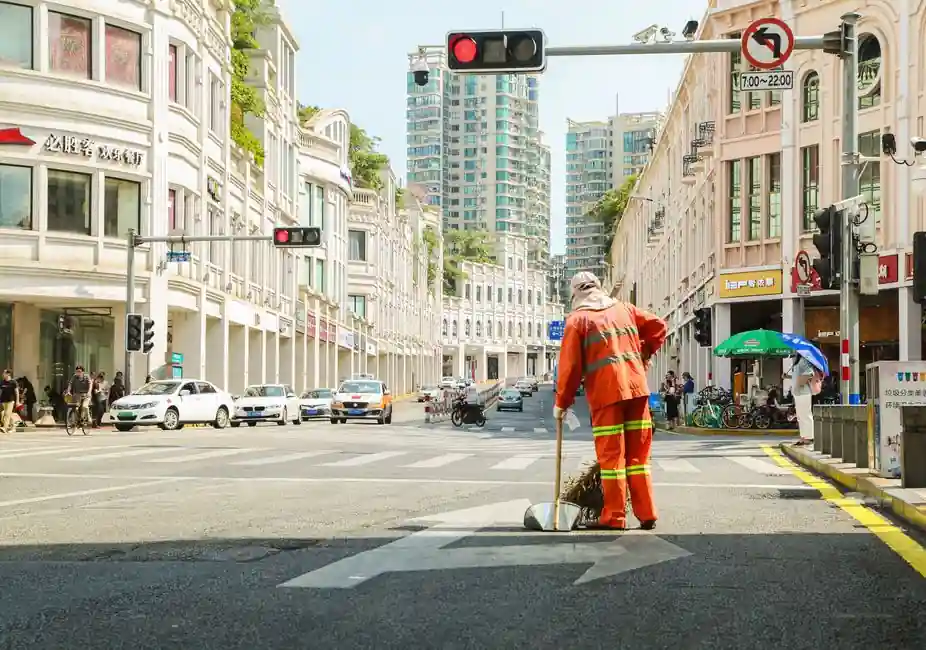
Road-maintenance access is dominated by bridges, tunnels, retaining walls, and noise barriers, and the working envelope at each of those four assets is different enough that a single ZLP-class cradle is rarely the right answer. The standard ZLP630 cradle with 1.0-1.2 m width and 250-400 kg rated load fits general façade and lighting-column cleaning; the wide 1.5-2.0 m class lifts 400-600 kg for multi-person inspection and heavier tools such as needle scalers and chipping hammers [S1].
Bridge soffit work and pier-column inspection run from 10 m to 60 m, while cable-stayed and suspension bridge pylons push rope lengths past 100 m and force a 2.0 factor on the design safety factor of the rope, not on the platform nameplate [S1]. The category sits under EN 1808 in Europe, OSHA 29 CFR 1926.451 / 1926.452 in the United States, and GB 19155 in China, with the suspended working platform treated as suspended access equipment rather than scaffolding.
Road Asset Types and the Load They Impose
Bridge soffit work typically weighs in at the lighter end: 2-3 inspectors, laptops, NDT gauges, and a small chipping hammer, with a total live load in the 300-440 kg range, which forces the spec away from a standard 400 kg platform toward a wide 500 kg class [S1]. The total load formula is Personnel + Tools + Materials + Platform self-weight with a 2.0 safety factor, and a 3-person 440 kg working pack with 150 kg of cradle already exceeds a standard 400 kg model [S1].
Tunnel lining inspection, by contrast, drives a different envelope: ceiling-mount anchors replace the roof outrigger, and curved cross-sections often require a rounded or modular platform. The ZLP-family rounded lifting platform rated at 1200 kg with 6.6 kW hoist power and 8-10 m/min lift speed is one published example, paired with a 2000 kg cirque platform drawing 13.2 kW for heavier bridge-pier work [S2]. Road-maintenance teams rarely need 1200-2000 kg, but a 630-800 kg rated cradle with a 6x19 or 4x31 working rope in 8.3-9.1 mm diameter covers most soffit, parapet, and noise-barrier jobs [S5].
Working Height, Rope Self-Weight, and the 100 m Threshold
Above 50 m of drop height, wire-rope self-weight becomes a design constraint rather than a footnote. A 6 mm steel wire rope weighs roughly 0.14 kg/m, so a single 200 m rope already pulls 28 kg out of the hoist's effective capacity, and the paired safety rope adds a matching 28 kg, for 56 kg of consumed rope mass on a small cradle [S1]. Past 150 m of rope, elastic elongation and creep rise, and the practical response is to step up to a thicker rope or to apply pre-tension rather than to push a smaller hoist harder [S1].
For projects over 100 m, a variable-frequency-drive hoist drops motor starting current to roughly one-seventh of direct-on-line starting, which matters on a long SOOW power cable run where voltage at the platform can sag to 190 V from a 220 V hoist feed and overheat the motor [S1][S6]. Daily load-voltage checks at the platform end of the cable are a documented mandatory item, and the remediation path is booster transformers, heavy-gauge SOOW cabling, and phase selector switches at platform level [S6]. Road-maintenance work on highway interchange lighting masts and gantries usually stays below 30 m and does not need VFD, but cable-stayed bridge cable inspection does.
Wind, Corrosion, and the Coastal Bridge Envelope
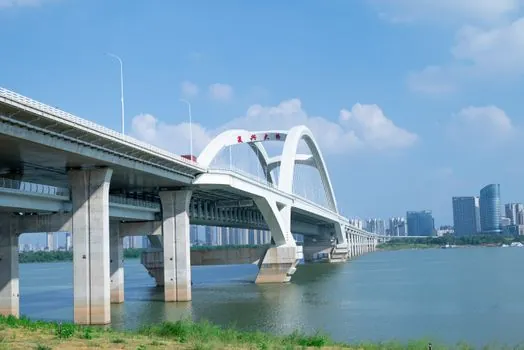
Coastal bridge work is the case where material selection moves from cost optimization to mandatory specification. Type 304 stainless wire rope suits general coastal exposure; Type 316 is required for tropical-coast or industrial salt-spray environments, because ordinary galvanized rope lasts only 6-12 months in those conditions while stainless reaches 3-5 years [S1]. Wind load on the platform scales with frontal area: a 1 m wide cradle has roughly 2.5 m² of frontal area, a 2 m cradle has roughly 5 m², and each 1 m of additional width adds 35-40% to the wind load and forces 50-80 kg of extra counterweight [S1].
EN 1808 wind-pressure calculation carries a 0.4 dynamic coefficient, and at 12.5 m/s the unit wind pressure reads roughly 98 Pa; work stoppage is recommended above 10 m/s and mandatory above 15 m/s (Beaufort 7) [S1]. Wind speed monitoring tied into the platform and a building BMS for remote shutdown is the documented Middle East configuration and applies equally to exposed coastal viaducts and elevated expressway ramps. Road projects in temperate climates often run without permanent wind-speed integration, but a portable anemometer with an automatic stop is cheap insurance.
Power, Hoist, and the Voltage-Drop Failure Mode
Most road-maintenance cradles run 220 V single-phase or 380 V three-phase hoists at 1.5-2.2 kW each, and the failure mode that kills the most platforms on site is not mechanical wear, it is voltage drop on the power cable. If a 220 V hoist sees only 190 V at the end of a 400-foot drop, the motor overheats and the hoist fails prematurely, and the cure is to oversize the SOOW cable, add a booster transformer, and verify voltage at the platform under load every shift [S6].
For night-shift road work under generator power, phase selector switches at platform level let crews lock to the best of three legs, and a daily on-platform load-voltage reading is the cheapest preventive maintenance step on the job. Standard ZLP-class hoists draw 1.5-2.2 kW each; the heavier 6.6-13.2 kW units belong on the cirque and rounded platforms rated 1200-2000 kg and are typically overkill for routine road work [S2]. A related ZLP procurement walk-through for steel construction is laid out in ZLP Platform Selection for Steel Construction: Load, Hoist, and Rope Specs.
Buy vs Rent and the 6-Month Crossover
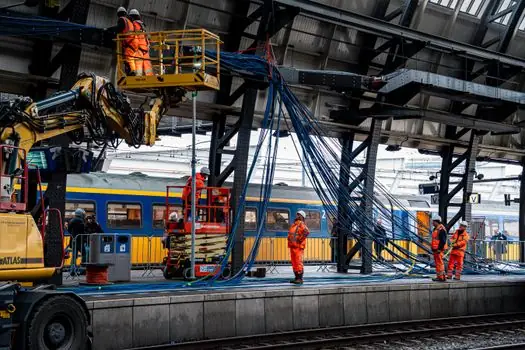
EU and US daily suspended-platform rental runs $400-800/day, so a 6-month rental totals roughly $36,000-72,000, which converges on the purchase price of a standard or wide cradle [S1]. Purchase price bands sit at $8,000-15,000 for a standard electric cradle, $12,000-20,000 for wide, and $20,000-35,000 for extra-wide, excluding wire ropes and counterweight; CE-certified units carry a 15-25% premium over non-certified equivalents [S1].
The crossover is the breakeven rule of thumb: short-term projects of 1-3 months rent, projects over 6 months buy, and anything between is a project-cashflow decision rather than a spec decision. Annual maintenance is a real line item, not a footnote, and runs about 8-12% of the procurement price per year for inspections, wire-rope replacement, and hoist service [S1]. For road-maintenance fleets operating across multiple bridges per year, purchase usually wins by month 5; for one-off tunnel lining repair, rental almost always wins.
Safety Devices, Rope Logic, and the Four Functional Groups
A compliant suspended platform has four functional groups, not just a deck: the working cage, the suspension mechanism (counterweighted outrigger or cantilever beam on the roof), the powered hoist train, and the independent safety system [S5]. The wire rope comes in pairs at every stirrup: a working rope that the hoist climbs and a separate safety rope that the lock grips; sizing is set by the operating code and the hoist sheave groove, and the safety factor on the rope is fixed by the standard, not by the OEM [S5].
The safety lock on a ZLP-class platform locks at a tilt-cable angle of 3-8° (some XP-series designs extend to 3-11°) and the lock's allowable impact force is 30 kN, which is the same figure quoted across multiple OEM datasheets and is the number to verify on the nameplate before sign-off [S2][S4]. Overload detection that prevents the platform from being raised past rated load, top limit switches, and independent safety ropes are not optional; they are the EN 1808 / OSHA / GB 19155 minimum, and a quotation missing any of those items is a quotation to reject, not to negotiate. When a project pushes past 30 m, when wind exposure is open, or when a bridge soffit inspection needs to land on a curved surface, the aerial work platform becomes the alternative, and a sister article covers that comparison: Aerial Work Truck Specs for Road Construction Sites.
Selection Checklist for Road-Maintenance Procurement
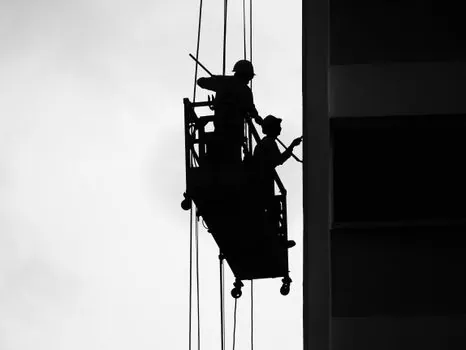
1. Define the worst-case load: 3-person 80 kg crew + 50 kg tools + 100 kg materials + 150 kg cradle = 440 kg, so size the cradle to the next class up, not to the average day. 2. Measure the working height, not the bridge height: a 60 m bridge soffit with a 5 m parapet means a 65 m rope run, and at 65 m rope self-weight is a few kilograms, not a design driver. 3. Specify rope material: 304 stainless for temperate coast, 316 for tropical or industrial coast, galvanized for inland only, and 8.3-9.1 mm 6x19 or 4x31 construction. 4. Specify the safety lock numbers: 30 kN allowable impact, 3-8° tilt-cable lock angle, independent safety rope. 5. Specify wind: 10 m/s work-stop recommendation, 15 m/s mandatory stop, anemometer with auto-stop on exposed viaducts. 6. Power: VFD for any project over 100 m, daily on-platform voltage check on every shift. 7. Buy vs rent: rent under 3 months, evaluate at 3-6 months, buy past 6 months, and budget 8-12% per year of purchase price for maintenance [S1][S5][S6].
Track the next decision points: (a) whether the road authority publishes a wind-stop policy that overrides the 10/15 m/s defaults, and (b) whether the cable-stayed bridge inspection tender specifies VFD or accepts direct-on-line starting with a heavier SOOW cable. The road roller fleets in the same work zone typically run separate lock-out procedures from the cradle, so the platform's BMS tie-in is a separate scope item, not a shared one.