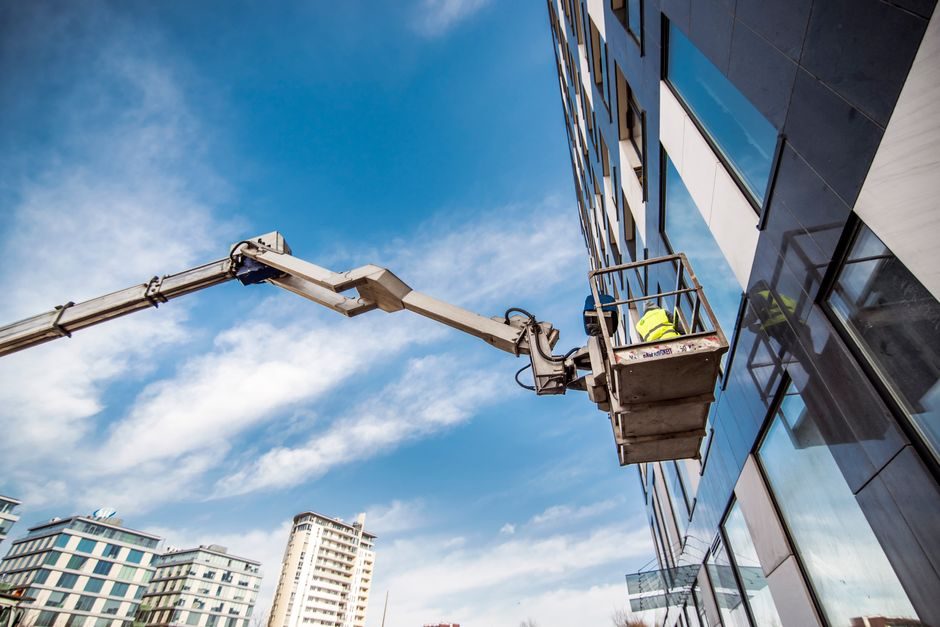
A correctly installed suspended working platform starts with verified roof rigging and a load-tested hoist, not with the basket itself. On 2026-07-08, Wuxi Powerston Technology published a selection guide [S3] flagging the ZLP family at 250-630 kg payload and modular cradle lengths to 15 m, with the suspended cradle as the carrying element suspended by wire ropes from an overhead structure.
Two failure clusters dominate field callouts: mis-rigged suspension on parapet clamps and untested hoist/brake pairs. Jiangsu Shenxi Construction Machinery lists spare hoist motors in the LTD8 / LTD6 / LTD5 series alongside 1.3-1.7 m parapet-clamp suspension mechanisms as separate serviceable parts [S2], confirming that component-level verification, not basket cosmetics, drives uptime on these units.
Pre-Install Site and Structural Verification
Structural verification must precede any cradle hoist-up. Powerston's company profile [S3] states cradle work platforms can reach 15 m in length and construction hoists 96 m/min lift speed; both figures only hold if the host structure can carry the reaction load at each suspension point, including a 1.3-1.7 m parapet-clamp span when the platform is rigged off a low parapet [S2].
Engineers should confirm roof concrete grade, parapet height, and clearance for the outrigger / counterweight scheme before delivery. Standard models from Wuxi suppliers span ZLP500 / ZLP630 / ZLP800 working-load classes [S1], and the 800-class basket is the heaviest variant in the public catalog; specifying a higher class without re-checking the host structure is the most common cause of rigging rejection at first inspection.
Powerston was established in 2016 with 18+ years of export experience and holds CE plus EAC conformity [S3]; for European builds that means the supplier-side paperwork already covers the EN 1808 / Machinery Directive baseline that most site safety officers will ask to see at handover.
Rigging Hardware: Parapet Clamps, Suspension Beams, Wire Rope
Rigging hardware is specified by reach and reaction, not by basket model. Jiangsu Shenxi's catalog treats the 1.3-1.7 m parapet clamp and the suspension beam as discrete SKU lines rather than basket accessories [S2], so a site installing two parallel cradles off one parapet should order two independent clamp sets plus a tie-back, never a shared anchor.
Wire-rope selection follows hoist class: LTD8 hoists pair with 8.3-8.6 mm galvanised rope, LTD6 with 6.2-6.5 mm, LTD5 with the 5 mm range [S2]. Mixing a larger hoist with a smaller-diameter rope is a documented failure pattern; rope diameter must come from the hoist nameplate, not the basket datasheet.
For a typical 6 m ZLP630 cradle, two suspension points spaced at the basket ends with a rear stabilizer / lanyard to the parapet is the default geometry. Longer configurations such as the 15 m Powerston build [S3] require intermediate outriggers and re-verified rope tension, which is why field teams ship a tension gauge with the rigging kit rather than rely on visual sag.
Hoist, Brake, and Safety-Device Verification
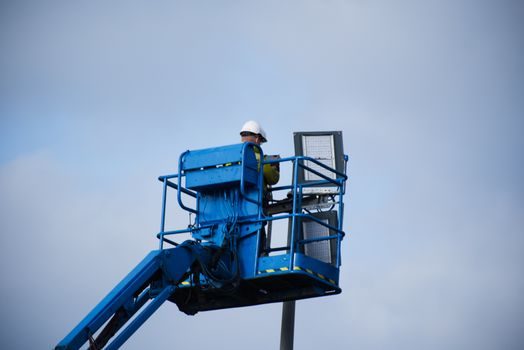
Hoist and brake verification is the single install step that catches the most field failures. The Shenxi hoist-motor / winch line (LTD8 / LTD6 / LTD5) is sold as a service part, not a one-time OEM component [S2], which signals that brake-pad wear, rope sheave grooving, and limit-switch drift are expected service items within the first 12 months on most sites.
Before first lift, the installer should run an empty-basket no-load ascent to top stroke, confirm the upper limit switch trips within 0.5-1.0 m of the rated travel, and verify the overspeed / anti-tilt lock engages when the basket is manually tilted 5-7 degrees. The centrifugal safety lock is the device that catches a rope-slip event, so the lock direction (left-hand / right-hand rope lay) must match the rope supplied.
ZLP500 / ZLP630 / ZLP800 baskets from Wuxi Powerston are listed in the Made-in-China product set dated 2025-12-20 [S1]; the 800-class figure of roughly 800 kg rated load sets the upper envelope for the 630-kg "wide body" sub-variant that Powerston's selection guide calls out for facade cleaning teams carrying water and tooling [S3].
Electrical, Control, and Pendant Wiring
Electrical and control wiring is where a clean install becomes a safe install. Powerston lists 96 m/min as the construction-hoist lift speed on its corporate profile [S3], which is well above the 8-10 m/min typical for suspended cradles, so the suspended platform's pendant circuit must be kept electrically and mechanically separate from any construction-hoist cabling sharing the same roof zone.
Two control philosophies are in market: a hardwired 24 V control pendant for single-basket installs, and a bus-linked multi-basket pendant for paired cradles. For lifts where two baskets must move in sync, the second basket is added via a powerston-class junction box, not by daisy-chaining pendants. Phase rotation must be checked on three-phase hoists; a reversed phase inverts the upper-limit logic and disables the safety lock direction.
Powerston's lineup includes mast climbing work platforms and building maintenance units (BMU) alongside suspended platforms [S3], which is relevant for sites evaluating a permanent BMU cradle versus a temporary ZLP install. The BMU is roof-rail mounted, the ZLP is rope-suspended; the electrical design differs accordingly.
On-Site Acceptance: Load Test, Drop Test, Documentation
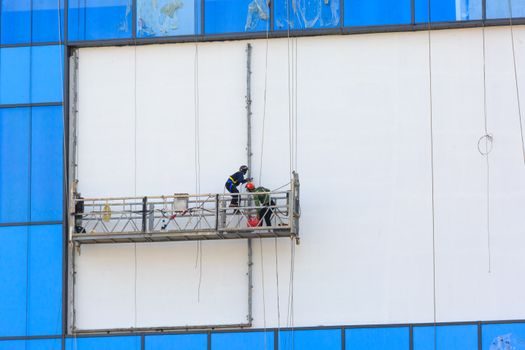
On-site acceptance is a documented load-and-drop test, not a visual sign-off. Standard practice is a 1.25x static overload hold of the rated basket capacity (312 kg on a 250-kg unit, 787 kg on a 630-kg unit, 1000 kg on an 800-kg unit) for 15 minutes with no permanent deformation, followed by a triggered safety-lock drop test from a defined height with the test mass locked by the centrifugal device, not the hoist brake. [S3]
The ZLP500 / ZLP630 / ZLP800 rated-load set comes from the Wuxi catalog [S1]; the selection guide [S3] confirms a 250 kg "narrow" model at the low end and 630 kg "wide body" at the high end, with the 800-class ZLP800 used for bridge maintenance aerial work where the longer rope travel and higher reaction load justify the heavier rigging. The 500-class mid-range typically uses two LTD6 hoists, while the 630 and 800 classes step up to LTD8.
Acceptance paperwork should include the CE / EAC declarations referenced in the supplier profile [S3], the rope manufacturer's test certificate, the hoist serial-to-LTD-class cross-check, and a signed drop-test sheet with the test mass, drop height, and lock-engagement distance recorded. A basket that passes the 1.25x static test but shows more than 50-100 mm of permanent cradle deflection under load should be taken out of service pending re-test, not just re-tagged.
Common Failure Modes and When to Escalate
Common failure modes cluster around four patterns: rope slip past the safety lock, brake-pad fade on the hoist, parapet-clamp slip on low-parapet roofs, and electrical phase rotation errors after generator hookups. The first three are caught by a documented drop test, brake torque test, and clamp reaction load-cell test respectively, while the fourth is caught by a pre-lift no-load ascent in both directions. [S2]
Escalate, do not field-repair, when the centrifugal safety lock fails to engage on the drop test, when the rope shows flat spots or corrosion pitting, or when the parapet-clamp reaction exceeds the host structure's local capacity. Jiangsu Shenxi's parts catalog [S2] treats the safety lock, the rope sheave, and the clamp as replaceable components, which is the right framing: a damaged lock or sheave is a swap-out, not a weld-and-go repair.
Track these signals: a new EN 1808 revision or a 2026 update to the European suspended-access machinery rule (supplier-side documentation refreshed after 2026-07), an uptick in ZLP800-class bridge-maintenance tenders in the Wuxi supplier feed [S1], and the next climbing formwork versus suspended platform tender in your market, which usually precedes a tightening of acceptance-test frequency by 6-9 months.
Spec-level background on the components involved: linear guide, and suspended ceiling.