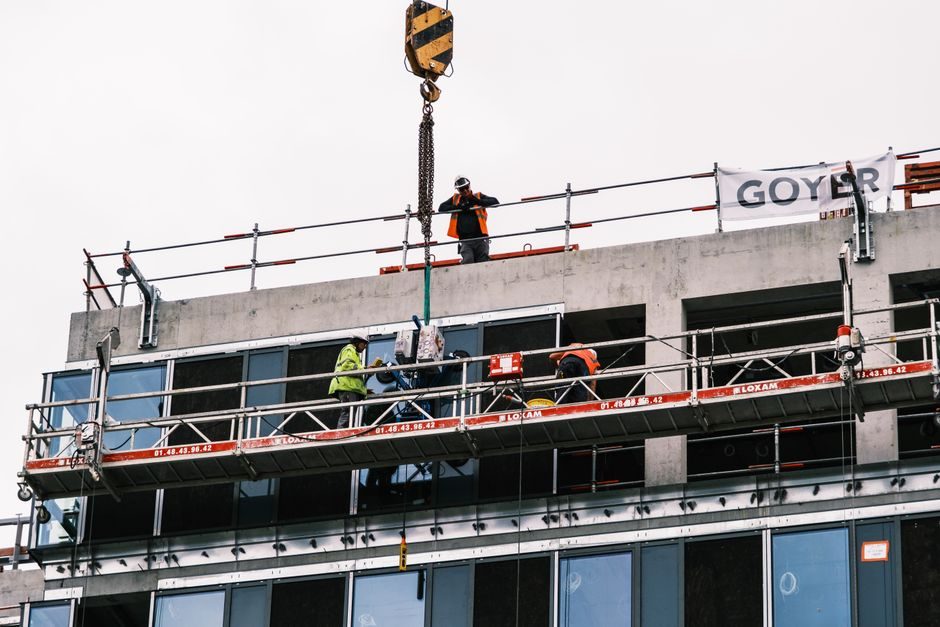
A self-climbing system lifts itself along a support rail fixed to the previously cast structure, with motive power from an integrated hydraulic cylinder rather than a tower crane — RIMMCA markets the SCS 80 as crane-independent and rated for "structures of any shape and any height" [S1]. The same family of rail-climbing units is also sold under the KITSEN "Self-Climbing Scaffolding System" product line, anchored by a hot-dip galvanized steel support rail and bracket assembly [S2].
The economic case is a function of repetition: CB240 and CB210 climbing brackets are engineered for "high bearing capacity" so that "very large scaffold units" can be lifted in one piece, which "saves the number of anchor points required as well as reducing climbing times" on pier, column, shear wall, and core wall pours [S3]. For towers and cores above roughly 12–15 storeys, that crane-free cycle is where climbing formwork earns its keep — on shorter or irregular geometry the same capex rarely pays back.
Where the System Fits — and Where It Does Not
Climbing formwork is specified where vertical repetition is high, the structural section is regular enough to anchor a rail, and the schedule penalty of waiting on a crane for every lift is unacceptable — typically cores, lift shafts, bridge pylons, and tall shear walls [S1][S3]. It is a poor match for low-rise (under ~5 storeys), heavily stepped, or highly sculpted façades, where the rail anchorage density and pre-planning effort cannot be amortised over enough cycles.
Field installation rules for these systems are covered in a complementary reference on climbing formwork installation cycle and acceptance, which lines the typical lift sequence against the same rail-and-bracket geometry described here. For sites where the cycle is set by horizontal rather than vertical repetition, conventional scaffolding installation practice is the more honest baseline.
Core Advantages Against Conventional Formwork
Hydraulic self-climbing removes the crane from the critical path: the SCS 80 climbs on its own cylinders, which directly converts into a shorter cycle between pours and less dependence on shared tower-crane time on congested sites [S1]. The CB240 bracket extends that logic by allowing the climbing scaffold and the formwork panel to be "moved as a single climbing unit by crane" on smaller sites, and — with a retrusive set — to strike "large formwork elements … quickly" without crane assistance at all [S3].
Safety and access scale with the bracket: CB-series platforms are "assembled firmly with bracket and will be climbing together, without scaffolding but can work safely in spite of your high location" [S3]. Because the rail is fixed to the previously cast structure, the working platform and the formwork always sit one floor below the fresh pour, giving trades a guarded deck for rebar tying, embed installation, and inspection before each lift.
Quality and dimensional control are the third leg. A rigid, rail-guided climb holds wall geometry tighter than stick-built formwork, which is why the system dominates cores where tolerance on verticality and door-duct alignment compounds over storeys. The same rail-anchored logic underpins the broader climbing formwork system concept, where the dominant variables are cycle time, anchorage pattern, and panel stiffness rather than the concrete mix itself.
Real Disadvantages Engineers Hit on Site
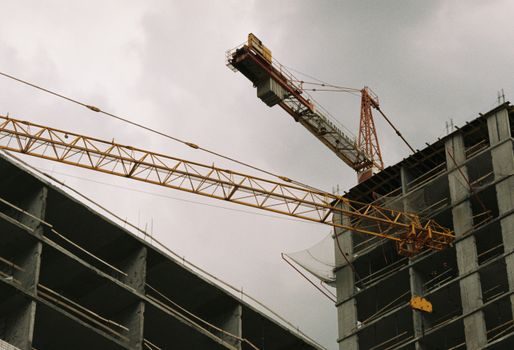
Capex is the first number the estimator will flag. Climbing brackets, rails, hydraulic power packs, and the higher-capacity wall formwork they carry are a step change from hand-set panels, and CB-series supply runs at minimum order quantities of 50 m² with 1000 m²/month capability — not a stock item [S3]. On projects under ~8–10 climbing repetitions that per-m² cost is rarely recovered.
Anchorage and structural preparation are the second constraint. The support rail must be fixed to a "surface adjacent an edge of a structure" [S2], and every anchor point has to be designed into the lift drawings, cast in, and pull-tested before the next climb. Miss an embed and the cycle stops; under-design the local bearing and the bracket stamps the concrete. Crews also need to be trained on the hydraulic sequence, lock-off pins, and wind-speed limits — none of which are forgiving.
Geometry flexibility is narrower than the marketing line suggests. The SCS 80 is described as applicable to "any shape and any height" [S1], but in practice every change in wall thickness, setback, or opening requires a re-shop of the bracket spacing and sometimes the rail length. For highly sculpted towers, plan changes mid-rise are expensive. There is also a practical height ceiling tied to the rail's buckling length and the hydraulic stroke available in a given OEM's range, beyond which the system must be re-anchored or supplemented with a conventional crane-climbed jump form.
Selection Criteria and a Side-by-Side Trade-Off
Specifying climbing formwork is a four-criteria decision, and the right answer changes with pour height, repetition, geometry, and crane access. The table below lines the main system families against those axes; values are typical engineering bands, not catalogue absolutes. [S3]
Self-climbing hydraulic (SCS-class) scores high on cycle speed, very high on capex and planning effort, mid on geometry flexibility, and removes crane dependence entirely [S1]. Crane-lifted climbing bracket (CB240/CB210-class) is lower capex and faster to mobilise, but ties each lift to a crane and a clear lifting radius [S3]. Conventional hand-set wall formwork plus scaffolding remains the cheapest per m² for low-rise or one-off geometry, but is the slowest per cycle and the most labour-intensive, which is why the scaffolding installation trade-off map treats it as a separate decision tree.
For projects that sit between these — say a 10-storey core with a single setback — the right call is often a hybrid: hydraulic self-climbing for the lower, repetitive lifts and crane-climbed brackets above the setback, because re-anchoring the rail across a step costs more than the crane time it saves.
Sourcing, Standards, and Field Cues
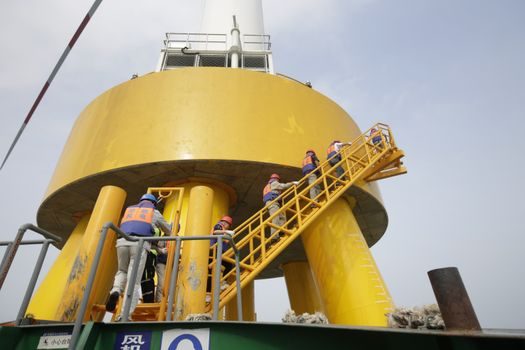
Procurement typically runs as a packaged supply — rail, brackets, hydraulic unit, and platform — from a single OEM, with a CB-class bracket minimum order of 50 m² and monthly capacity of 1000 m² quoted out of Tianjin [S3]. Lead times, not headline price, drive the schedule: hydraulic power packs, hot-dip galvanized rails, and the larger CB240 brackets are the long-pole items, and buyers should confirm galvanizing thickness, seal-kit availability, and spare cylinder stock before signing.
Standards discipline matters more than vendor brochures admit. Load-bearing components should be traceable to a recognised material grade (e.g. Q345 steel tube for propping members on adjacent RIMMCA formwork lines) and to a published formwork/shoring standard — AS 3610 is named on a comparable RIMMCA V-Shore Frame spec sheet [S1]. Climbing-specific verification should still cover anchor pull-out capacity, platform guarding, and hydraulic hose integrity, regardless of which OEM's logo is on the rail.
For projects where cycling speed is the bottleneck, the practical signals to track are: confirmed rail anchorage pattern on the structural drawings, hydraulic stroke and lift height per cycle, platform width and tie-off points for rebar trades, and a documented wind-speed cut-out. The condition monitoring framing of these hardware axes is a useful cross-check if the project team is also instrumenting the climb for safety audits — the same five-axis logic (load, stroke, pressure, position, environment) maps cleanly onto hydraulic self-climbing systems.
Next move for a specifier: lock the pour-height cycle and crane-access plan first, then shortlist two OEMs against rail length, bracket spacing, and hydraulic stroke — and confirm galvanizing, anchor test method, and cylinder spares before pricing, not after.
Detailed specification references: asrs system, and shuttle system.