
A swing check valve is suitable for relatively clean, low-viscosity pulp and paper service when the line can accept its larger envelope and flow-path loss.
Its hinged disc closes automatically without power, but durability depends on the stream chemistry, solids content, pressure, temperature, and closure behavior.
Where swing checks fit in a mill
Swing and dual-plate check valves are the principal check-valve forms used in pulp and paper applications, with available space and flow characteristics deciding between them [S1].
The traditional swing design uses a flat disc pivoted by a hinge pin. It opens with forward flow and returns under gravity when flow reverses [S5]. Unlike powered control equipment, the swing disc requires no external electrical signal from the pump control system, which makes it mechanically simple for automatically protecting a pump discharge [S5].
This valve family is a poor default for every service. It is best reserved for a line where the medium is relatively free of fibers and solids, installation length is available, and a full-size flow passage is valuable. For a broader comparison of check-valve behavior, see swing check valves.
Compare the main check-valve options
Against installation space, solids tolerance, and closure control, a swing check offers a simple automatic closure but occupies more length than a wafer or dual-plate unit. A dual-plate check valve is more compact, while a lift check valve closes faster and is better suited to controlled, short-travel closure. [S1]
No universal check-valve type fits all pump-discharge conditions [S5].
Screen media before selecting the body
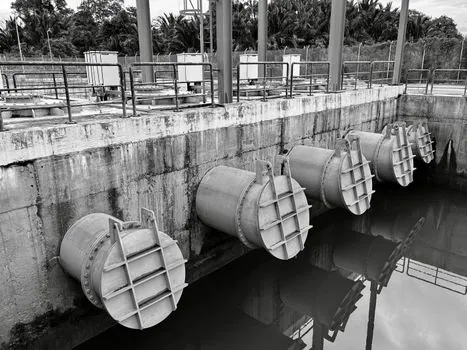
Pulp and paper streams can contain wood fibers, silica, and abrasive solids that accelerate erosion, while sodium hydroxide, sodium sulfide, and chlorine dioxide can attack unsuitable metals and elastomers [S1]. The selected body, trim, seat, disc, stem, hinge, and packing materials must therefore be checked against both process chemistry and the boil-out or solvent chemistry used to remove deposits [S1][S4].
Mechanical erosion and chemical corrosion are separate design problems. Hard trim can address abrasion, but it does not protect an incompatible elastomer or gasket. Conversely, corrosion-resistant stainless construction does not prevent erosion by wood fibers or silica [S1]. Specify the wetted material combination for the complete service envelope rather than naming one alloy as a universal solution.
For brown-stock or other fiber-heavy service, evaluate a dual-plate or other compact check design rather than assuming a swing disc will remain free and seat reliably. The defining constraint is not simply whether the check is automatic, but whether solids can lodge between the sealing surfaces and restrict disc movement.
Pressure, temperature, and closure control
The valve pressure rating must cover the line design pressure, while the seat, hinge, body, and closure mechanism must remain functional across the full process and temperature range [S4]. Pulp and paper installations may encounter thermal and pressure fluctuations, including rapid temperature cycling in steam-injected digesters or recovery-boiler systems [S1].
The required response depends on the protected system, surge tolerance, and downstream piping arrangement.
Do not select an auxiliary lever and weight without a hydraulic calculation. Dashpot or assisted-closure provisions should be tied to a surge study rather than treated as generic accessories [S5].
Materials, maintenance, and installation
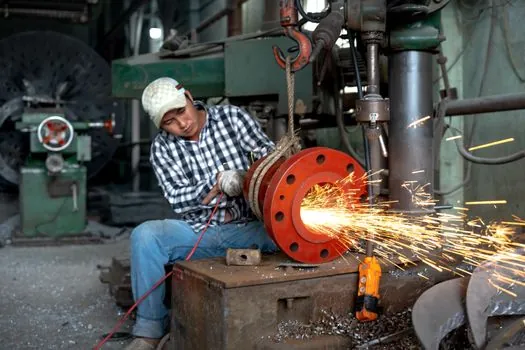
Installation criteria include dimensional fit, service access, pipeline support, and the ability to inspect or replace the disc, hinge, and seat without damaging nearby equipment [S4]. A large swing body may offer a generous flow passage and straightforward in-line maintenance, but that advantage disappears when the available spool length is too short or removal requires dismantling a crowded header.
Installation and maintenance checks should cover fluid velocity, operating frequency, leak tightness, packing behavior, erosion of the seat and disc, hinge wear, and corrosion around concealed wetted parts [S4].
Use the manufacturer’s rated flow coefficient and pressure-drop data for the selected geometry and trim, then compare that loss with the system’s pumping requirement.
Best-fit applications and exclusions
Swing checks are credible for relatively clean water or low-solids process lines, including pump discharges where a robust full-size flow path is more important than compact installation. They also suit installations that can accommodate the longer body and that prefer a gravity-operated design with no external power [S5].
They are a poor choice when the stream contains substantial fibers, grit, or entrained solids; when installation length is restricted; or when rapid, predictable closure is required. Under those conditions, a dual-plate check valve or lift check should be evaluated, with the final choice based on solids, closure, pressure loss, and maintenance access [S1][S5].
Do not use a swing check as a process-control valve or as a substitute for a relief device. Its function is automatic prevention of reverse flow, not controlled throttling or overpressure protection. If the line must isolate, modulate, or relieve pressure, those functions require separate valve classes.
Specification checklist for buyers

A complete purchase specification should identify the medium, temperature and pressure conditions, solids content, fluid density and viscosity, required closure time, allowable pressure loss, installation orientation, and accessible maintenance envelope [S4]. It should also define the seat and disc materials, body and cover materials, elastomers, hinge or spring materials, end connections, and the applicable pressure-temperature rating.
For a swing check, request the disc weight and lever option, if any, along with data on the seating behavior, head loss, minimum opening characteristics, and any dashpot arrangement. The general check-valve selection reference divides evaluation into initial cost, maintenance cost, head loss, energy cost, non-slam characteristics, fluid compatibility, and an overall selection method [S5].
The shortlist logic is straightforward: choose a swing check for clean, low-solids service with adequate space; choose a dual-plate or wafer arrangement where installation length controls; choose a lift check where fast closure dominates; and require a surge calculation before adding assisted closure. For deeper service-specific comparison, the related pharmaceutical manufacturing check-valve guide shows how sanitary-material and contamination requirements change the selection boundary.
Before purchase, verify three trackable items: the vendor’s dimensioned installation drawing, the material certificate for every wetted component, and the tested pressure-temperature and flow-loss data for the exact valve configuration.