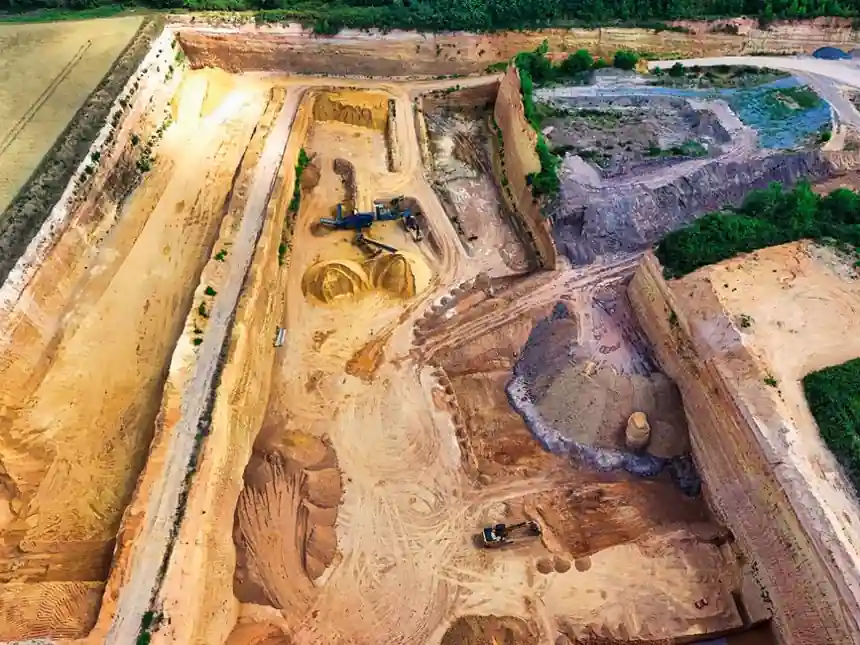
A swing check valve should be selected and sized according to the manufacturer's guidance and the application's operating conditions.
The valve fits clean or lightly contaminated mining-water lines, dewatering discharge, and hydrocyclone service where full parallel flow is valuable, but it is a poor default for abrasive slurry or rapid pump shutdown.
Define the service boundary before choosing the valve
A swing check valve uses a hinged disc to permit forward flow and close on reversal, with straight-through and Y-pattern bodies available [S1]. Its self-acting mechanism requires no external control, but it needs an installed flow path, gravity or another closing force, and sufficient forward-flow differential to move the disc [S1][S5].
Mining systems commonly handle slurry transport, tailings management, and dewatering, with exposure to abrasion, corrosion, pressure, vibration, and remote-site maintenance constraints [S3]. A conventional swing check is best reserved for relatively clean water or process liquid with restricted solids. For high solids concentrations or long-distance transport, the disc, hinge, seat, and body can become erosion targets; the abrasive wear rate rises with particle concentration and velocity [S3].
Do not confuse a swing check with a generic check valve. The disc-and-hinge construction provides a large open area and low through-flow restriction, but the moving closure is vulnerable to chatter, wear, and hydraulic slam if the operating point is poor [S1][S6].
Compare the main mining check-valve choices
A conventional swing check provides the greatest parallel opening among the listed conventional styles, while a wafer check valve has the shortest installation length and a simpler, wafer-like envelope. A dual-plate check closes at a defined differential pressure without a large swinging mass, while an axial-flow check uses a guided disc and spring to begin closing before flow reverses [S1][S2].
The selection comparison is straightforward. A swing check valve may be selected when low pressure loss and simplicity are priorities, subject to the manufacturer's guidance. Use a wafer check where installation length is critical and the fluid contains no material that will lodge against the seat. Use a dual-plate check when compact installation and controlled shutoff are more important than a full-bore swing passage. Use a spring-assisted axial-flow check when rapid pump-stop water-hammer control is the governing requirement [S1][S2].
A tilting-disc check valve is a separate high-performance option rather than a generic substitute for a gravity-closed swing disc. Its disc geometry and controlled closing behavior require a manufacturer-specific hydraulic and transient assessment before selection.
Screen pressure loss, cracking pressure, and installation
Selection requires more than matching nominal pipe size. Confirm forward-flow capacity, minimum cracking differential, allowable pressure loss, maximum operating pressure and temperature, fluid compatibility, solids loading, and installation orientation with the valve manufacturer [S5]. The Kennedy manual covers 2-inch through 12-inch swing check valves and directs users to AWWA C508 for additional check-valve information [S5].
Removal of the spring leaves reverse flow able to close the disc, but removes the intended water-hammer reduction and limits installation-orientation options [S2]. Disc weight, stem weight, internal friction, and factory review govern the final setting [S2].
In a vertical-flow application, gravity may assist closure of a swing check valve after flow stops, potentially causing water hammer.
Control water hammer and pump-stop transients
Gravity does not close a conventional swing check until forward flow has stopped, so pump shutdown can convert the remaining fluid column into a pressure surge; a spring-assisted design starts closing as flow falls below its cracking differential [S2]. For mining pump stations, model the rapid-stop transient and compare it with allowable pipe and equipment pressure before accepting a gravity-closed design.
Check-valve selection by service duty is covered in Mining Check Valve Selection by Service Duty. That distinction matters because a water discharge line, a tailings line, and a high-pressure slurry header do not share the same closure requirements.
Installation direction is part of the valve specification. Vertical upward flow can let gravity assist closure only after forward flow ceases, while vertical downward flow requires assessment of disc and stem weight, spring selection, and the static fluid head that must remain above the valve [S2]. A conventional swing check in a vertical line must therefore be treated as a transient-control problem, not merely a gravity-operated isolation device.
Match construction to corrosion and abrasion
Mining water can contain salts, acids, reagents, or sulfide-oxidation products, and these fluids can cause both general corrosion and localized pitting [S3]. Specify body, trim, hinge, seat, stem, and fastener materials as a complete assembly rather than naming only a valve body material.
Coatings and elastomers need separate evaluation because slurry abrasion can remove protective surface layers and expose fresh metal to accelerated corrosion [S3]. A rubber-coated seat in an abrasive line may erode at the sealing interface, while a hard metallic seat may tolerate solids better but can damage seating surfaces if debris is trapped.
For light solids, a swing design can remain attractive because the disc opens fully and avoids a spring, actuator, or pilot system [S1]. For aggressive slurry, specify a valve type whose closure member and seat are designed for solids. If the service requires zero leakage, evaluate a dual-plate check valve or another positive-separation closure rather than assuming a gravity swing disc will remain leak-tight after erosion.
Identify mining installations that should use another design
Do not specify a conventional swing check for a rapid-stop mine-water pump discharge when pressure-transient limits are tight and no surge-analysis credit is available [S2]. It is also a poor fit for high-concentration tailings, long-distance slurry transport, or lines with solids that can lodge on the seat and prevent closure [S3].
Do not choose a spring-assisted axial-flow check merely because its face-to-face length resembles a wafer valve. Its cracking pressure, orientation limits, flow coefficient, and available sizes must be checked, and the spring must remain part of the hydraulic performance case [S2]. The more complex ball check valve, lift check, or piston check can provide positive sealing and faster closure, but each introduces different pressure-loss, contamination, and fouling considerations that must be compared with the mining fluid.
Installation and maintenance details also affect reliability. Inspect the valve for damage, confirm flow direction, clean the interior, and verify that the disc closes before the pipeline is pressurized or backfilled [S5]. Never lift the valve by the hinge, spring, lever arm, limit switch, or air cushion; support the complete valve weight with suitable lifting equipment [S5].
Build a defensible purchase specification
Issue the data sheet with the minimum normal differential pressure, maximum and minimum flow, design and test pressures, design temperature, fluid chemistry, maximum particle size, solids concentration, installation orientation, allowable pressure surge, and required closure method [S2][S5]. A 2-inch through 12-inch envelope is a useful initial screening range for the cited Kennedy swing check family, not a universal size limit for every manufacturer [S5].
Require the manufacturer to state the verified flow coefficient, cracking pressure, disc material, seat material, hinge and stem arrangement, allowable orientation, and whether the hydraulic model includes closure timing. Compare swing, wafer, dual-plate, and spring-assisted options using four criteria: pressure loss, solids tolerance, installation length, and pump-stop transient control.
The shortlist logic is direct: select a conventional swing check for clean water, steady gravity-driven service, and minimum pressure loss; select a spring-assisted or faster-closing check when pump-stop surge governs; select a solids-resistant design for slurry. Final approval should rest on the actual mining fluid, flow curve, installation geometry, and transient analysis rather than the generic label “check valve.”