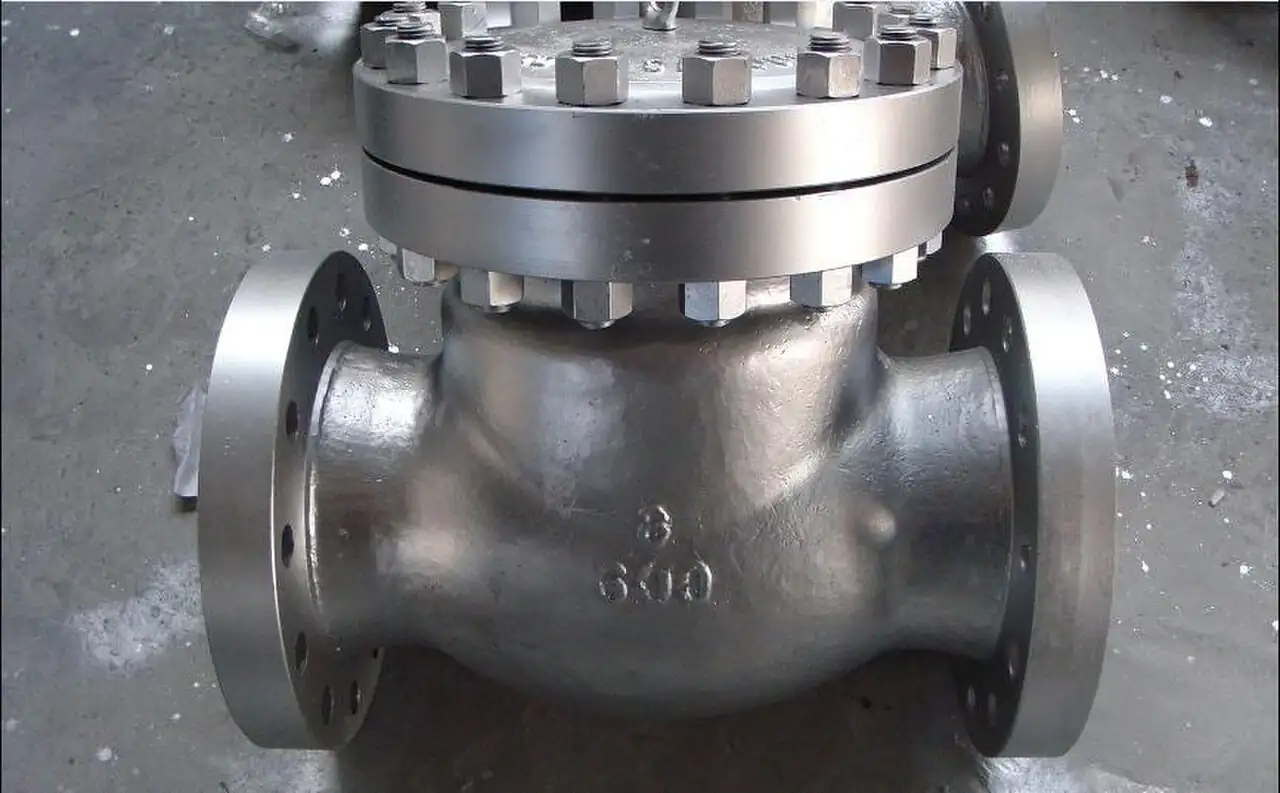
A dual plate check valve, the double-door or wafer check of the piping world, is a non-return valve whose two spring-loaded semicircular plates swing open around a central hinge pin, split the flow between them, and snap shut against angled seats the moment forward flow decays, all inside a wafer body short enough to sandwich between two pipeline flanges. It is the API 594 Type A pattern, and its reason for existing is hydraulic manners: the split plates travel a fraction of a swing disc's arc, the springs start closing before flow reverses, and the result is a non-slam shutdown that protects pump discharges and long water lines from the water hammer a sluggish check valve converts into a repair budget. Where the swing check valve owns the low-pressure-drop story and the generic check valve page owns the family survey, this leaf carries the volume product of industrial water, HVAC, and utility piping: compact, light, fast, and cheap by the meter.
Specifying one is four linked decisions: the body pattern and end arrangement, wafer Type A between flanges or lug and flanged bodies where the line must be taken apart around the valve; the pressure class and material ladder, Class 150 through 600 in carbon, stainless, and duplex grades against the chemistry and temperature; the seat and spring internals, metal seats for hot and abrasive duty or elastomer inserts for tight shutoff, with the spring alloy carrying the temperature ceiling; and the hydraulic sizing, because a check valve too large for the normal flow never leaves its seats and flutters to death, and one too small spends pressure drop the pump budget did not allocate. This page works each decision with catalog numbers and closes with the RFQ lines that make dual plate quotes comparable at engineering level.
This page treats the dual plate check valve as a hydraulic damper masquerading as a valve: twin-plate closing physics, non-slam arithmetic against water hammer, API 594 Type A construction and material ladders, seat and spring internals, sizing against flutter, and the RFQ lines that carry the specification.
Chapter 1 / 06
What a Dual Plate Check Valve Is and What Is Being Decided
The geometry defines the machine. Inside a short wafer body, two semicircular plates sit against seats angled a few degrees off the flow axis, hinged on a pin on the vertical centerline, each backed by a torsion spring. Forward flow pushes both plates open, each sweeping a short arc of roughly 30 to 45 degrees from seat to stop, and the flow divides symmetrically above and below the pin. When the pump stops and column momentum decays, the springs begin closing the plates while flow is still moving forward, and reverse flow, when it arrives, finishes the stroke: the plates land on their seats with the reverse velocity still near zero, which is the entire non-slam claim, and the two landed plates brace each other through the central pin against the full line differential. The body carries the flange sealing faces at each end and nothing else: the wafer installs between the line's flanges with through-bolts, and the face-to-face is a fraction of any full-bodied alternative.
What is being decided at purchase is where the valve sits in the system and how hard its life is. First, the end arrangement: a plain wafer, Type A, is the volume choice for lines that can be drained for service, because the flange bolts must come off to remove it; a lug body, each flange face drilled and tapped, allows line-side dismantling; a fully flanged or Type B body serves where the standard or the client demands a body with its own ends. Second, the class and material: Class 150 and 300 cover the water and utility world, Class 600 begins the severe duty, with carbon steel WCC for treated water and steam-adjacent service, CF8M and CF3M stainless for chemistry and coastal duty, duplex 2205 and higher for brine and desalination, and the nickel grades where chloride and temperature combine. Third, the internals: metal seat for hot water and condensate and slurries-adjacent tolerance, elastomer seat inserts, EPDM for water duty, NBR and PTFE variants by chemistry, for the tight shutoff the metal pair cannot promise; spring alloys from stainless through Inconel X-750 carrying the temperature story. Fourth, the size against velocity: the valve wants 1.5 to 3 meters per second of normal flow to open honestly and stay off its seats, and the size ladder is a hydraulic decision before it is a catalog row.
The competitive frame keeps the selection honest. Against the swing check valve, the dual plate wins on closing speed and water hammer, on face-to-face and weight, roughly a quarter of the swing's envelope, and on price as diameters grow; the swing wins on absolute pressure drop in very low-head gravity lines, where its full-bore disc is gentler, and on simplicity for buried and wastewater duty. Against the tilting-disc check, the dual plate wins on price and availability; the tilting disc wins on pressure drop at high velocity and on severe cycling. Against the lift and piston checks, the dual plate wins on size and horizontal-vertical flexibility; the piston check wins on pulsating flow near a reciprocating machine. Against the butterfly valve used with an actuator as a controlled non-return, there is no honest comparison: the check valve is passive and instant, the butterfly valve is a throttling machine with a motor, and a dual plate costs a fraction. Against the ball check in small dirty lines, geometry decides. And the family survey page, the generic check valve leaf, carries the taxonomy and the selection philosophy; this page carries the wafer twin-plate machine in depth.
One positioning note: this page is the single-product page for the API 594 wafer pattern. The check valve family page, the swing check valve leaf, and the gate, globe, and ball isolation families each have their own pages; here the assumption is a pump discharge or process line needing fast passive non-return in a compact envelope, and every number that follows is chosen for that world.
Chapter 2 / 06
How the Twin Plates Stop Reverse Flow Fast
The closing physics is a race against reverse velocity, and the dual plate wins it by shortening the track. Slam in a check valve happens when the disc is still traveling toward its seat while the fluid column has already reversed: the disc arrives late, the reverse flow must be decelerated abruptly by the closing disc, and the deceleration is the pressure surge, Joukowsky's arithmetic, surge proportional to the fluid's density and the velocity change and the speed with which the closure imposes it. The dual plate design attacks every term: the plates travel a short arc, the springs start the return before reversal begins, and the split plates are light, so the closure completes while reverse velocity is still small. Catalog language calls this non-slam, and the honest phrasing is that the pattern reduces slam severity by an order of magnitude against an equivalent swing check on pump-stop transients; it does not repeal surge analysis, and long lines with high static lift still get the hydraulic study.
The opening physics prices the pressure drop. The flow pushes two plates against spring torque and pivots them to their stops; at full opening the plates park against the stop pins, angled out of the stream but not vanished, and the residual obstruction plus the seat contour sets the valve's flow coefficient, Kv values by size placing the dual plate among the moderate-loss checks: meaningfully more loss than a full-bore swing at low velocity, comparable or better at normal pumped velocities where the plates park fully, and always a fraction of a globe-style check. The velocity window is the sizing truth: below roughly 1 meter per second normal flow the plates hover near their seats and flutter, the classic killer of oversized checks, spring chatter wearing the pins and seats and broadcasting noise; above roughly 4 to 5 meters per second steady, erosion and the dynamic load on the stops become the story. The sizing rule that follows is to choose the nominal size for 1.5 to 3 meters per second at normal flow, which on pumped water lines usually matches the pipe size, and to resist the temptation to oversize for margin, because margin in a check valve is flutter.
Closing architecture
Travel before seat
Closing behavior at pump stop
Slam character
Dual plate, spring assisted
short arc, about 30 to 45 deg
Spring starts closing before reversal
Non-slam at pumped velocities
Swing check, plain disc
long arc, about 70 to 90 deg
Gravity and reverse flow only
Slams on long lines, needs damping
Tilting disc, offset
medium arc
Sprung variants close early
Good, priced higher
Piston or lift check
short stroke
Spring, fast
Good but high loss, small sizes
The spring is the component that decides both behaviors. Its torque must be light enough that the flowing liquid parks the plates fully open at normal velocity, heavy enough to begin closing as flow decays, and the catalog's cracking pressure, the forward differential at which the plates leave their seats, typically a few kilopascals, is the honest statement of that balance. Spring material carries temperature and chemistry: stainless 316 springs serve water and mild chemistry to their limits, Inconel X-750 is the standard hot-service spring to roughly 400 deg C and better, and monel-family alloys serve seawater and sour-adjacent duty where the corrosion map demands. The spring lives in the flow, wetted on every cycle, and its failure, corrosion or set, shows up as slow closing and slam where the valve used to be polite: the spring is the valve's behavior, and it is a line item in the RFQ, not a footnote.
Seating is the last physics. The plates land on body seats machined at the wafer's waist, metal on metal in the base design, with the API 594 leakage allowance, a controlled small leak rather than bubble-tight isolation, because a check valve is a flow-direction device, not a shutoff valve; where the duty needs tight seating, elastomer inserts bonded or retained in the plate faces close to bubble-tight against clean liquids, with the insert's chemistry and temperature window, EPDM to about 120 deg C on water, fluorocarbon to about 200 deg C broadly, deciding the offer. The hard boundary is honest: no dual plate is a substitute for the isolation valve that must hold behind it, and every discharge train still carries its gate or ball or knife pattern isolator, which is why the related categories at this page's foot are half isolation families.
Chapter 3 / 06
Bodies, Seats, and Duty Boundaries
Bodies divide by end arrangement and by pressure class. The wafer, API 594 Type A, is a bare ring with sealing faces, installed between line flanges on through-bolts: the shortest, lightest, cheapest form, standard from DN50 through DN1200 and beyond, and the one that must be sandwiched correctly, gasketed, and torqued evenly, because the wafer's sealing is the flanges' job as much as its own. The lug pattern drills and taps each flange face so the line can be opened on one side, at a price step. The flanged Type B body carries its own flanges and a longer face-to-face, serving retrofit geometry and specs that want the valve to exist without its neighbors. Double-flange and grooved-end variants serve fire protection and mechanical-joint water duty. The class ladder runs 150 and 300 as the volume grades, 600 for higher-pressure water and hydrocarbon service, 900 and above as engineered territory, and the wall thickness and flange drilling follow ASME B16.34 and B16.1 or B16.5 by material and size, with EN 1092 drilling for metric projects.
Materials follow the water and process ladder. WCC and WCB carbon steel serves treated water, cooling, and steam-condensate duty to about 425 deg C, the utility default. CF8M and CF3M stainless serve chemistry, food-adjacent, and coastal duty; duplex 2205 and super duplex serve desalination, brine, and high-chloride cooling where the 300 series stress-cracks; the nickel and high-alloy grades serve the sour and acid duties by their certificates. Trim follows body: plates in the body alloy or one grade harder, seat surfaces hardened or faced where the liquid carries solids, pins in hardened stainless, and the spring alloy chosen by temperature and chemistry as Chapter 2 set out. Soft-seat inserts add EPDM for the water world, NBR for oils, fluorocarbon for the broader chemistry and temperature, each with its own pressure-temperature derating that the datasheet states and the RFQ should transcribe.
Body and trim
Typical envelope
Duty where it wins
Hard boundary
WCC wafer, metal seat
DN50 to DN1200, class 150 to 600
Cooling water, condensate, utility
Leakage class not isolation
CF8M wafer, EPDM insert
to about 120 deg C seat
HVAC, potable, clean water
Insert temperature ceiling
Duplex 2205, metal seat
by class
Desalination, brine, chloride cooling
Cost; welding qualification
Fluorocarbon insert seats
to about 200 deg C
Hydrocarbon-adjacent, chemistry
Insert wear on solids
Inconel X-750 spring trim
to about 400 deg C
Hot water, steam condensate
Spring line item pricing
Lug or flanged Type B
by class and size
Line-side maintenance access
Price and weight step
Duty boundaries, sentence by sentence. Pump discharge on water, HVAC, cooling, and treated effluent at class 150 and 300: the dual plate owns the duty, sized to the pipe and selected for closing behavior; it is the volume product of the entire water industry. Horizontal and vertical lines with flow up: served, with the spring doing in a vertical line what gravity does in a horizontal one; flow down in a vertical line is the boundary, the column weight defeats the spring, and the answer is a different pattern. Hot water and condensate to the insert or spring limits: metal-seat executions with alloy springs serve; steam mains themselves belong to the swing and power-assisted check families with their heavier bodies. Pulsating flow near reciprocating pumps: the piston and lift check families own the duty, the twin plates chatter on the pulse. High head, long transmission lines: the dual plate is a strong candidate but the surge study owns the decision, and damped or tilted-disc alternatives enter on its verdict. Solids-bearing and slurries: metal seats and hardened trim, or by honest admission, a different family, the swing check with an elastomer face or the ball check by concentration. Low-velocity gravity lines below 1 meter per second: the swing check's full bore wins, the dual plate flutters. Buried and wastewater: the swing and gate families own the access and solids story. Behind the check, every train still carries its isolator, a gate valve on buried water mains, a knife gate valve on wastewater duty, a ball valve on skids, a globe valve where the line also throttles, and above the discharge vessel the safety relief valve stands its certified guard regardless of how polite the check behaves; the centrifugal pump that drives the line and the stainless steel materials ladder that survives its chemistry complete the same library card. Every boundary follows from the twin-plate physics, and Chapter 5 turns each into an RFQ line.
Chapter 4 / 06
Key Specification Parameters
The decode table is the datasheet skeleton. Every row is an RFQ line, and the two right columns are what each row decides and what it costs to leave blank.
metal to API 594 leakage, EPDM or NBR or FKM insert
Shutoff honesty and temperature ceiling
Spring alloy
316, Inconel X-750, monel family
Closing behavior life in the chemistry
Cracking pressure
a few kPa by size and spring
Low-head system honesty
Flow coefficient
Kv by size, moderate-loss class
Pump head budget at real flow
Face-to-face
API 594 short pattern by size
Fitting the gap between flanges
Orientation limits
horizontal, vertical with flow up
Installation drawing truth
Certificates
API 594 and B16.34 conformity, EN 10204 3.1, drinking water
Acceptance by audit and jurisdiction
The velocity sizing row is the one that separates a decade valve from a warranty claim. Compute normal flow velocity at the duty point and place it between 1.5 and 3 meters per second: at normal pumped velocity the pipe size is usually right, and the discipline is refusing both temptations, oversizing for margin, which buys flutter, and undersizing for price, which buys pressure drop and erosion. State normal, minimum continuous, and maximum flow in the RFQ, and require the maker's Kv so the pump head math can be checked; a check valve quoted without a flow coefficient is a fitting, not a component.
The seat and spring rows are the ones that decide behavior in year five. The metal seat serves hot and dirty duty with the API 594 leakage allowance honestly stated; the insert seats buy bubble-tight against clean liquids and pay with a temperature ceiling and solids sensitivity, so the RFQ states the liquid, its solids, and its excursions, and takes the insert datasheet's derating at face value. The spring alloy line is where hot-service economy is won and lost: a stainless spring in 150 deg C condensate is a slow-closing valve in three years, and the Inconel line item priced at purchase is cheaper than the slam study after the first gasket failure. The cracking pressure row pairs with low-head systems: gravity and can-margin lines must verify that the few-kilopascal cracking differential exists in operation, or the plates never truly open.
The pattern row prices maintenance honestly. The plain wafer depends on the line flanges for its existence: gasketed correctly, bolted evenly in the cross pattern to the flange spec, and removed only when the line opens. The lug body buys the right to dismantle downstream pipework while the upstream side holds, worth its price on water skids and plant rooms. The flanged body buys standard-face geometry for retrofits and specs that want independence. None of the three changes the hydraulics; all three change the installation drawing, and the drawing is where the choice belongs.
The certificate stack is the delivery ticket: API 594 and ASME B16.34 conformity statements, material certificates EN 10204 3.1 by project class, drinking-water approvals where the potable line demands them, NACE conformance where sour service is flagged, and the pressure-test record from the maker's shop. A quote missing the stack is not cheaper, it is later.
Chapter 5 / 06
Selection Decision Factors and RFQ Language
The decision sequence runs from the hydraulic system outward, because every later step prices the earlier one.
Characterize the system first: pumped or gravity, line length and static lift, the pump's stop transient if known, and the surge study's verdict, because the non-slam claim is a severity reducer, not a waiver from hydraulic analysis.
Compute the velocity window: normal, minimum continuous, and maximum flow at the installed size, and hold normal between 1.5 and 3 meters per second, moving the valve size, not the pump head budget, when the numbers disagree.
Fix pattern and ends by the maintenance drawing: wafer where the line opens freely, lug where one-side dismantling matters, flanged where geometry or spec demands.
Choose class and body material against chemistry and temperature, with the trim, seat, and spring following the liquid rather than the body price: duplex where chloride cracks, inserts where tightness is real, alloy springs where the line runs hot.
Verify the internals against the duty's honesty: metal seats with stated leakage for dirty and hot service, inserts for clean cool liquids, hardened pins and seats where solids ride the flow.
Plan the installation: flow arrow, gasketing, cross-pattern torquing to the flange spec, supports so the wafer is not a pipe-load bearing, and the isolation valve behind the check that every train still needs.
Close with the commercial lines: Kv and cracking pressure stated, certificates listed, spares, spring and insert kits, priced, and the maker's velocity window confirmed against your duty point in writing.
The cost comparison is installed cost against transient and maintenance risk. Against a swing check of the same diameter, the dual plate prices lower at most sizes, installs in a fraction of the envelope, and behaves better on pump-stop transients; the swing pays its way only where its full bore serves a low-head gravity line or where solids argue for its single robust disc. Against a tilting-disc check, the dual plate wins on price by roughly half and loses a little on extreme velocity duty. Against the actuated butterfly valve as a controlled non-return, the dual plate wins by an order of magnitude on price and by immediacy, no controls, no power, no logic; the actuated machine wins only where throttling or remote operation is genuinely wanted. The maintenance arithmetic: a dual plate on a clean pumped water line is a set-and-forget component for a decade; the same valve on a fluttering oversized duty eats pins and seats in a season; the difference was free, it was the sizing line in the RFQ.
Duty
Configuration to specify
Watch line
Pump discharge, cooling water
WCC or CF8M wafer, metal or EPDM seat
velocity window 1.5 to 3 m/s
HVAC chilled and condenser loops
CF8M wafer, EPDM insert
insert temperature ceiling
Desalination and brine
Duplex 2205, metal seat, alloy spring
chloride certificates
Condensate and hot water
Metal seat, Inconel X-750 spring
spring line item
Plant-room skids, one-side access
Lug pattern
flange drilling match
Long transmission, high lift
Dual plate plus the surge study verdict
damped alternatives on study
The RFQ language that makes quotes comparable, written as the datasheet lines a vendor must answer with numbers: size, pattern, and class; body, plate, pin, seat, and spring materials named; seat type with leakage class or insert grade and its temperature limit; cracking pressure and Kv by size; face-to-face standard; orientation limits stated; velocity window the maker confirms in writing; certificates, API 594 and B16.34 conformity, material 3.1, drinking water where applicable; and the spares kit listing. A quotation answering those lines is a hydraulic component with a guarantee; anything else is a disc with a price.
Chapter 6 / 06
Installation, Standards, Failure Modes, and Maintenance
Installation follows the flange discipline. Check the flow arrow against the drawing before the valve enters the gap, because a reversed dual plate is a chattering obstruction with a totalizer in reverse. Set the wafer between the flanges with the gaskets the spec names, center it, and draw the bolts in the cross pattern to the flange torque, evenly, because a cocked wafer leaks at one quadrant and pinches the plates at another. Give the valve pipe supports of its own: the wafer is a component, not a structural member, and line thrust belongs on the anchors. Horizontal lines take the hinge pin vertical, the drawing's default; vertical lines take flow upward only, and a flow-down installation defeats the spring and the geometry together. Leave the isolation valve where the design put it, downstream or upstream per the philosophy, because the check valve's leakage allowance is written on its certificate and the day will come when that sentence is read aloud.
The standards frame is short and checkable. API 594 governs the wafer and lug dual-plate pattern, its face-to-faces, its leakage allowance, and its test regime; ASME B16.34 carries the pressure-temperature wall basis for steel bodies, B16.1 for the iron grades, B16.5 and EN 1092-1 the flange drilling and facing; NACE MR0175 or ISO 15156 govern where sour service is flagged; drinking-water regulations by jurisdiction govern the potable inserts and coatings. The pressure test record, shell and seat, from the maker's shop belongs in the valve file with the certificates, and the field test after installation is the isolation valve's test, not the check's, a distinction that saves many an argument at commissioning.
Failure modes arrive in a predictable order, and each has a specification answer. Flutter wear on oversized valves shows as pin and seat wear, noise at low flow, and eventual plate rattle: the answer is the velocity sizing line, 1.5 to 3 meters per second, and the maker's window confirmed in writing. Spring set or corrosion shows as slow closing and returning slam on pump stops: the answer is the spring alloy for the chemistry and temperature, and the spring kit on the five-year list for hot duty. Insert wear on solids service shows as rising seat leakage: the answer is metal seats for dirty duty honestly chosen, or the insert replaced at the season service. Pin wear shows as plate wobble and chatter: the answer is hardened pins from the trim list and the wear inspection at the year-three opening. Debris jamming shows as a blocked or weeping valve after commissioning: the answer is line flushing before the valve enters service, the oldest rule in water piping, and the strainer where the system design uses one. Gasket leakage at one quadrant shows as the cocked-wafer installation finding its audience: the answer is cross-pattern torquing and a level check at installation, both free.
Maintenance is a calendar with few entries, honestly earned. Quarterly in the first year: listen at low flow for flutter, check the flange faces for weep, and log the differential if a gauge pair exists. At the first line opening, or year three on clean duty: plates and pins inspected, spring free and uncorroded, seats lapped or inserts replaced as found, and the closing behavior proven by pushing the plates by hand through the gap of a removed spool, never by hammering through the body. The spares posture: one spring and insert kit per valve size for the fleet, the pins with it, and the maker's service exchange for large-bore bodies where site work is uneconomic. Beyond that the valve asks nothing, which is the quiet reason it won the water industry: a dual plate on a correctly sized clean line is the closest thing piping has to a fit-and-forget component with a physics paper behind it.
The commissioning record closes the loop: as-built size and materials, flow arrow verified, torque record from the flange work, first-flow observation for quiet opening, and the certificates filed against the tag. One page per valve, in the line book. Plants that keep it close arguments in minutes; plants that do not close them in lawyers.
FAQ
Is a dual plate check valve really non-slam?
It is non-slam by design, not by magic: the twin plates travel a short arc and the springs start closing while flow is still forward, so the plates land with reverse velocity near zero. On pumped water lines this cuts pump-stop surge by an order of magnitude against a plain swing check. It does not replace a surge study on long lines with high static lift; where the study says damping is needed, damped check patterns or surge control enter the design.
Wafer, lug, or flanged body, which do I order?
Order the wafer, API 594 Type A, where the line can be opened for valve removal: it is the shortest, lightest, cheapest form and the volume product. Order the lug body where downstream pipework must be dismantled while the upstream side holds, common on skids and in plant rooms. Order the flanged body where the specification or retrofit geometry wants a valve with its own ends. The hydraulics are identical; the maintenance drawing decides.
Can it be installed in a vertical pipe?
Yes, with flow upward: the spring does in the vertical line what gravity assists in the horizontal, and the maker's orientation table confirms it by size. Flow downward is the boundary: the standing column defeats the spring and the plates never close honestly, so a vertical flow-down line needs a different check pattern, typically a spring-loaded piston or ball check specified for the column load.
Does a dual plate check valve give bubble-tight shutoff?
A metal-seat dual plate closes to the API 594 leakage allowance, a small controlled leak, because it is a direction device, not an isolator. Elastomer seat inserts, EPDM or NBR or fluorocarbon by chemistry, bring clean cool liquids to bubble-tight against their temperature ceilings. Either way, the isolation valve behind the check remains mandatory on every train; a check valve is never the lock for line entry.
How do I size it against the pipe diameter?
Size for 1.5 to 3 meters per second at normal flow, which on pumped water lines usually equals the pipe size. Oversizing is the classic killer: below roughly 1 meter per second the plates hover and flutter, wearing pins and seats in a season. Undersizing spends pressure drop the pump budget did not allocate. State normal, minimum continuous, and maximum flow in the RFQ and have the maker confirm its velocity window in writing.
Dual plate or swing check for my discharge line?
Dual plate where the line is pumped and the envelope is tight: faster spring-assisted closing against water hammer, roughly a quarter of the swing's face-to-face and weight, and lower price as diameters grow. Swing check where gravity lines run below 1 meter per second and its full bore wins, or where solids and wastewater argue for one robust disc. Both deserve the surge review on long high-lift lines before the pattern is fixed.
What maintenance does it need?
Very little on a correctly sized clean line: listen quarterly for flutter noise, watch the flange faces for weep, and inspect plates, pins, springs, and seats at the first line opening or around year three. Keep one spring and insert kit per size in stores. The failures that end these valves early, flutter from oversizing, spring corrosion from wrong alloy, and jamming from construction debris, were all specified in or out at purchase, which is the maintenance plan that matters.