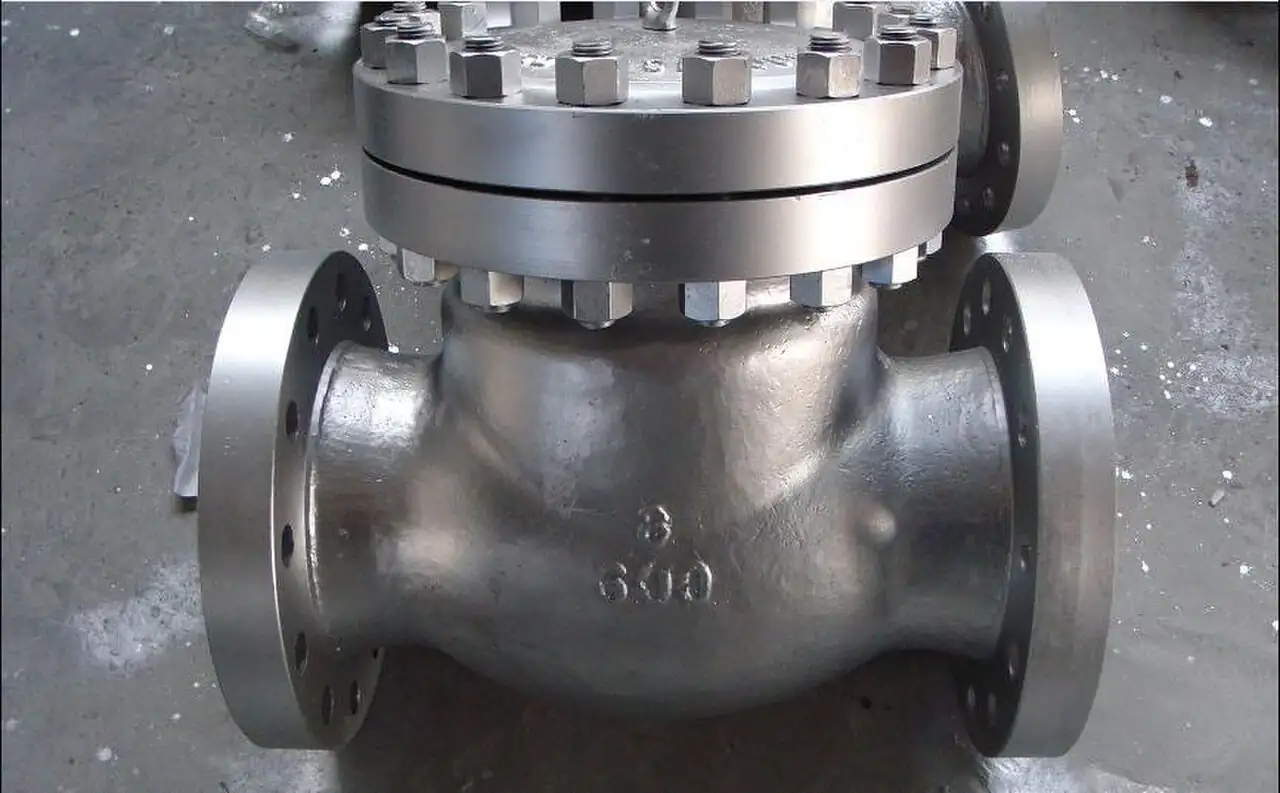
A swing check valve is a self-actuated non-return valve in which a single disc, hinged at the top of the body, swings open under forward flow and drops shut by gravity when flow stops or reverses. It is the oldest and most widely used check valve mechanism, prized for a near full-bore, low pressure-drop flow path and a construction with only one moving part. Like all check valves it has no handle, stem, or external actuator: the disc is moved only by the fluid itself and by gravity, with a spring or counterweight added when faster closure is needed.
The same simplicity that makes swing checks reliable also makes them the most slam-prone of the common check types. A long-arc disc that is still partly open when flow reverses can be driven onto its seat by the reverse column, producing the violent surge known as check valve slam. This guide decodes the swing-check family, from plain bolted-bonnet and pressure-seal designs to tilting-disc and swing-flex variants, the standards that govern them, and the parameters that separate a quiet, long-lived valve from a noisy liability.
This guide is written for procurement engineers and design engineers selecting swing check valves before a capital purchase. It covers 6 chapters from working principle and history, type classification, slam and dynamic closure behavior, body materials and trim, to spec-sheet decoding and selection decisions, with 7 selection FAQs and manufacturer comparisons. All parameters reference the API 6D and API 594 valve standards, BS 1868 for steel swing and tilting-disc checks, BS 5153 and EN 12334 for cast-iron checks, AWWA C508 for waterworks swing checks, ASME B16.34 pressure-temperature ratings, ASME B16.10 face-to-face dimensions, and API 598 or ISO 5208 inspection and test criteria.
Chapter 1 / 06
What is a Swing Check Valve
A swing check valve is a directional, self-actuated valve that permits flow in one direction and closes automatically against reverse flow. Its defining feature is a single disc hinged at the top of the body on a pin. Forward flow pushes the disc off its circular seat and swings it up and clear of the bore, giving a near full-bore, low-restriction opening. When forward flow decays, stops, or reverses, the disc swings back down under its own weight and the developing reverse pressure seats it firmly, blocking backflow. Because the disc is moved only by the fluid and by gravity, a swing check needs no handle, stem, actuator, or operator, and it consumes no signal or power.
Structurally a swing check valve has four functional parts: (1) the body, with inlet and outlet bores and an integral or renewable seat ring; (2) the disc, with a machined seating face and a clevis boss that carries the hinge arm; (3) the hinge arm and pin, which let the disc rotate through its arc and which set the disc geometry; and (4) the cover, bonnet, or cap that closes the body cavity above the disc and provides access for inspection and seat lapping. On a horizontal valve the bonnet or cap sits at the top so the disc can swing freely and gravity assists seating. The seat ring and disc face are the wear interfaces and are commonly renewable bronze, 13-chrome stainless, or Stellite hardfacing.
Check valves are among the oldest valve concepts: hinged-flap non-return devices appear in Roman and Renaissance pumps, and the modern bolted-bonnet swing check took its present form alongside cast-steel gate and globe valves in the late nineteenth and early twentieth centuries. The swing check is one of the five common check mechanisms recognized in the literature, the others being lift (piston and ball), butterfly or dual-plate, tilting-disc, and stop-check. Of these the swing check remains the default for large-diameter, relatively steady, horizontal service because of its full-bore path and mechanical simplicity.
Functionally a swing check valve protects rotating equipment and piping. On a pump or compressor discharge it prevents backspin and reverse rotation when the unit stops; on elevated or looped piping it prevents drain-down and column separation; on boiler feed and condensate systems it keeps flow moving the right way; and on potable and process headers it blocks backflow contamination. Despite this breadth of duty, the swing check is also one of the most commonly mis-selected components in a piping system. The wrong stroke geometry or an oversized body causes disc flutter, accelerated seat wear, and slam, which is why the dynamic behavior covered in Chapter 3 matters as much as the static pressure rating.
It is worth fixing terminology early. Swing check valve, non-return valve (NRV), one-way valve, reflux valve, and backflow valve are regional and industry synonyms for the same class of device. North American and oil-and-gas specifications favor check valve, while European, marine, and water-utility documents often write non-return valve. The word swing is the type designation that tells you the mechanism is a hinged disc rather than a lift piston or an axial nozzle. On a piping line list or datasheet, read the type word, not just the generic term, to know what you are buying.
Chapter 2 / 06
Swing Check Valve Types
Within the swing-check family the variants differ in three ways: how the body cavity is closed (cover construction), how the disc is hinged and stroked (disc geometry), and how end connection and face-to-face length are set (body pattern). The table below summarizes the five mainstream swing-check variants and the service each suits. Choosing the wrong variant is the most common selection error, because a plain bolted-bonnet swing check and a tilting-disc swing check look similar on a line list but behave very differently on pump-trip transients.
Variant
Disc / Stroke
Typical Class Range
Best Suited To
Bolted-bonnet swing
Single long-arc disc
150 to 2500
General process, steady horizontal flow
Pressure-seal swing
Single long-arc disc
600 to 2500
High-pressure, high-temperature steam and power
Wafer / API 594 Type A
Short single or dual plate
150 to 2500
Tight spaces, pump discharge, HVAC
Tilting-disc swing
Off-center pivot, ~25 deg open
150 to 2500
Large lines, pump and compressor discharge
Swing-flex / resilient hinge
Flexing disc, 35 deg stroke
to 250 psi
Waterworks and wastewater, non-slam
Bolted-bonnet swing check is the baseline design: the body cavity is closed by a flanged cover bolted down on a spiral-wound or ring-joint gasket, giving easy access to the disc, hinge, and seat for inspection and lapping. The single disc swings through a long arc, so the open path is essentially full bore with minimal pressure drop at full lift. This construction dominates Class 150 to 2500 process service, in flanged or butt-welding ends, and is the form most people picture when they say swing check. Its weakness is the long closing stroke, which makes it the most slam-prone variant on rapid flow reversal.
Pressure-seal swing check replaces the bolted cover with a pressure-seal bonnet, in which line pressure energizes a sealing ring so the joint gets tighter as pressure rises. This is the standard high-energy construction for Class 600 to 2500 steam, boiler-feed, and power-plant service, where a bolted cover would be impractically large. The disc and hinge are the same long-arc geometry as the bolted-bonnet design, so pressure-seal swing checks share the same slam tendency and are frequently fitted with a counterweight, spring, or external dashpot on pump-discharge duty.
Wafer and API 594 Type A designs compress the swing check into a short face-to-face body that bolts between two pipe flanges. The obturator may be a single short-arc swing disc or a spring-loaded dual plate. Wafer and lug bodies save weight, length, and cost, which is why they are common on pump discharge, cooling water, and HVAC headers where space is tight. API 594 also defines a Type B long-pattern bolted-cover swing check whose face-to-face follows ASME B16.10 and which resembles a gate or globe valve in length, chosen where more body strength is wanted in higher-pressure or higher-temperature service.
Tilting-disc swing check pivots the disc on an off-center axis rather than hinging it at the top. The disc rotates closed through a much shorter stroke, and at full open it sits at roughly 25 degrees to the flow axis, giving a low-restriction path whose flow coefficient beats most plain swing discs. Because the upper portion of the disc catches reverse pressure earlier, the tilting disc begins to close before significant reverse velocity develops, which makes it markedly less slam-prone, especially with an external hydraulic dashpot. Tilting-disc checks are the workhorse for large high-flow lines and for pump and compressor discharge.
Swing-flex and resilient-hinge checks are the waterworks evolution of the swing check, listed in AWWA C508. They use a flexing elastomer disc with steel and fabric reinforcement, hinged so the disc travels a short 35-degree stroke from a seat slanted at about 45 degrees. The short stroke gives quick, non-slam closure and low head loss with only one moving part, in ductile-iron or stainless bodies from 2 to 48 inch and rated to about 250 psi (17 bar). This is the dominant non-slam swing check for potable water, raw water, and wastewater pumping, frequently certified to NSF/ANSI 61 and 372 for drinking-water contact.
Chapter 3 / 06
Slam and Dynamic Closure
The single most important engineering property of a swing check is not its pressure rating but its dynamic closure behavior, because that is what determines whether the valve runs quietly or slams. Slam is a water-hammer event: when forward flow decays and reverses, a disc that is still partly open is driven onto its seat by the reverse column, and the abrupt stop of that reverse mass generates a pressure surge that can damage pumps, piping, and fittings. The governing variable is the reverse velocity present at the instant of seating: the higher the reverse velocity at closure, the larger the surge and the harder the impact on the seat.
Field experience gives a practical threshold. Reverse velocity up to about 0.3 m/s (1.0 ft/s) at the moment of closure is treated as a mild, tolerable slam, while higher reverse velocities produce loud, potentially damaging surges. The reverse velocity that actually develops depends on the system, not just the valve: how fast forward flow decays after a pump trip (the flow-reversal deceleration), the pipe length, and the elevation profile all set how much reverse motion accumulates before the disc seats. A valve that is benign on a short, flat line can slam violently on a long discharge with high deceleration, which is why a swing check must always be matched to its system dynamics.
The cure for slam is to reduce the closing stroke or to close the disc before reverse flow builds. The table below ranks the swing-check options by how aggressively they suppress slam, and gives the qualitative trade-off in head loss and cost. The general rule is that anything which shortens the disc stroke or biases the disc toward the seat before reversal reduces slam, at the cost of either more head loss or more mechanical complexity.
Closure Strategy
Slam Suppression
Head Loss
Notes
Plain long-arc swing
Lowest
Lowest
Most slam-prone; avoid on rapid pump-trip unless damped
Swing + counterweight / spring
Low to medium
Low
Biases disc closed before reversal
Tilting-disc (with dashpot)
Medium to high
Low
Short stroke, ~25 deg open, earlier closure
Swing-flex / resilient hinge
High
Low
35 deg stroke, non-slam, AWWA C508 waterworks
Nozzle (axial) / dual-plate
Highest
Medium
Spring-loaded, closes before reverse flow develops
Counterweights and springs bias a conventional swing disc toward the seat so it starts closing earlier in the deceleration, shortening the effective open time. An external lever and counterweight can also be tuned to balance disc inertia, and an oil dashpot on the same lever cushions the final seating so the disc lands without impact. These add-ons keep the full-bore advantage of the swing geometry while cutting the surge, and they are common on pressure-seal and large bolted-bonnet checks on power and pumping service.
Tilting-disc checks attack slam through geometry rather than added force. The off-center pivot gives a short rotational stroke, the disc catches reverse pressure on its upper half and begins to close before significant reverse velocity builds, and an external hydraulic dashpot can cushion the last few degrees of travel. The combined effect is a substantial reduction in pump-trip surge spikes compared with a plain long-arc swing of the same size, while preserving a low-restriction flow path.
Swing-flex, resilient-hinge, and nozzle checks are purpose-built non-slam designs. The swing-flex disc travels only a short 35-degree stroke and reseats before the reverse column gathers momentum, which is why it dominates waterworks pump stations. Nozzle and dual-plate checks go further: a spring closes the obturator through an ultra-short axial or split stroke, so the valve is shut before damaging reverse velocity can develop at all. Where a system has high reverse-flow deceleration, for example a large boiler-feed pump trip, even a dashpotted tilting disc may struggle, and a spring-loaded nozzle check is the safer choice. The penalty for these designs is somewhat higher head loss and unit cost.
Chapter 4 / 06
Body Materials, Trim, and Standards
Body and trim selection follows the line material, the media, and the temperature, and is constrained by the pressure-temperature ratings of ASME B16.34. The body alloy sets the pressure-temperature envelope and corrosion resistance, while the trim, meaning the seat ring and disc face, sets the shutoff tightness and wear life. A mismatch causes seat leakage, wire-drawing, or, in corrosive service, body wall loss. The table below maps common service conditions to typical swing-check body materials and their ASTM designations.
A216 WCB cast carbon steel is the default body for water, oil, steam, and non-corrosive process across Class 150 to 2500, and is by far the most common swing-check body. Its rating falls off with temperature per ASME B16.34, and its low-temperature limit is around minus 29 degrees Celsius, below which the steel risks brittle fracture. For colder duty, A352 LCB or LCC low-temperature carbon steel is impact-tested and rated down to about minus 46 degrees Celsius, and forged constructions such as the Velan CHK series extend to roughly minus 101 degrees Celsius (minus 150 degrees Fahrenheit).
A351 CF8 (304), CF8M (316), and CF3M cast stainless bodies cover corrosive, sanitary, and cold service; 316 (CF8M) is rated for cryogenic-adjacent duty and tolerates many acids, chlorinated organics, and food and pharmaceutical media. For aggressive chloride service, duplex 2205, Monel, and nickel alloys raise the pitting and stress-corrosion resistance well above 316. Cast iron (A126) and bronze (B62) bodies remain common on low-pressure potable water and HVAC, where their cost advantage outweighs their lower strength.
Trim is selected for tightness and wear. Renewable bronze or 13-chrome stainless seat rings, threaded or pressed into the body, are standard, and the disc seating face or the seat ring is frequently overlaid with Stellite hardfacing for high temperature, erosive flow, and long cycle life. Soft inserts in PTFE, NBR, EPDM, or FKM give bubble-tight shutoff at moderate temperature, while all-metal trim handles high temperature and abrasives at the cost of a small allowable leakage rate. The seat tightness achieved is verified by test, not assumed.
Several standards govern swing checks depending on service. API 6D is the pipeline standard for full-bore swing and other checks on oil and gas transmission lines, covering ASME pressure Classes 150 through 2500 only; the higher API 2000 to 15000 psi rated-working-pressure designations belong to API 6A wellhead equipment, not to API 6D pipeline checks. Pipeline-service valves such as the Velan CHK series are built to API 6D with ISO 5208 and API 598 seat testing and API 607 or API 6FA fire testing. API 594 covers compact checks by face-to-face length, Type A short-pattern wafer and lug and Type B long-pattern bolted-cover swing, in Classes 150 to 2500 with face-to-face per ASME B16.10. BS 1868 specifies steel swing and tilting-disc checks; BS 5153 and EN 12334 cover cast-iron checks; and AWWA C508 covers waterworks swing checks 2 to 48 inch. Inspection and testing follow API 598 or the ISO 5208 leakage classes.
Chapter 5 / 06
Key Specification Parameters
Reading a swing-check datasheet is a fundamental procurement skill. A line list may show only nominal size and class, but the spec sheet carries a dozen parameters, and the ones below are the eight that actually drive selection: nominal size, pressure class, body and trim materials, end connection, face-to-face length, seat leakage class, cracking pressure, and minimum full-open velocity. Each is decoded here.
Nominal size and pressure class are the headline numbers. Swing checks span roughly DN50 to DN900 (2 to 36 inch) in the common process range, with larger waterworks sizes to 48 inch, in ASME Class 150, 300, 600, 900, 1500, and 2500 (PN16 to PN420), which is the full class range API 6D allows for pipeline check valves. Class is not the working pressure: the allowable working pressure for a given class falls as temperature rises, following the body-material curve in ASME B16.34. Always read the rating at the actual operating temperature, not the cold rating.
End connection and face-to-face set how the valve fits the line. Common ends are raised-face or ring-joint flanges, butt-welding ends, and wafer or lug bodies clamped between flanges. Face-to-face or end-to-end length follows ASME B16.10 for flanged and welded valves and the API 594 patterns for compact checks; a 6-inch Class 150 long-pattern (Type B) swing check, for instance, has a face-to-face of 356 mm (14.0 inch) per ASME B16.10, whereas a 6-inch Type A wafer check is only on the order of 60 to 98 mm. Wafer Type A bodies are far shorter than Type B bolted-cover bodies, which matters when a valve must drop into an existing spool.
Seat leakage class quantifies allowable backflow leakage at the test pressure, verified per API 598 or ISO 5208. Soft-seated checks are typically specified for zero visible leakage (bubble-tight), while metal-seated checks carry a small allowable rate that scales with seat diameter. The class you specify must match the duty: a process isolation check may demand bubble-tight, while a cooling-water check tolerates a metal-seat rate. Fire-tested designs additionally meet API 607 or API 6FA, which verify that the valve still seals after exposure to flame.
Cracking pressure and closure aids describe the dynamic behavior. A plain gravity swing check has a near-zero cracking pressure set only by disc weight, so it opens at the slightest forward differential, but it also relies on flow reversal to close, which is the slam risk. Spring-assisted and resilient-hinge checks add a defined closing force and a short stroke for non-slam service. Where the datasheet offers a counterweight, spring, or oil dashpot, that option is the lever you use to tune closure to the system, as covered in Chapter 3.
Minimum full-open velocity is the parameter most often ignored, and the cause of most flutter complaints. A swing disc needs a minimum forward velocity to hold it firmly against its full-open stop; below that velocity the disc floats and flutters against the seat, wearing both. The manufacturer publishes a minimum-full-open velocity curve, on the order of 1 to 3 m/s for water depending on type, alongside the flow coefficient (Cv or Kv). Sizing for flow rather than line size, sometimes one nominal size below the line, is what keeps the disc stable. The remaining datasheet items, ambient and media temperature limits, weight, and certifications, complete the specification.
Chapter 6 / 06
Selection Decision Factors
To turn the preceding chapters into a specific model, follow the decision sequence below. Most swing-check failures come not from a single wrong choice but from settling size and pattern before the dynamic duty is understood. These eight steps can serve as a fixed RFQ template.
Service and flow direction: Confirm the medium, normal and minimum flow, temperature, and the direction the valve must protect (pump backspin, drain-down, backflow contamination). Establish whether the line is horizontal or vertical, and for vertical lines confirm upward flow only unless a spring-assisted design is specified.
Dynamic duty and slam risk: Decide whether the service has rapid flow reversal, for example a pump or compressor trip on a long or elevated discharge. If so, target a closure aid up front: tilting-disc with dashpot, swing-flex, counterweight or spring, or a nozzle check, and keep reverse velocity at closure near or below 0.3 m/s.
Size for flow, not line: Use the manufacturer minimum-full-open velocity curve and Cv or Kv to size so normal flow holds the disc against its stop. Accept a one-size-smaller body on low-velocity water service rather than tolerate flutter.
Pressure class and rating at temperature: Select ASME Class 150 to 2500 (the full range API 6D allows for pipeline checks) and verify the allowable working pressure at the actual operating temperature against the ASME B16.34 body curve, never the cold rating alone.
Body and trim materials: Match the body to media and temperature per Chapter 4 (A216 WCB, A352 LCB/LCC, A351 CF8/CF8M, duplex, or bronze), and choose seat and disc trim (bronze, 13-Cr, Stellite, or soft seat) for the required tightness and wear life.
End connection and face-to-face: Choose flanged, butt-welding, or wafer/lug ends, and confirm the face-to-face per ASME B16.10 or the API 594 pattern fits the spool. Wafer Type A is short; Type B bolted-cover is gate-valve length.
Standards, leakage class, and certifications: Specify the governing standard (API 6D, API 594, BS 1868, AWWA C508), the seat leakage class (API 598 or ISO 5208, bubble-tight or metal-seat rate), fire-test (API 607 or 6FA), pressure directive (PED 2014/68/EU), and potable certification (NSF/ANSI 61 and 372) where applicable.
Total cost of ownership (TCO): Weigh purchase price against installation, the surge-damage risk of an under-specified slam valve, seat and hinge-pin wear, and serviceability. A cheap long-arc swing on a high-transient discharge can cost far more in pump and pipe damage than the premium for a damped or non-slam design.
One last commonly overlooked dimension is serviceability over the valve life. A bolted-bonnet swing check allows the cover to be removed for disc inspection, seat lapping, and hinge-pin replacement in place. Hinge-pin-to-bore clearance is a wear point: it starts at roughly 0.05 to 0.10 mm, and wear past about 0.4 mm causes disc chatter and seat wire-drawing, so a renewable pin and bushing is worth specifying. Renewable, seal-welded, or Stellite-overlaid seats extend the rebuild interval, and a manufacturer with local spare parts and field service shortens repair response after years of operation. Velan, Bonney Forge, Wheatley (Cameron, now SLB), Crane, and KSB all offer swing-check families across cast and forged steel with documented spares support, which makes them dependable choices for large projects.
FAQ
How does a swing check valve work?
A swing check valve has a single disc hinged at the top of the body on a pin. Forward flow pushes the disc off its seat and swings it up and out of the flow path, giving a near full-bore, low-restriction opening. When forward flow slows, stops, or reverses, the disc swings back down under its own weight, and reverse pressure seats it against a circular seat ring to block backflow. There is no handle, stem, or external actuator: the disc is moved only by the fluid and by gravity. Because closure depends on gravity and developing reverse flow, a plain swing check is inherently a flow-reversal-closing valve, which is the root cause of its tendency to slam on sudden pump trip.
What is the difference between a swing check valve and a lift check valve?
They differ in how the closure element moves. A swing check valve uses a disc hinged at the top that rotates through an arc, so it offers a full-bore, low pressure-drop path and suits larger lines on relatively steady flow. A lift check valve uses a disc or ball that rises vertically off a horizontal seat, guided by the body, and reseats straight down; its flow path turns through the body like a globe valve, giving a higher pressure drop but tighter, more positive shutoff at small sizes and high pressures. As a rule, swing checks are preferred for low-velocity, large-diameter, horizontal service, while lift checks suit small-bore, high-pressure lines and are often paired with globe-pattern piping. Both are self-actuated non-return valves.
Why do swing check valves slam and how do I prevent it?
Slam happens because a long-arc swing disc is still partly open when forward flow reverses; the reverse column then drives the disc onto the seat at high speed, producing a pressure surge (water hammer). Field practice treats reverse velocity up to about 0.3 m/s (1.0 ft/s) as a mild, tolerable slam, while higher reverse velocities produce loud, damaging surges. Cures, in order of effectiveness, reduce the closing stroke or close the disc before reverse flow builds: switch to a tilting-disc swing check whose short rocker stroke and external hydraulic dashpot cut the surge; use a swing-flex or resilient-hinge check whose short 35-degree disc stroke gives non-slam closure; add a counterweight, spring, or oil dashpot to a conventional swing check; or move to a nozzle (axial) or dual-plate check on high-transient pump-discharge service. Plain long-arc swing checks should be avoided on rapid pump-trip duty unless damped.
Can a swing check valve be installed vertically?
A conventional gravity-closed swing check is intended for horizontal lines, or for vertical lines with upward flow only. In horizontal service the bonnet cap or hinge pin must be at the top so the disc swings freely and gravity helps it seat. In a vertical line, only upward flow is acceptable: the disc opens with upflow and closes when flow stops, while downward flow would simply hold the disc open and defeat the valve. If vertical-down or any-orientation service is required, specify a spring-assisted swing check, a tilting-disc check with spring, or a different type such as a nozzle or dual-plate spring check. Always respect the flow-direction arrow cast into the body and confirm the installable orientation on the datasheet.
What standards govern swing check valves?
Several standards apply depending on service. API 6D is the pipeline standard for full-bore swing and other check valves on oil and gas transmission lines, covering ASME pressure Classes 150 through 2500 only; the higher API 2000 to 15000 psi rated-working-pressure designations belong to API 6A wellhead equipment, not API 6D pipeline checks. API 594 covers compact check valves by face-to-face length, including Type A short-pattern wafer and lug designs and Type B long-pattern bolted-cover swing checks, in Classes 150 to 2500. BS 1868 specifies steel swing and tilting-disc checks, BS 5153 covers cast-iron checks, and EN 12334 is the European cast-iron check standard. Pressure-temperature ratings follow ASME B16.34, face-to-face dimensions follow ASME B16.10, and inspection and testing follow API 598 or ISO 5208 leakage classes. Waterworks swing checks 2 to 48 inch follow AWWA C508, and fire-tested designs follow API 607 or API 6FA.
Which body and trim materials should I choose for a swing check valve?
Match the body and trim to the line material, media, and temperature. ASTM A216 WCB cast carbon steel is the default for water, oil, steam, and non-corrosive process across Class 150 to 2500. ASTM A352 LCB or LCC low-temperature carbon steel covers cold service down to about minus 46 degrees Celsius, and Velan CHK-type forged bodies extend to roughly minus 101 degrees Celsius. ASTM A351 CF8 (304), CF8M (316), and CF3M cover corrosive and sanitary duties; cast iron and bronze suit low-pressure water and HVAC. The seat ring and disc face are commonly renewable bronze, 13-chrome stainless, or Stellite hardfacing for high temperature and abrasion, while soft seats in PTFE, NBR, EPDM, or FKM give bubble-tight low-temperature shutoff. For seawater, chloride brine, or wet chlorine, move to duplex 2205, Monel, or nickel alloy.
How do I size a swing check valve so the disc stays fully open?
A swing check must be sized for flow, not simply line-matched. The disc needs a minimum forward velocity to hold it firmly against its full-open stop; an oversized valve runs partly open, so the disc flutters against the seat and causes premature wear, noise, and seat damage. As a rule of thumb, size so normal flow keeps the disc against the stop, which often means the check is one nominal size smaller than the line on low-velocity water service. Use the manufacturer flow coefficient (Cv or Kv) and the minimum-full-open velocity curve, typically on the order of 1 to 3 m/s for water depending on type. Tilting-disc and spring-assisted swing checks tolerate lower and more variable velocities than plain swing discs because the shorter stroke and spring remove flutter.