
For 2026 energy-equipment builds, the resin decision is a three-axis call: service temperature, chemical environment, and fatigue or impact load. Matching those axes against the actual property numbers on the data sheet is what separates a 30-year service life from a 3-year field failure [S1][S4][S5].
The working envelope covers amorphous thermoplastics like bisphenol-A polycarbonate (PC) for enclosures and optics, glass-fibre-reinforced unsaturated polyester and vinyl ester for wind blades and FRP tanks, and high-performance thermoplastics such as PEEK for the hot, chemically aggressive corners of the plant. A typical 100 MW onshore wind farm carries US$640,000 to US$1.5 million of non-blade composite value per project, so the resin pick on those parts has direct bill-of-material weight [S2].
Bisphenol-A Polycarbonate for Enclosures, Optics, and Battery Hardware
Bisphenol-A polycarbonate is the default amorphous engineering thermoplastic for energy-equipment enclosures, with density 1.18–1.22 g/cm³, heat deflection around 135°C unfilled, glass transition near 145–150°C, dielectric constant 3.0–3.2, Izod notched impact 600–900 J/m, and inherent UL 94 V-2 flammability (V-0 achievable with FR grades) [S1]. Mechanically it tolerates low creep under 100°C and snaps into modular energy-cabinet clips, which is why it has displaced phenolic in molded circuit-breaker housings and meter bodies [S1].
The PC slice of the data-center plastics market is projected at a 17.3% CAGR through 2032, the highest of any resin tracked in that study, and that pull is dragging PC into cable and wire management, busway insulation, cooling-system components, and battery module housings [S1]. The synthetic resin encyclopedia entry lays out the same property envelope for cross-referencing during RFQ review. For outdoor cabinets, PV combiner boxes, or pad-mount transformer windows, an FR/UV-stabilised PC/ASA or PC/polyester blend is normally a safer call than neat PC, because unstabilised PC yellows and embrittles under UV [S1].
Vinyl Ester and Epoxy for Wind Blade Infusion and Pultrusion
Wind blade matrix resin is dominated by glass-fibre-reinforced unsaturated polyester and vinyl ester composites processed by vacuum infusion, with epoxy-modified vinyl ester specified for the structural profiles that carry the fatigue load [S4]. The two process gates that drive the resin grade are infusion viscosity (100–300 mPa·s) and pot life (1–2 hours under vacuum) for VARTM, plus a controlled exotherm that fully cures thick laminates without thermal damage [S4].
India’s 140 GW wind target by 2030, up from roughly 44 GW installed, will require tens of thousands of new blades, each consuming 1–15 tonnes of matrix resin depending on size, so the infusion-grade supply chain is now a strategic procurement line rather than a commodity buy [S4]. Epoxy-modified vinyl ester (e.g. RPL-407 pultrusion resin) is the default for spar caps and other structural profiles because it delivers better fatigue life than straight polyester under millions of load cycles across a -40°C to +70°C service window [S4]. The full blade-matrix chemistry picture sits next to the broader electronics resin spec map, which covers moulded electronics housings built from the same resin families.
Isophthalic, Bisphenol, and Vinyl Ester for Chemical-Plant FRP
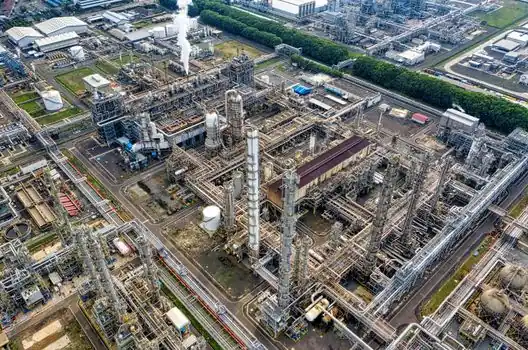
FRP built with the right resin system is 25–40% lighter than steel, fabricates into complex shapes, and gives 20–30+ year service in corrosives where steel fails in 2–5 years [S5]. The three resin tiers used in chemical plant tanks, scrubbers, ductwork, and piping are: isophthalic polyester for dilute acid, alkali, and water service; bisphenol-A fumarate for concentrated organic acids, solvents, and oxidising chemicals; and vinyl ester (including epoxy novolac vinyl ester with heat distortion above 150°C) for chlorine, strong mineral acids up to H₂SO₄ 50% or HCl 35%, and FGD service [S5].
Design discipline matters as much as resin choice: the inner face of any chemical-storage laminate must be a 1–2 mm resin-rich corrosion barrier laid up before the structural laminate, or the glass reinforcement is exposed to direct chemical attack [S5]. The synthetic resin selection guide for construction covers the same resin families but for civil substrates, and is a useful cross-check when the same contractor handles both process and civil FRP scopes.
Thermoplastics for the Hot, Corrosive Corners
High-performance thermoplastics such as PEEK, glass-fibre-reinforced polyamides, and fibre-reinforced polypropylene or polyethylene are taking share in renewable-energy infrastructure where impact, recyclability, and chemical resistance all matter [S7]. PEEK is the typical pick for downhole and geothermal hardware, transformer lead insulation, and any part running continuously above 150°C in oil or aggressive chemistry, because its continuous service temperature sits roughly 80–100°C above unfilled PA66 and its fatigue behaviour under cyclic load is well documented.
For less aggressive service, glass-fibre-reinforced PP and HDPE are the workhorses in cable management, floatation collars on floating PV, and chemical dosing tanks, and they accept the same fusion-welded fabrication used in polyolefin process piping [S7]. Where the requirement is also optical transparency, however, PC is usually substituted, since unfilled polyolefins are opaque and lose stiffness rapidly above 80°C.
Decision Criteria: PC vs Vinyl Ester vs Isophthalic Polyester vs PEEK
Lining the four main resin options for energy equipment against the criteria that actually drive a 2026 RFQ: (1) Continuous service temperature, where PEEK leads at roughly 250°C, vinyl ester and epoxy novolac vinyl ester reach 150–200°C, bisphenol-A PC sits at 120–135°C, and isophthalic polyester caps out near 100°C [S1][S4][S5]; (2) Chemical resistance, where vinyl ester (especially epoxy novolac grades) handles chlorine, HCl up to 35%, and H₂SO₄ up to 50%, bisphenol fumarate covers organic acids and solvents, isophthalic covers dilute acid and alkali, and PC fails in strong alkalis, hydrocarbons, and chlorinated solvents [S1][S5]; (3) Impact and fatigue, where PC posts 600–900 J/m notched Izod and dominates snap-fit and enclosure duty, while vinyl ester and epoxy are chosen for blade spar caps and structural pultrusion running through millions of load cycles [S1][S4]; (4) Process route, where PC injection moulds at 280–320°C, vinyl ester and polyester run through VARTM or pultrusion at room-temperature infusion with heated-die cure, and PEEK needs 370–400°C melt processing with mould temperatures above 170°C [S1][S4][S5].
Failure Modes That Drive Resin Substitution
Three field-failure patterns drive most resin substitution in 2026: UV-driven yellowing and embrittlement of unstabilised PC, which forces the move to FR/UV-stabilised PC/ASA blends for outdoor cabinets [S1]; hydrolysis and stress cracking of PC in high-pressure steam, which rules it out of any wet high-temperature service [S1]; and styrene emission and exotherm damage in thick polyester laminates, which is why low-styrene, long-pot-life, controlled-exotherm systems are now standard for blade infusion [S4].
For FRP chemical equipment, the failure pattern is usually attack of the glass reinforcement through a resin-starve or pinhole in the corrosion barrier, which is why the 1–2 mm resin-rich inner layer is treated as a design requirement rather than a finishing touch [S5]. The marine side of the same problem is mapped in the marine resin selection guide, where vinyl ester and isophthalic grades face seawater and osmotic blistering rather than process chemistry.
Standards, Sourcing, and Trackable Signals
Selection sits on top of a small set of standard references that buyers should call out on the data sheet: UL 94 V-0 or V-2 for flammability rating, glow-wire ignition temperature and comparative tracking index for electrical enclosures, and ASTM or ISO grade designations for the corrosion-barrier laminate thickness in FRP tanks and piping [S1][S5]. For wind blades, the resin supplier should be asked to confirm viscosity, pot life, and Tg_DSC data on the production batch, not just the brochure number [S4].
Two signals to track over the next two quarters: PC-grade announcements aimed at 800 V battery-module housings with UL 94 V-0 and CTI above 400 V, and any domestic infusion-grade vinyl ester capacity additions tied to the 140 GW Indian wind build-out, both of which will reset landed cost and lead time across the resin families discussed here [S1][S4].
For the relevant spec sheets and selection criteria, see synthetic resin, energy management, and energy meter.