
A pair of rectangular keys mounted 90 degrees apart on the same shaft, each key tangent to the shaft circumference, is the standard mechanical answer to a reversing flywheel drive where a single parallel key would slack off every time the load reverses direction [S2]. Tangential keys only develop reaction on one face at a time: forward torque loads one key in compression, reverse torque flips the load to the second key 90 degrees around the shaft, which is exactly why they are specified for large reversing flywheels, hoists, and rock-crusher drives rather than for steady one-direction power transmission [S2].
The practical difference between hobby flywheels and industrial reversing flywheels is twofold: industrial hubs get a matching tapered keyway, and they often get two keys instead of one. The tapered keyway locks the key into the hub by wedge action rather than relying on a set screw or a cap at the end of the shaft, and the 90-degree twin arrangement keeps one key positively loaded no matter which way the shaft turns [S1].
Why a Single Tapered Key Fails Under Reverse Torque
A standard parallel rectangular key is a two-way device only as long as it is a sliding fit: the clearance that lets it assemble is the same clearance that lets it rock when the load reverses, and a rocking key hammers the keyway ends until it either shears the key or mushrooms the hub [S5]. A single tapered key driven into a matching tapered keyway is a one-way device: its taper face carries compression load only in the direction of drive, and on reversal the key tends to back out of its own taper [S1]. Practitioners have observed exactly this on working engines, where a tapered key driven into a parallel hub keyway can work loose from wedging action against the corner of the straight keyway under repeated reversals [S1].
The textbook way to break that one-way lock-out is to add a second tangential key 90 degrees around the shaft. Because the two keys are mounted tangent to the shaft on perpendicular centerlines, the rotational direction that unloads key A simultaneously loads key B in compression, and the shaft never sees a half-cycle where both keys are slack [S2]. This is the geometry that heritage Corliss valve gears, large reversing mill drives, and stationary engine flywheels have used for over a century, and it is still the default when a flywheel is asked to absorb and return energy through a reversing prime mover [S1].
Taper Ratios: 1:96 Imperial, 1:100 Metric, and the Old 1:12 Misread
The taper written onto a flywheel key is small by general machining standards and is easy to misquote. The historical UK figure is 1 in 96, equivalent to 1/8 inch rise over 12 inches of length, while the metric equivalent is 1 in 100; the much-quoted 1 in 12 figure refers to the taper on the end of a conical shaft seat, not to the key itself [S1]. When a key blank is ground to 1:96 on a length of, say, 150 mm, the total height change end-to-end is only about 1.56 mm, which is why sine tables, spacer-and-rule setups, or a broach bush with a tapered slot are used rather than a swivelling vice [S1].
Cutting the hub keyway to match is the second half of the job, and the part most often skipped on small or model flywheels. A standard keyway broach guided through a bush with a 1:96 (or 1:100) tapered slot reproduces the same wedge angle in the hub so the key seats positively along its full length rather than only at one corner [S1]. Where the hub is too narrow to broach in a single pass, slotting at an angle on a milling machine achieves the same result; the point is that both sides of the joint share the taper, otherwise the key is just a parallel key with a slight uphill floor.
When a Single Shear Key Is the Right Answer Instead
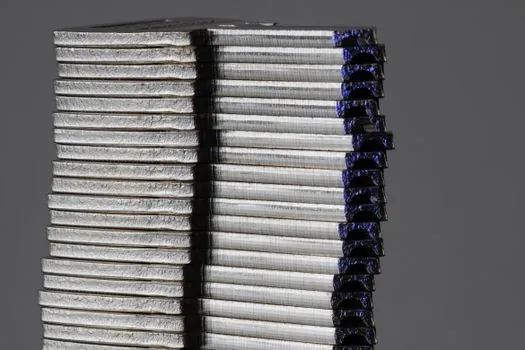
Not every flywheel key is supposed to be a structural drive key. Small-engine flywheels (lawnmowers, portable generators, chainsaw powerheads) are routinely fitted with a soft-metal key, typically aluminum, sized so that it is the weakest link in the driveline [S5]. On a hard backfire or sudden stop, that key is meant to shear before the crankshaft, the flywheel, or the bearing arrangement does, and the operator is then supposed to see a no-start condition with full compression and good spark rather than a bent crank [S5].
The diagnostic chain is straightforward: confirm the key has sheared by checking the timing mark against compression peak, replace the key with a correct OEM part, and always inspect the flywheel itself for cracks because an event severe enough to shear a key can crack the casting as well [S5]. These keys are not tangential, they are not paired, and they are not tapered to wedge: they are parallel shear pins intended to fail, and confusing their role with a tangential drive key is the most common specification error on a retrofit job [S5].
Failure Modes Observed in the Field
Sheared keys on small engines present as a hard-start or no-start condition with normal compression and normal spark, because the flywheel has rotated relative to the crankshaft and the ignition timing mark no longer lines up with the compression stroke [S5]. On tangential key arrangements, the failure mode is different: rather than shearing, the key either migrates axially out of a parallel hub keyway, or it hammers the end grain of the keyway into a bell-mouth, and the second key 90 degrees away is what carries the drive while the loose key makes noise [S1][S2].
Repair-time data on a typical small-engine shear ranges from 45 to 90 minutes for the flywheel puller and reinstallation work, with the replacement part costing $2-8 in most cases; the expensive part is not the key but the flywheel puller, the access to the recoil housing, and the torque check on reinstallation, which is typically 40-55 ft-lbs depending on engine size [S5]. For a tangential key on a large reversing flywheel the repair is a machine-shop job: the hub keyway has to be recut to its original taper, the key blank has to be reground to match, and both keys are usually replaced as a pair so the contact pattern stays symmetric.
Material, Pairing, and Cap Retention
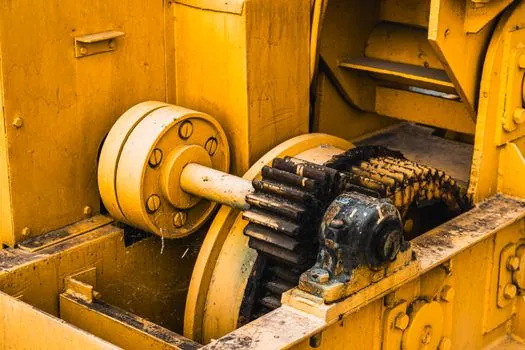
For reversing service the keys are medium-carbon steel, often EN8 / AISI 1045 or 4140, hardened to roughly 30-35 HRC so they can take the repeated shock of a reversing flywheel without brinelling the hub. A softer key will deform and gradually lose its taper match; a harder key will gall the hub keyway and crack it on the first severe reverse. The 90-degree pair is what makes the assembly reversible, not the key material, so specifying a high-grade key in a single-key arrangement does not buy reversibility [S2].
Large industrial flywheels often add a third retention feature on top of the tangential pair: an end cap bolted onto the end of the crankshaft, or a Castle nut with a split pin, that keeps the keys from migrating axially even if one of the two tapers does slack off [S1]. For a sense of how the same principle of paired, opposing load paths shows up in rolling-element bearing arrangements, see tandem angular contact bearing arrangement; the geometric logic of stacking two single-direction devices to cover both directions is the same one that drives the 90-degree tangential key pair.
Sourcing Tapered and Tangential Keys Off the Shelf
Stock tangential keys in standard metric and imperial widths are catalog items from industrial key suppliers, but the matching tapered hub keyway is not: that is almost always a machined feature, either broached with a tapered guide bush or cut on a mill with the table set over to the key taper angle [S1]. Generic Woodruff and parallel-shaft key sets cover flywheel and crankshaft repairs in the small-engine and light-machinery range, but the taper of a true flywheel drive key is shallow enough that a parallel key blank is not a drop-in substitute [S6].
For one-off large tapered flywheel keys the realistic options are a machine shop making the blank from silver steel, or a specialist industrial key supplier willing to cut to a 1:96 or 1:100 drawing; off-the-shelf gib-head and parallel stock will not give the correct wedge angle on its own, and a parallel key jammed into a tapered hub keyway is a guaranteed future rework [S1]. Buyers should specify the taper explicitly, the nominal width and height, the length over the tapered section, and whether both hub and shaft keyways are to be matched, because the only thing worse than a missing key is a key that does not match its own seat.
For the related decision of specifying sealing washers in reversing or vibration-loaded bolted joints, PTFE vs compressed fiber washers covers the same paired-versus-single choice from a fastener-sealing angle. A 2026-10 reference point for tangential key geometry remains Machinery's Handbook and Kempe's Engineers Year Book (1965 edition cited in practitioner discussion [S1]); the imperial 1:96 versus metric 1:100 distinction is the single most-asked question when retrofitting older UK-built flywheels onto modern metric shafts, and it is the number to confirm on the drawing before the key blank is ground.
For the relevant spec sheets and selection criteria, see shaft key, pressure transmitter, and flow meter.