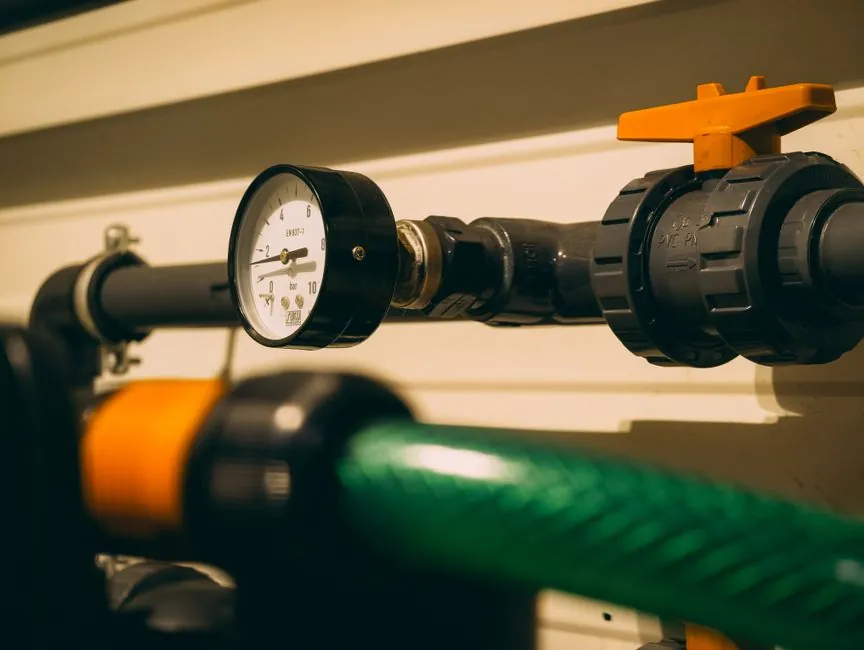
A hose listed as 500 psi at 21°C (70°F) derates to 320 psi at 66°C (150°F) once a 0.64 factor is applied, a worked example from Continental ContiTech's Tip 91 sheet that shows why catalog WP cannot be used unaltered [S4].
Catalogue working pressure (WP) is published at ambient, typically 21°C (70°F) [S5]; above that point, elastomers soften, polymers creep, and metal assemblies lose alloy strength, so the assembly WP is the catalog WP multiplied by the limiting derating factor for hose, braid, and fittings, and the lowest resultant governs the whole assembly [S2][S4][S7].
How Derating Curves Are Built: Reference Temperature and Family Limits
Reference temperature is 21°C (70°F) for the US catalog convention and 20°C for the European bar-rated convention, with the same physical meaning: a hose rated 20 bar at 20°C may only be safe at 10 bar at 80°C once the derating curve is applied [S1][S5].
Hydraulic rubber hose families have a continuous fluid limit of -40°C to +100°C and an intermittent limit near +120°C; the SAE 100R12, 100R13, and 100R15 spiral constructions push the continuous limit to +121°C, and PTFE extends the upper end to +204°C with a -54°C cold floor [S3].
Thermoplastic 100R7/100R8 hose caps at +93°C continuous, so any hydraulic loop running above that must move to spiral-wire rubber or PTFE before any pressure is even calculated [S3].
Reading the Derating Chart: Alloy, Polymer, and the 0.64 Worked Example
For corrugated metal hose, the NAHAD Hose Safety Institute (HSI) Handbook provides per-alloy derating factors; the assembly WP is the catalog WP multiplied by the most limiting factor across the hose alloy, the braid alloy, and the fitting method [S2].
Rubber and plastic hose charts are published per polymer family; the same 150°F (66°C) operating point returns a 0.64 derating factor on the chart, so 500 psi catalog WP becomes 320 psi allowable WP, and that 320 psi is the new ceiling for the whole assembly [S4][S9].
Stainless steel braid retains strength at cryogenic temperatures where carbon steel embrittles, so for sub-ambient service the derating direction reverses: a 304/316 corrugated assembly can be run at or near its catalog WP at -196°C, while a carbon-steel braid on the same hose must be re-specified [S2].
Materials Compared on Pressure, Temperature, and Chemistry
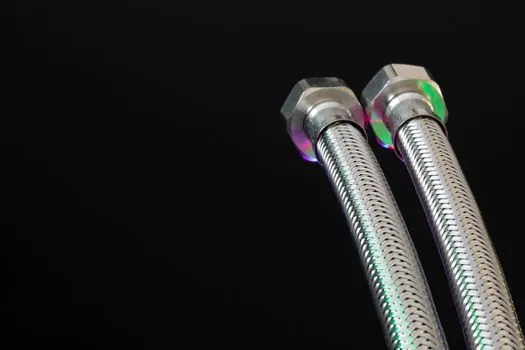
Rubber hose typically covers 10-40 bar (roughly 145-580 psi), fits air, water, and mild chemicals, and is the default for low- and medium-pressure service up to 300 psi or 300-3,000 psi depending on construction [S1][S5].
PTFE hose exceeds 70 bar (about 1,015 psi), holds chemistry against aggressive media, and takes the upper temperature bracket to +204°C continuous, which is why it is the standard for high-purity chemical, pharmaceutical, and steam dosing lines [S1][S3].
Stainless steel corrugated hose handles the extreme temperature bracket on both ends, from cryogenic LNG service to high-temperature steam headers, and the published factor is per-alloy in the HSI Handbook tables rather than a single polymer curve [S2].
Common hydraulic service spans 300 psi low-pressure lines up to over 10,000 psi high-pressure hydraulics, with operating media temperatures typically 40°C to 120°C in mobile machinery and 60°C to 150°C in industrial presses [S5][S6].
Selection Criteria: Catalog WP, Derating Factor, and the Weakest-Link Rule
Selection starts with the catalog WP at the reference temperature, then multiplies by the derating factor at the maximum operating temperature, and finally applies the lowest-rated-component rule across hose, couplings, adapters, clamps, and seals [S2][S4][S5].
A 300 psi hose fitted with 500 psi couplings and a 200 psi adapter has an assembly WP of 200 psi, because the lowest-rated component governs; a hose derated to 320 psi by temperature but fitted with 250 psi couplings must be further clipped to 250 psi [S4][S5].
A 25% safety margin above maximum operating pressure is standard practice, so a 200 bar system should be specified against a hose whose derated WP at operating temperature is at least 250 bar, not just 200 bar [S1].
Use Cases by Service: Steam, Hydraulics, Chemicals, Cryogenics
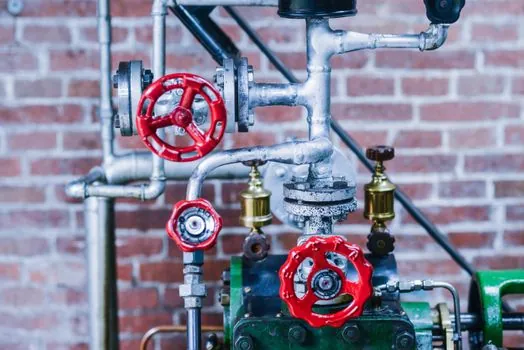
Steam hose selection is entirely derating-driven: saturated steam lines above 150°C cut catalog WP sharply, and the published chart must be read at the actual steam pressure and steam temperature, not at the hose's room-temperature number [S10].
Standard mobile hydraulics at 80-100°C continuous fluid usually stay inside the 1.0 factor for 100R1/100R2 rubber, but a sustained 110°C loop in a hot climate already needs the 0.93-0.95 region of the chart, and any +120°C intermittent excursion is the hard ceiling for standard rubber [S3].
Chemical transfer with aggressive solvents at 60-120°C is the PTFE domain, where the +204°C continuous rating gives headroom against both temperature derating and chemical permeation, at the cost of higher price per metre than rubber [S1][S3].
Cryogenic LNG and nitrogen service at -162°C to -196°C is the stainless corrugated domain, with no temperature-derating penalty and a warning that carbon-steel braid components are not suitable for low-temperature duty [S2].
Limits, Failure Modes, and Verification Before Purchase
Service life halves for every 10°C of sustained over-temperature, and seal life can drop 80% or more on the same 10°C overshoot; these are hose-maker and seal-vendor rules of thumb, not standard-mandated numbers, so they belong in the margin-buying decision rather than the spec line [S3].
Failure mode at the elevated-temperature end is coupling blow-off: hot rubber softens, the shank loosens in the hose, and the rated coupling is no longer held at its catalog pressure, which is the mechanical reason derating factors exist at all [S4].
Always ask the supplier for the four temperature numbers (continuous fluid, intermittent fluid, ambient, surface exposure) and the derating curve at the actual operating point, not just the headline WP, before purchase; rubber hose and thermoplastic 100R7/100R8 datasheets must be compared on the same four-number basis or the comparison is invalid [S3].
Standards, Documentation, and a 10°C Buffer
Burst pressure sits at roughly 4x working pressure on rubber and PTFE industrial hose and is the failure point, not a design point, so the published WP is what the assembly is rated to hold in continuous service [S1][S5].
Proof/test pressure sits above WP and below burst, used only for the factory integrity test, not for the operating envelope; the operating envelope is the catalog WP times the most limiting derating factor from the HSI Handbook (metal) or the polymer-family chart (rubber, thermoplastic, PTFE) [S2][S5][S7].
A practical buffer is to derate to the next chart step below the operating point, so a loop that peaks at 145°C gets specified against the 150°F (66°C) column, not the 140°F column; for a related reference on hose-versus-laser levelling in obstructed work areas, see the water level vs laser comparison piece. A second rule is to confirm the derating factor at the assembly's maximum temperature, not at the normal temperature, because pressure surges, water hammer, and hydraulic shock can stack on top of the derated WP and still push the weakest component to failure [S5].
For component-level specifications, see construction machinery and equipment, lamps and light fittings, and lighting equipment and electric lamps.