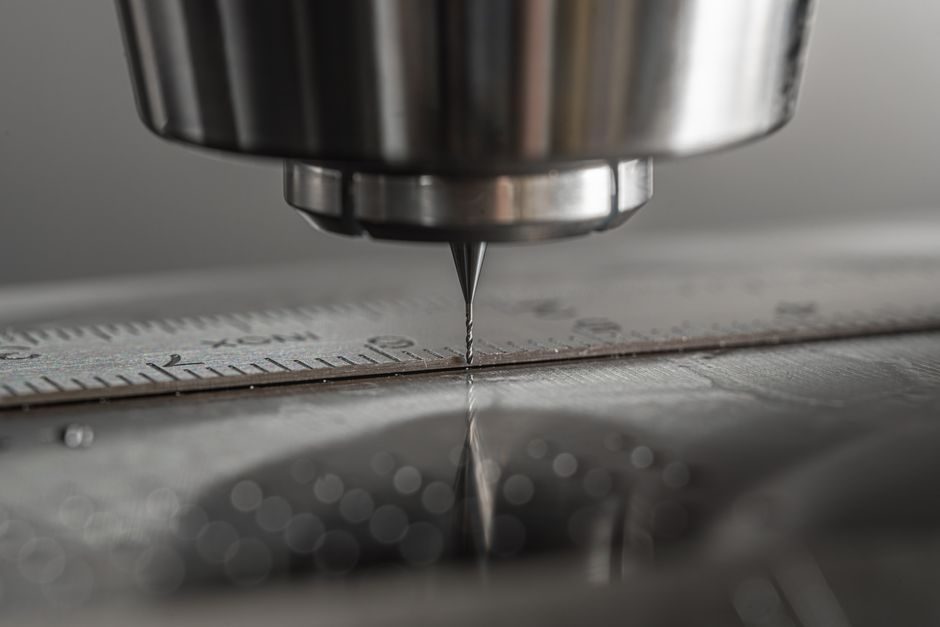
A tensile testing machine applies controlled uniaxial force to a specimen and records force-displacement data to derive yield, ultimate tensile strength, and elongation; a laser tracker sends a laser beam to a retroreflector and resolves 6-degree-of-freedom spatial coordinates over distances of tens of metres [S1][S2].
They are not substitutes. One characterizes a coupon of material in a lab bench or production cell, the other surveys the geometry of a physical asset on a shop floor. Mixing the two in a single specification sheet is a recurring procurement error that wastes calibration budget and confuses audit trails.
What each instrument actually does
A tensile testing machine in the 2026 catalogue (e.g. AMETEK Test CS2Plus, HAIDA HD-B609B-S) is sold as a computer-controlled load frame with touchscreen, capable of tensile, compression, flexure, life-cycle, and shearing modes on plastics, rubber, packaging, wood, and electronic components [S1][S2]. Drive trains are typically servo-electric with ball screws, frame capacities are quoted in kilonewtons (5 kN, 10 kN, 20 kN, 50 kN, 100 kN classes for electromechanical UTM; 600 kN and 1000 kN classes for PC-strand and rebar frames) [S5][S6]. Outputs are stress, strain, modulus, and elongation per ISO 3377-2, ISO 13xxx-series, or ASTM equivalents referenced on the OEM datasheet.
A laser tracker is an interferometer-plus-absolute-distance-meter head that follows a spherically mounted retroreflector (SMR) or a T-Mac. The head resolves XYZ plus two angular axes at sub-arc-second and 10–50 µm linear uncertainty over a 30 m working volume, used to measure machine-tool geometry, robot kinematics, turbine blade tip profiles, and large aerospace jig alignment. It outputs coordinates and derived deviations, not material properties.
Decision criteria: which one belongs on the requisition
Spec the tensile testing machine when the deliverable is a number on a material certificate, a quality-control release test, or a research data point (modulus, peak load, break elongation) [S1][S3]. Spec the laser tracker when the deliverable is a geometric report on an existing part or assembly — flatness, squareness, parallelism, positional accuracy of axes, blade profile deviation.
For both, the specifier must lock four variables before contacting vendors: (1) test article material and form factor, (2) required force or load range in kilonewtons, (3) accuracy class (ISO 7500-1 class 0.5 / 1 / 2 for load frames; ASME B89.4.19 for tracker linear distance), (4) throughput (samples per shift, or measurement points per alignment). Without these, OEM selection degenerates into a price fight, and the wrong class — say a class 2 frame on a class 0.5 audit job, or a tracker with 100 µm U95 on a turbine blade job that needs 25 µm — is shipped [S1].
Side-by-side comparison on four decision criteria

The two instruments diverge on every axis the spec engineer cares about: [S1]
• Output type: load-frame returns force (N, kN) and displacement (mm) → derived stress (MPa) and strain (%); tracker returns XYZ coordinates (mm, m) plus angular values (arc-sec, arc-min) [S1][S2].
• Working volume: load frame grips span 50 mm to 2000 mm typical, with 600 kg-class frames for rebar; tracker working radius is 20 m to 80 m depending on model, with line-of-sight to retroreflector [S5][S6].
• Standards lineage: load frames quote ISO 7500-1 accuracy class and ISO 3377-2 (leather) / ISO 13xxx-series (paper, textiles) test methods; trackers cite ASME B89.4.19 and VDI/VDE 2634-3 for dynamic acceptance.
• Environment: load frame sits on a vibration-isolated lab bench or QC cell, indoor, 10 °C to 35 °C; tracker is taken to the asset on the shop floor, often next to a running machine tool, with thermal compensation required across gradients larger than 2 K/m.
A useful single-sentence rule: if the report contains the word "MPa", you need a tensile testing machine; if the report contains the word "mm/m" or "arc-sec", you need a laser tracker.
Who the load frame is FOR, and who the tracker is FOR
Tensile testing machine — FOR: materials labs in plastics, rubber, packaging, textiles, metals, electronics QC, fastener suppliers, wire and cable plants, rebar and PC-strand producers, university test rigs [S1][S2][S3][S4][S5][S6]. NOT FOR: shop-floor machine alignment, robot cell calibration, large-asset geometry surveys, in-situ blade measurement.
Laser tracker — FOR: machine tool builders, metrology labs servicing aerospace assembly jigs, turbine blade and large casting inspection, robot and gantry acceptance, on-site installation surveys. NOT FOR: small coupon testing, any deliverable expressed in stress or strain, any test that requires a closed-loop load cell inside the working volume.
When a request for quotation mixes terms — "tensile test of a 4 m wing spar on a robot cell" — the right answer is to split it: the load frame tests material coupons cut from the spar, the laser tracker measures the assembled spar's geometry against CAD.
What a 2026 load frame datasheet typically carries
Catalog entries published in 2026-05 describe HAIDA HD-B609B-S as computer-controlled, mobile horizontal configuration, for material, rubber, and packaging, with a digital servo-electric drive, sector-targeted at laboratory, packaging, and textile labs [S2]. The AMETEK Test CS2Plus is positioned as a multi-mode frame (tensile, life cycle, flexure, compression, shearing), standalone with large touchscreen, sectors covering production, medical packaging, pharmaceutical, electronics, and quality control [S1]. Universal testing machine listings on Alibaba and Made-in-China quote capacity ladders 5/10/20/30/50/100 kN for electromechanical UTM, with 20/30 ton hydraulic classes for rebar, 600 kN and 1000 kN for PC-strand [S5][S6].
Pricing for PC-strand 600 kN / 1000 kN frames landed in Qingdao shows a US$15,000–30,000 per set band with 200 sets/year production capacity [S5]. Entry-level universal frames on Made-in-China list US$1,000–3,000 per piece at 1-piece MOQ, 1-year warranty, AC220V, 600 kg weight, accuracy grade 1. The factor-of-thirty spread between PC-strand class and entry-level class is not linear with capacity; it reflects frame stiffness, load-cell class, alignment of the crosshead, and the extensometer channel count.
Limitations and failure modes each buyer must budget for
Load frames fail audits when: the load cell drifts between calibrations beyond ISO 7500-1 class tolerance; the grips slip on high-elongation plastics; the extensometer loses contact at break; thermal expansion of the column shifts zero between room-temperature and elevated-temperature tests. The 2026 build sheets still highlight touchscreen controllers and stand-alone operation as product differentiators, which is a tell that software-driven test-method libraries and remote diagnostics are the field where lower-tier OEMs are catching up [S1][S2].
Laser trackers fail when: the retroreflector is bumped mid-session, breaking the laser lock; the part is moved between stations and the local coordinate frame is not re-registered; thermal gradients along a long axis (>2 K/m) are not compensated; line-of-sight is lost to a fixture. Tracker uncertainty budgets stack sensor U95, SMR form error, environmental compensation residual, and operator-induced probe contact error. Specifying a tracker without an environmental compensation plan is the single most common reason large metrology projects slip their tolerance budget.
Sourcing, standards, and audit trail
Tensile testing machine sourcing in mid-2026 runs through four channels: OEM direct (AMETEK Test, HAIDA, Fine Manufacturing Industries), trade-fair directories (DirectIndustry, CENS), B2B aggregators (Made-in-China, Alibaba), and textile-specialist labs (TESTEX) [S1][S2][S3][S4][S5][S6]. Standards coverage is dense: ISO 7500-1 for load-frame calibration, ISO 3377-2 and ISO 13xxx-series for material-specific methods, ASTM E8/E8M for metals (parallel to ISO 6892-1), and the sector-specific methods named on each OEM datasheet.
Laser tracker sourcing is narrower — OEMs (API, FARO, Hexagon/Leica, Mitutoyo, Creaform/Ameni), each with a defined ASME B89.4.19 or VDI/VDE 2634-3 acceptance test report. The audit trail is built around calibration certificates for the interferometer and ADM, SMR form-error maps, and a documented environmental compensation routine.
For related reference on mechanical-strength instrumentation, the load cell vs electronic scale article covers the weighing-versus-force-test boundary that sits upstream of the tensile testing machine spec, and the Spec Engineer's 2026 frame selection guide walks through the load-class and accuracy-class decision tree. For the metrology side, the laser tracker encyclopedia page lists the working-volume and accuracy-class options to compare against your alignment tolerance budget.
Trackable signals for the next quarter: OEM datasheet updates referencing ISO 7500-1 class 0.5 load cells in mid-range UTM, and tracker vendors expanding environmental-compensation accessories (weather stations, dual-axis compensators) for outdoor wind-energy tower alignment jobs.
Related: laser level.