Specifying a terminal block in 2026 means picking a current family first: signal/PCB headers (typically 2.54 mm pitch, 3- to 12-pin, 6-10 A), control pluggable strips (5.0 or 5.08 mm pitch, 12-24 AWG, 8-12 A per pin), or power distribution blocks sized 175-760 A per pole for panel and feeder work [S1][S3][S4].
Three numbers drive 90% of selection: pitch, current rating, and wire range. Get those wrong and the rest — actuator type, plating, housing material — is decoration. Buyers should treat the connector as a current-carrying structural part, not a commodity pin strip.
Pitch, Current and Wire Range: The Three Numbers That Decide the Part
2.54 mm / 0.1" pitch remains the default hobby and low-voltage signal header, commonly shipped as 3-pin through-hole strips rated around 6-10 A with 26-20 AWG wire range, and is the footprint used on most Raspberry Pi-style breakout accessories [S3]. Step up to 3.5 mm or 3.81 mm pitch, and the same spring-cage architecture handles 24-16 AWG at 8 A; 5.0 mm and 5.08 mm pitch pluggable formats carry 12-30 AWG up to about 12 A per circuit, which is the workhorse of cabinet I/O and PLC marshalling [S1].
For feeder and sub-feeder work, UL 1059-recognized open power distribution blocks are built around the stud or set-screw opening, not the pitch. Edison's PB3122, for example, is a 2-pole, 310 A open block where the line side accepts 350 MCM to 4 AWG and the load side accepts smaller conductors, all under one UL 1059 dossier [S4]. Pitch language stops mattering once you cross roughly 100 A — the geometry becomes a box, an opening, and a torque value.
The pitch map is consistent: sub-3.5 mm = signal, 3.5-5.08 mm = control (8-12 A), 6-10 mm = high-current pluggable, and 175-760 A power distribution. Cross-reference wire range in mm² or AWG against the block's rated current, not against the housing color, and you will not mis-spec a panel.
Connection Technology: Screw, Spring, Push-In and Insulation Displacement
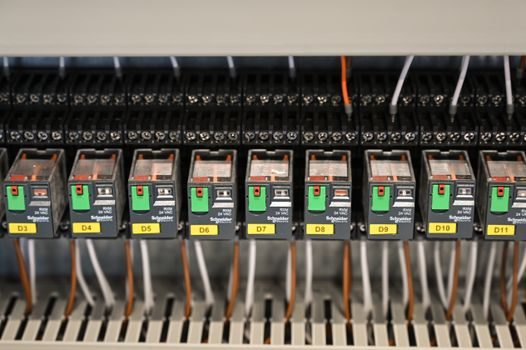
Screw terminals still dominate the 8-12 A control segment because they tolerate a wide wire range and survive field re-termination. Spring-cage and push-in variants take that same 5.0/5.08 mm footprint but cut termination time: a stripped ferruled conductor is pushed straight into a stainless-steel spring and held at a defined contact force, typically rated for the same 8-12 A as the equivalent screw version [S1].
Push-in terminals (often sold as "PTI" or "PIT" series by the major European brands, and as "push-in spring" by PCB spring-terminal factories) tolerate vibration better than screw but require ferruled wire on the fine-pitch sizes; bare stranded copper will deflect the spring over time. Insulation-displacement connection (IDC) is a separate family used on ribbon-to-board headers and on sensor/actuator splitters, where the wire is pressed through a blade that cuts the insulation — fast, gas-tight, but limited to specific wire gauges and insulation types.
For cabinet builders the practical rule is: specify push-in where the wire is ferruled at the shop and never re-touched in the field; specify screw where field serviceability matters. Mixing the two on the same DIN rail is normal and does not create an electrical compatibility problem — they are mechanically distinct but electrically interchangeable at the same pitch and current.
Materials, Plating and the Hidden 5% of Failures
The copper alloy matters more than the housing. Tin-plated phosphor-bronze contacts carry the signal/control current; the high-current 310-760 A blocks move to tin-plated or optional silver-plated copper alloy bar stock, and the plating dictates both contact resistance and the long-term creep under thermal cycling [S4]. A UL 1059-recognized block is qualified as a system — base, stud, and clamp — so swapping a zinc-plated clamp for an unplated one on a 310 A pole quietly voids the recognition and the heat-rise test behind it.
Housing is almost always PA66 (nylon 66) with a UL94 V-0 flame rating on the brands that matter for industrial cabinets; PA6 is acceptable for cost-driven PCB spring terminals but carries a lower continuous service temperature. For power blocks, the cover and base are often glass-reinforced PA66 or PBT, and the operating temperature ceiling is usually 110-130 °C — enough for any normal cabinet but not for under-the-hood automotive or furnace-adjacent mounting.
Torque is the silent killer. A 310 A pole spec'd at, say, 31 N·m on the line side and 14 N·m on the load side needs a calibrated driver, not a "snug" feel. Under-torqued lugs run hot, oxidize, and re-torque themselves tighter as they expand, which is the failure mode that takes a feeder down at 18 months [S4].
Certifications and Standards That Actually Matter in 2026
UL 1059 is the block-specific standard covering open and enclosed power distribution blocks up to 760 A, and it is the dossier an inspector will ask for on a 310 A PB-series installation [S4]. For control and signal blocks, look for UL 1059 recognition at the relevant current, plus IEC 60947-7-1 for European copper-conductor terminal blocks used in industrial control assemblies.
For hazardous-area cabinets, IEC 60079-7 governs increased-safety ("e") terminal enclosures, and ATEX category 2/3 compliance is achieved by using Ex e-certified blocks inside an Ex e enclosure — the block alone does not carry the area classification. On the railway and rolling-stock side, EN 50155 and the associated fire/smoke standards (typically EN 45545-2) drive housing and insulation choices that an office-grade block will not meet.
For PCB spring and screw terminal headers coming from the Chinese OEM channel, the practical reality is a UL 1977 or UL 1059 dossier at the part-number level, sometimes combined with CE marking under the LV Directive and RoHS/REACH compliance [S1]. Buyers should not accept a generic "CE" on a PCB terminal — ask for the UL file number and the exact standard edition cited on the datasheet.
PCB, Pluggable and Panel-Mount: Matching Form Factor to Assembly Process
PCB terminal blocks are wave-soldered or reflowed onto the board, then a screw or spring face accepts the field wire. The 2.54 mm 3-pin header is the canonical example, but the same family extends to 2- to 24-position strips with horizontal or vertical wire entry [S3]. Choose vertical entry when the wire drops behind the board, horizontal (90°) entry when the wire exits toward the panel front — geometry, not current, is the deciding factor at the signal level.
Pluggable terminal strips add a plug and a header so the field wiring can be disconnected from the PCB as a single harness — a major serviceability win on field-replaceable I/O cards. The header is soldered to the PCB; the plug carries the screw or push-in cage. Current and pitch track the non-pluggable version, and the only new variable is the retention latch, which is the part that fails if the harness is yanked instead of unlatched.
Panel-mount and feed-through blocks (the PB-series and similar) are bolted to the panel or DIN rail, and the wire enters from one or both sides. The 310 A 2-pole open block is essentially a stud-and-bar assembly with a polycarbonate cover — no moving parts, no plug, no latches, and a longer service life than any pluggable strip in the same cabinet [S4].
Sourcing Reality 2026: Lead Times, MOQ and the Chinese OEM Channel
Lead times for a stock catalog item at a Western distributor remain in the 1-3 week range for 5.08 mm pluggable strips and the small Edison-style open power blocks [S4]. For a custom PCB spring terminal block from a Chinese OEM factory, expect 2-4 weeks for samples and 4-8 weeks for production after drawing approval, with MOQs typically starting at 500-1,000 pieces per pole count [S1].
Two cost levers dominate. First, pole count and pitch: doubling the pole count on a 5.08 mm pluggable strip does not double the price — it adds roughly 40-60% because the housing is one molded part and the metal contacts are a continuous stamped strip. Second, plating: tin over copper alloy is the default and is fine for most industrial atmospheres; optional nickel or silver plating adds 10-25% to the contact sub-assembly cost but is worth specifying for corrosive or marine cabinets, where the failure mode is surface oxidation, not thermal.
For copper conductors and bus bars that feed these blocks, the 2026 copper grade and form guide maps C11000 electrolytic tough-pitch and C10100 oxygen-free bands against rod, bar, and strip pricing — useful when a 310 A block is being built into a custom copper busbar assembly. For the plastic housings, the engineering plastic price & cost guide 2026 covers PA66, PA6 and PBT bands that drive housing cost; for the steel DIN-rail and mounting hardware, the stainless steel price & cost guide 2026 covers the 304/316 brackets and clips used in stainless-cabinet builds.
Selection Checklist Before You Click Buy
Confirm five things before issuing a PO. (1) Pitch and pole count match the PCB footprint or the DIN-rail layout. (3) Wire range covers both metric mm² and AWG and includes any ferrule requirement. (4) Certifications: UL 1059 file number for power blocks, IEC 60947-7-1 for control blocks, and ATEX/IECEx Ex e for hazardous-area cabinets. (5) Torque values for any screw or stud above 50 A — and a calibrated driver on the shop floor to hit them. [S1]
Two failure modes to design out at the specification stage: torque creep on 200+ A power blocks (solve with Belleville washers or a second torque check at commissioning) and vibration-induced loosening on 8-12 A control blocks (solve by specifying spring-cage or push-in instead of screw for mobile equipment). For an introduction to the basic terminal block concept and Japanese terminology, the terminal block encyclopedia page is the right starting reference.
One trackable signal: UL 1059 editions continue to tighten creepage and clearance for 600 V blocks, and the 2024-2025 revisions pushed several legacy 175 A open blocks into re-qualification — worth a datasheet check on any PB-series equivalent you have been buying for five years. A second signal: the European push toward push-in-only control cabinets in OEM machine building is pulling 5.0/5.08 mm push-in volume up roughly a tier per year, which is shortening lead times on the push-in variant relative to the screw version of the same part number [S1].
For component-level specifications, see linear guide, and crossed roller guide.