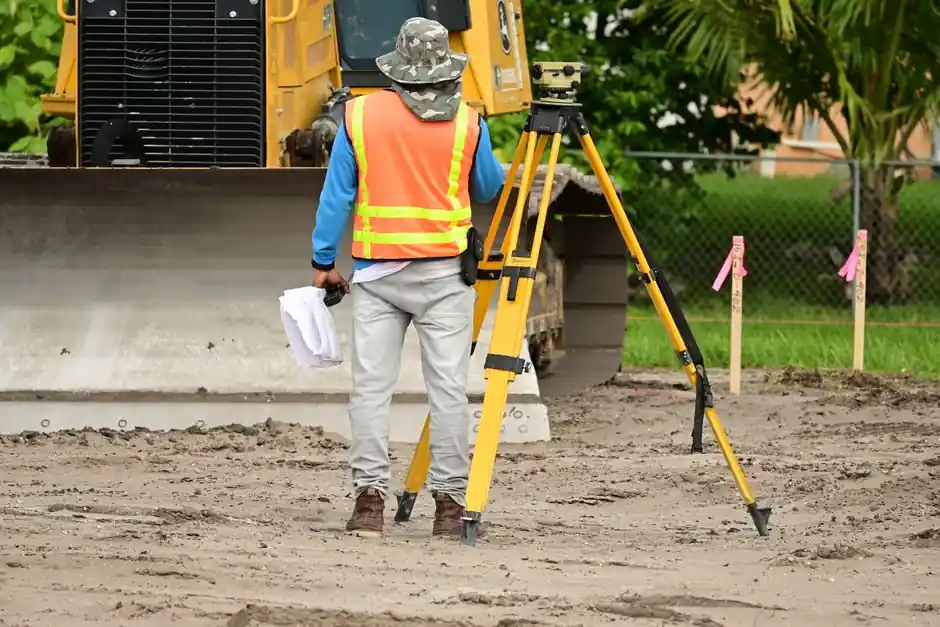
A theodolite suited to landscaping sits in the 20x-30x magnification band with a magnetic or air-damped automatic compensator, a horizontal tangent drive, and a stadia reticle for rough distance reads, as listed on current Spectra Precision AL-series option sheets [S3].
Selection is driven by the longest sight distance on site, the gradient of the terrain, and the vertical tolerance the grading plan calls for; matching those three against magnification, compensator type, and angular resolution is what separates a productive day of layout from rework.
Where a Theodolite Fits a Landscaping Job
A theodolite on a landscaping site is used to set slope ratios for drainage runs, mark fence and hedge lines against a property boundary, stake patio falls, and check finished grade against a design elevation [S1][S2]. Two angle measurements, horizontal and vertical, are read from a single setup, which is why the instrument beats a long tape for any line longer than roughly 15-20 m [S1].
Cut/fill and area-leveling tasks, the bread and butter of landscape grading, are listed as core applications for automatic levels and theodolites in the Spectra Precision AL-series datasheet, which covers general building construction, cut and fill, area leveling, and landscaping in a single use-case block [S3]. That grouping matters: it tells the buyer the same instrument class serves both concrete slab work and a backyard regrade, so a landscaper does not need a specialist model.
Magnification, Compensator, and Optics: The Real Spec Triangle
Three specifications decide whether a theodolite is usable on a landscape site: telescope magnification, compensator type, and the presence of stadia lines. Spectra Precision lists its AL auto levels at 20x, 24x, 28x, and 32x, with a choice of magnetic or air-damped automatic compensators and stadia lines on the reticle for distance measurement [S3]. Entry-level optical theodolites sit in the 20x-30x range with bubble levels for setup, which is adequate for non-specialized angle and elevation work [S2].
Compensator choice is not cosmetic. Air-damped units handle vibration from nearby plant and foot traffic better; magnetic damped units settle faster in still air. For a one-person landscaping crew setting grade stakes every 3-5 m, a magnetic damped unit at 24x or 28x is the common fit because sight lines are short and the operator is moving frequently. For sight lines past 60 m on open ground, 30x-32x keeps the rod readable without a tripod extension.
Accuracy, Tolerance, and Reading Method

Horizontal angle is read off a 360-degree scale, usually below the eyepiece, with double-sided continuous tangent drives for fine adjustment on Spectra AL-series instruments [S3]. Vertical angle is read against an index, and a built-in bubble plus optical sighting alignment keeps the instrument level between readings [S3].
Landscape grading tolerance is typically +/-10 mm over a 30 m run for a patio fall, looser than a concrete slab tolerance, so a 1-minute or 2-minute optical theodolite is more than enough. Where the spec tightens to +/-3 mm, the same hardware can be pushed only by a careful bipod-and-tribrach setup, and most landscapers step up to a total station instead. A bubble mirror, which Spectra lists on the AL-series, is a small but real time-saver because the operator can level from the eyepiece position without walking around the tripod.
Mechanical and Environmental Build
Field build matters on a muddy or dusty site. Spectra fits metal housings and water-resistant construction across the AL-series, and ships each unit in a hard carrying case [S3]. Cheap optical theodolites typically ship with the same kit list: case, mounting hardware, and basic adjustment tools, which is the minimum a working landscaper should accept [S2].
Short focusing distance is a quiet spec that pays off on tight sites. Spectra explicitly calls out "a short focusing distance provides for better performance in tight spots or on steep slopes" on the AL-series datasheet [S3]. A gardener re-grading a slope behind a house will read a rod at 2-3 m far more often than a surveyor on a highway job, and the close-focus number decides whether the instrument is usable in that mode at all.
Manual Optical Theodolite vs Total Station vs Auto Level
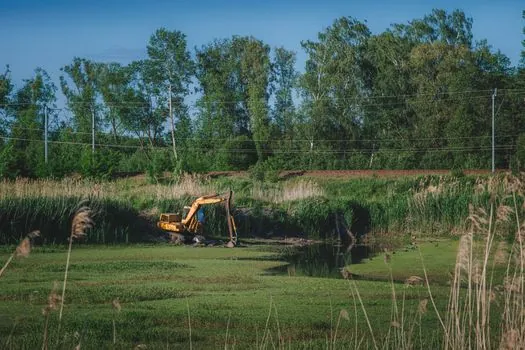
Three instrument classes compete for the landscape budget, and the right pick depends on distance and tolerance. A manual optical theodolite, 20x-30x, 1-2 minute angular resolution, with a horizontal scale and basic compensator, covers line and grade work out to roughly 100 m at a +/-10 mm tolerance [S2]. An automatic level, 20x-32x, magnetic or air-damped compensator, stadia reticle, no horizontal angle scale, covers elevation-only grading and is cheaper for pure cut/fill work [S3]. A total station adds electronic distance measurement, on-board data logging, and sub-second angular accuracy, but the cost step is roughly 5-10x and is only justified on plots over 0.5 ha or where a CAD file is being laid out directly.
For most landscape contractors, the middle row, optical theodolite or auto level with a 24x-28x telescope and a magnetic compensator, is the right answer. The total station earns its keep only when layout points are being driven from a digital drawing rather than a paper plan.
Setup, Calibration, and Common Field Errors
Setup is the same on any optical theodolite: tripod on firm ground, plate bubble centered, optical plummet or plumb bob over the ground point, and the index bubble checked before every reading. Cheap theodolites rely on a bubble level for coarse setup and assume the operator handles the fine index check by eye, which is fine for +/-10 mm work [S2].
The two error sources that bite landscapers most are a tripod leg sinking on soft ground during a traverse, and failing to re-level after a 90-degree swing. A quick check is to read a backsight, swing 180 degrees, and see whether the foresight has moved; if it has, the compensator or the bubble is the problem, not the rod man. For a deeper look at GNSS RTK error sources, which apply when a landscaping crew upgrades to a GNSS-enabled total station, the breakdown of multipath, ionospheric delay, and base-line length tradeoffs carries over directly from construction-surveying practice.
Selection Rules and Sourcing Notes
Match magnification to the longest sight: 20x for under 30 m, 24x-28x for 30-80 m, 30x-32x for 80-150 m. Pick the compensator damping by site vibration: magnetic for still, urban, or indoor sites; air-damped for plant-heavy or windy sites. Require a horizontal tangent drive and a 360-degree horizontal scale if any line, fence, or hedge needs to be set to a bearing, not just a fall. Insist on a hard case, metal housing, and water-resistant construction; the difference between a one-year and a five-year service life on a landscape tool is almost always the case and the housing [S3].
On sourcing, Spectra Precision publishes datasheets, user guides, and accessory lists (tripods, rods, clamps, vials, brackets) for its AL-series directly on the product page, and routes sales through a dealer locator rather than direct [S3]. Theodolite, auto level, and tripod package pricing for landscape use is consistent across entry-level OEM kits, which include the protective case, basic mounting hardware, and adjustment tools as standard [S2]. When the project scope is heavy structural work adjacent to landscaping, the same logic used for sander selection on bridge jobs applies: pick by substrate and tolerance, not by brand recognition. The wider construction-tooling logic for matching equipment to substrate and code, as covered in rebar coupler selection for road maintenance, also tracks: spec the instrument to the work, then verify the build.
Track two signals before buying: (1) whether the dealer stocks a current-generation AL20M/AL24M/AL28M/AL24A/AL32A unit and the matching tripod and rod under one part number, since mismatched thread sizes are a common field delay; (2) whether the landscaper's typical job is moving toward GNSS-staked layouts from a CAD file, in which case a total station with onboard software will pay back faster than another optical theodolite.
Detailed specification references: theodolite, pressure transmitter, and flow meter.