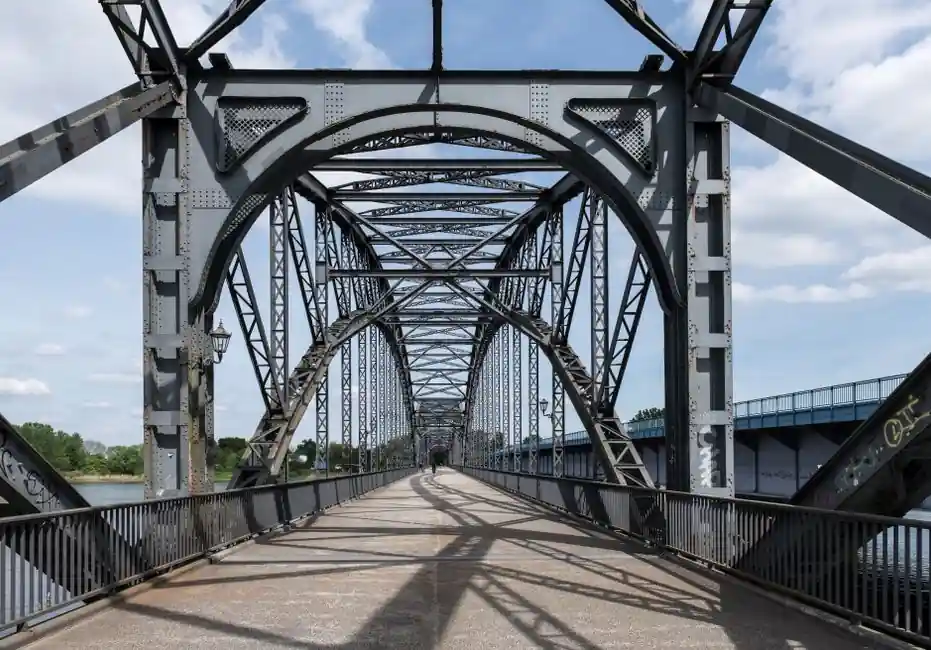
Bridge-site sanding is a two-axis decision: substrate (ASTM A709 weathering steel plate, galvanized rebar mat, or concrete pier cap) and span of the work face (point repair on a stiffener vs full-length fairing of a 2 m pier cap). The wrong sander wastes hours, the wrong abrasive destroys a metallized zinc coating, and the wrong dust extraction can shut a job down under the silica rule.
This map lines the main sander families used on bridge sites against the substrates and span classes they actually fit, drawing on current AASHTO LRFD-aligned bridge construction reference material and recent design-build procurement data for a US-70 lake crossing replacement [S1][S3].
Substrate-Driven Sander Class Selection
Random-orbit sanders (125-150 mm pad, 750-1,200 W, 8,000-12,000 rpm no-load) are the default for localized steel prep: weld seam blending on plate girders, spot corrosion removal on weathering steel diaphragms, and key-area roughening before spot-coat touch-up [S1]. On a bridge deck, the same tool with a P40-P60 fiber disc handles tack-coat surface prep between membrane layers.
Belt sanders (75-100 mm belt width, 850-1,400 W) fit linear runs: removing mill scale along a girder flange, blending long weld toes, and feathering old coating edges before re-paint. Their directional cut and high material removal rate (roughly 3-5x a random-orbit on steel) make them the right tool where the geometry is a straight line, but the wrong tool on contoured stiffener webs because the belt cannot follow the profile.
Long-board / drywall-style rectangular sanders (rectangular pad roughly 225 x 110 mm, 400-600 W, 1,000-2,800 rpm, 1.8-2.3 m extendable reach) are specified for concrete fairing work on pier caps, abutment bearing seats, and parapet faces, where the operator needs a flat plane across a long run without ladders. For site work on bridge construction, the wider sander family and the related construction-tools category overlap directly with surface-prep equipment used in civil and structural trades [S1].
Abrasive, Speed and Dust Extraction: the Spec Layer
Hardness must stay below the coating being removed, otherwise heat load on the substrate rises fast and the metallized zinc layer under a duplex system can be cut through in a single pass. [S1]
No-load speed band selection is the second decision. 8,000-12,000 rpm covers paint, primer and light mill scale; 2,800-4,500 rpm covers concrete fairing where higher peripheral speed sinters dust into the pad and burns the surface. A variable-speed trigger is essentially mandatory on bridge work, because the same operator commonly moves between steel and concrete within a shift, and these substrates want different speeds.
Dust extraction is no longer optional: OSHA 1926.1153 respirable crystalline silica applies to concrete grinding, sanding and chipping on construction sites, and most state DOTs now require either a shroud with integrated dust port or a fully-enclosed shroud-plus-vacuum setup. Look for a sander body with a 27-35 mm internal hose port matched to a HEPA M-class vacuum, not the 32-38 mm range that fits only shop vacs.
Power Source: Corded, Cordless and Pneumatic at the Span
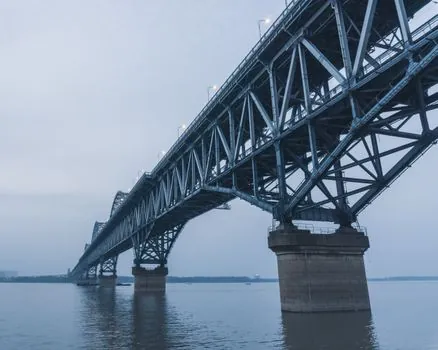
Corded 220 V / 50 Hz models (1,200-1,500 W) still dominate sustained production work: pier cap fairing, full-span deck membrane prep, and any operation where an 8-hour shift is the baseline. Continuous duty ratings, no battery thermal cut-off, and lower per-hour cost at high utilization make them the default for fixed-position bridge-site tasks [S1].
Cordless 18 V / 54 V brushless models (125-150 mm pad) now cover 70-80% of the spot-prep workload: weld blending at height on a snooper, parapet touch-up, and any task on the far side of a girder where running a cord creates a trip hazard or a strike risk against moving equipment. A 5.0-9.0 Ah battery at 54 V platform covers roughly 25-40 minutes of intermittent cut on a P60 disc before voltage sag starts removing material at half the rate.
Pneumatic sanders (orbital, 150 mm pad, 6-8 bar / 90-120 cfm) remain standard inside abrasive-blast cabinets and on large shop-prep yards where the dust load is already controlled, but on open bridge deck they have been almost entirely replaced by electric models. Air hose management on a suspended platform is its own safety hazard, and the 90-120 cfm draw needs a compressor that most site electricians will not dedicate to a single sander.
Site-Fit Selection: Decision Map by Task
Use a 125 mm random-orbit cordless with P60 fiber disc for weld blending and spot corrosion on ASTM A709 plate girder diaphragms; weight matters because the operator is on a snooper or under-deck platform, so target 1.4-1.8 kg with battery.
Use a 75-100 mm belt sander with P60-P80 zirconia belt for linear runs along girder flanges and for feathering old coating edges before re-paint; pair it with a tracking adjustment because belt wander on a vertical flange will burn the workpiece in under a minute. Use a 225 x 110 mm long-board sander at 1,000-2,800 rpm with P80-P120 mesh abrasive for concrete fairing on pier caps and abutment bearing seats; this is also where the construction-machinery and equipment category feeds in, because the dust extraction system, the extension pole, and the vacuum all have to be specified together [S1].
Decision rule for abrasive on concrete: P16-P24 for leveling high spots and form-work marks, P36-P40 for general fairing, P60-P80 for finishing before a coating or a penetrating sealer. Going finer than P120 on a structural concrete surface is wasted because the next operation (epoxy bonding, sealer, membrane) is bonded mechanically and needs tooth, not polish.
Common Failure Modes and Constraints on Site
Heat damage on metallized or galvanized surfaces is the most expensive single failure. A ceramic P36 disc at 12,000 rpm on a single spot for more than 5-7 seconds will cut through 80-100 microns of zinc in one pass, which then has to be repaired by re-blast and re-spray. The fix is operator-side: keep the disc moving, reduce pressure, and use a P60 or P80 disc instead of jumping straight to P36. [S1]
Dust loading on a bridge deck during membrane prep is the second failure. A sander with no integrated shroud will put the site over the OSHA action level (25 microgram/m³ AL, 50 microgram/m³ PEL for respirable crystalline silica under 29 CFR 1926.1153) inside one shift. The fix is hardware, not procedure: shroud plus M-class HEPA vacuum, verified air flow at the sander before the operator starts, and a vacuum emptied on a schedule that does not let the filter load up.
Edge damage on precast segments is the third. When a segmental bridge is being prepared for an epoxy joint, the sander must not crush the 5-10 mm match-cast edge profile. That means low orbital speed, soft interface pad, and a hand block rather than a machine sander for the last 50-100 mm to the edge. Skipping this step cracks the segment on the next post-tensioning pass and the repair is a multi-day, multi-thousand-dollar job.
Standards, Reference Material and Sourcing
Steel-prep abrasive work on a bridge is governed in the US by SSPC-SP 2 (hand tool cleaning), SP 3 (power tool cleaning), SP 6 (commercial blast), and SP 10 (near-white blast); the choice between SP 2/3 and SP 6/10 drives whether a sander is even on the job, and the spec writer in the project documents will tell you which one. NSBA's Steel Bridge Design Handbook, aligned with the AASHTO LRFD Bridge Design Specifications, 10th Edition (2024), is the working reference for steel-bridge design and surface-prep adjacency, though the sander itself is a construction tool, not a design tool [S3].
For contractor-side equipment selection, the working frame is the bridge spec (span, type, height), project timeline, site access constraints, and budget, in that order of priority [S1]. A 900-ton precast segmental job, where a crane at the heavy end of the fleet is the bottleneck, cannot tolerate a sander that stops a finishing crew for two shifts; a 70-foot-deep foundation pier where a sander is run off a swing stage needs a cordless platform first, a corded tool second.
Trackable signals for the next planning window: the Roosevelt Bridge design-build procurement entered its accelerated innovation and collaboration phase on October 13, 2025, with final design phase notice to proceed expected in late March 2026 and the joint venture of Zachry Construction and Traylor Bros., Inc. selected on April 7, 2026 as apparent best value proposer to deliver the new US-70 bridge over Lake Texoma [S2]. Equipment decisions for that scope will follow the MPDB collaborative phase, not precede it, which means surface-prep sander specs for any subcontractor package will land in the 2026 design-phase task orders rather than the RFQ stage.
Related analysis: Angle Grinder Spec Map for Steel Construction: Size, Power, Disc, Source.