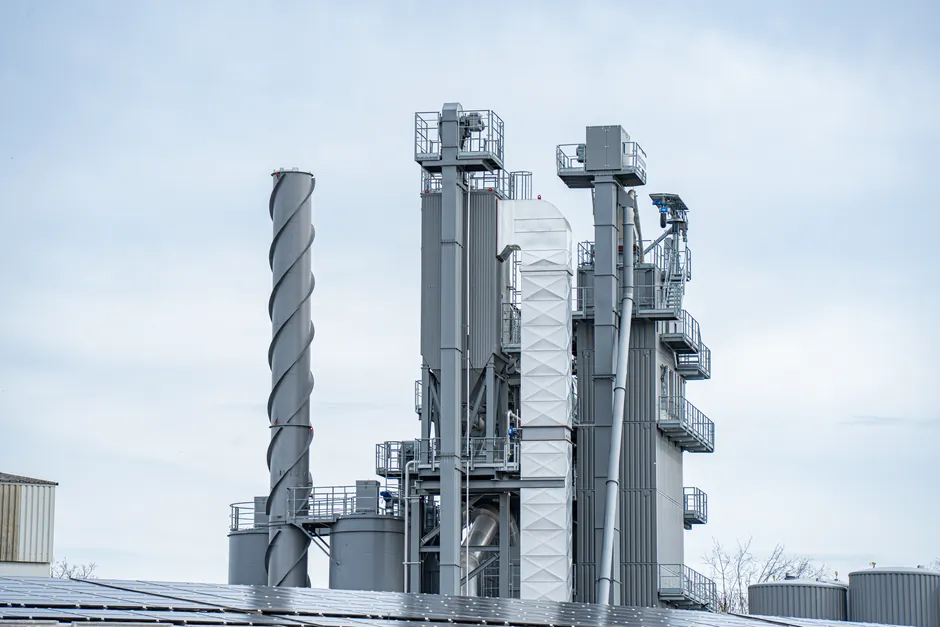
Cement plant rotating equipment, including rotary kilns (often 4-6 m diameter), ball mills, and vertical roller mills, imposes axial loads that commonly require thrust bearings in the 200-3000 mm bore range, with heavy-duty units built to ISO 9001:2015 quality systems [S1].
The two dominant bearing families for these duties are tilting-pad fluid-film thrust bearings, used where loads are high and speeds are well-defined, and rolling-element thrust bearings (ball, cylindrical roller, spherical roller, and rotary-table types), used where start-stop duty, misalignment tolerance, or compact installation is required [S2][S4]. For cement process engineers, the 2026 selection question is not which family is universally better, but which combination of load rating, pad geometry, sealing strategy, and lubricant regime matches a given kiln or mill duty cycle.
Where Thrust Bearings Sit in a Cement Plant
Thrust bearings in cement plants are typically deployed at four main locations: the kiln support rollers (reaction thrust from kiln inclination), the kiln drive girth-gear pinion housings (axial loads from drive misalignment), the grinding mill trunnions or shoe bearings, and the crusher and conveyor gearboxes [S1]. Industrial bearing suppliers like FARO Industriale produce rolling bearings up to 6000 mm in diameter, a size class that covers large-diameter mill and kiln thrust units [S1]. Across these locations, the axial loads vary from roughly 50 kN on a small crusher shaft to multi-MN levels on a 5 m diameter kiln, which is why the same supplier list spans both rolling-element and fluid-film product lines.
For the rotary-table bearing family specifically, a YRT-type combined bearing uses two axial roller rows plus one radial roller row to handle combined loads in a single compact unit, which is the geometry most commonly referenced in crusher and preheater tower slewing applications [S3]. The single-direction thrust ball bearing is the simplest and cheapest option and is typically used only on lightly loaded, low-speed shafts where axial load is purely unidirectional, per Koyo/JTEKT product documentation [S4].
Selection Criteria: Load, Speed, Misalignment, Contamination
The first gate is axial load capacity. Tilting-pad thrust bearings are routinely specified where the specific load exceeds roughly 2-4 MPa on the pad face, and Kingsbury publishes both equalizing and non-equalizing pad families to handle load distribution differences between rigid and flexible rotors [S2]. Equalizing designs (LEG, SlimLine, EQH, G-MD) tolerate misalignment and uneven thermal growth, while non-equalizing designs (KingCole, NE, VK) deliver higher load capacity on stiff, well-aligned shafts [S2].
The second gate is speed and pad lubrication. Kingsbury's flooded (bath or flood-fed) lubrication suits slower heavy machinery, while direct lubrication (high-pressure oil injection at the leading edge of each pad) is the 2026 default for high-speed turbomachinery because it reduces pad temperature, lowers power loss, and supports stable fluid-film thickness across load changes [S2]. For cement plant mills and kilns, where peripheral speeds are modest, flooded lubrication remains common, but direct-lube systems are now appearing on large gearless mill drives because the variable-speed operation pushes pads into a wider load-velocity range.
The third gate is contamination. Cement dust is abrasive and alkaline, and unsealed thrust bearings in mill gearboxes are the dominant premature-failure root cause. The rolling-element answer is a sealed spherical-roller or sealed cylindrical thrust bearing with a nitrile or fluoroelastomer lip; the fluid-film answer is a labyrinth seal with positive-pressure oil purge at the housing face. Neither is universal, so the decision must be made per equipment item.
Comparing the Main Options Against Decision Criteria
For cement plant engineers, four thrust-bearing architectures cover 90% of spec lines: tilting-pad fluid-film, spherical-roller thrust, cylindrical-roller thrust, and single-direction ball thrust. The decision table below is built from the published product ranges of FARO (rolling, up to 6000 mm), Kingsbury (fluid-film, equalizing vs non-equalizing), and Koyo/JTEKT (single vs double-direction ball) [S1][S2][S4].
Tilting-pad fluid-film bearings lead on specific load capacity, thermal management, and lifetime under steady loading, but they lose on first cost, footprint, and the need for a clean, pressurized lube skid [S2]. Spherical-roller thrust bearings lead on combined axial-plus-radial capacity, misalignment tolerance, and ability to handle shock loads typical of crusher and mill starts; they are widely available to 6000 mm OD and are the default for kiln support and large mill trunnions in the FARO product range [S1]. Cylindrical-roller thrust bearings offer higher axial capacity than ball bearings of the same bore and tolerate some misalignment, but they cannot carry any radial load unless paired with a radial bearing in the same housing, which complicates the seal arrangement. Single-direction thrust ball bearings are the lowest-cost, lowest-capacity option, and Koyo/JTEKT catalog data states they handle axial load in only one direction, requiring a second opposing bearing for bi-directional shafts [S4].
In terms of fit-for-purpose: a 4.5 m rotary kiln support roller at 1-3 rpm is the textbook spherical-roller application; a ball-mill pinion at 200-300 rpm with a 500 kN axial load is the textbook equalizing tilting-pad application; a 250 kW crusher rotor with shock loading is the textbook spherical-roller or sealed cylindrical-roller application; and a small fan or conveyor shaft at 1450 rpm with a 5 kN axial load is the textbook single-direction ball application [S1][S2][S4].
Standards, Materials, and Lubrication in 2026
Most cement-plant thrust-bearing suppliers operate under ISO 9001:2015 quality systems, and FARO additionally lists ISO 14001 environmental management, which is now a procurement gate for several European cement groups [S1]. Material selection for pads and rolling elements continues to center on through-hardened 100Cr6 / 52100 for standard duties, case-carburized variants for heavy shock, and babbitt-faced pads for fluid-film units, with Kingsbury's advanced materials portfolio covering overlay and polymer-modified linings for higher-temperature cement applications [S2].
Sealing materials default to nitrile rubber for temperatures up to roughly 100 degrees C, fluoroelastomer for hot zones near the kiln shell where ambient air regularly exceeds 120 degrees C, and PTFE-based lip seals where dry running is a possibility during coast-down. The fluid-film option sidesteps the seal question because the bearing is flooded, but it then requires an oil skid with particulate filtration to ISO 4406 cleanliness targets, typically 18/16/13 or better for tilting-pad units [S2].
What Thrust Bearings Are Not For, and Common Failure Modes

Thrust bearings are not for absorbing torsional load, and engineers who use a thrust unit as a torque anchor will distort the housing and induce early pad or roller failure. They are also not a substitute for a coupling: any axial deflection driven by the process must be absorbed by a flexible coupling, not the bearing. A rolling-element thrust bearing is not for applications where continuous steady loading pushes the specific load above the rating, which is the boundary case where a fluid-film unit is required [S2].
The most common failure modes seen in cement plant audits are: (1) abrasive wear of the rolling elements or pads due to dust ingestion past failed seals, (2) white-etching cracking or micro-spalling from under-lubrication during start-up, (3) pad burn on fluid-film units from lube-skid pressure loss or filter blockage, and (4) cage fracture on spherical-roller units subjected to vibration during mill inching. Each of these is preventable with the right seal, the right lube, and the right mounting, but the cure is specific to the bearing type, which is why the selection step is the highest-leverage decision an engineer makes on this equipment class.
The next decision node is verification: a tilting-pad spec should be cross-checked against a Kingsbury model (LEG, EQH, KingCole, etc.) before RFQ, while a rolling-element spec should be cross-checked for ISO 15 dimensional series and ISO 492 radial runout class. For deeper context on the bearing fundamentals behind this article, see the thrust bearing reference, the ball bearing entry, and the ceramic bearing page for hybrid options now entering heavy-industry trials. For comparison with corrosion-prone applications in heavy industry, the roller bearing selection for marine: 2026 spec gates, types, and corrosion playbook article applies many of the same selection gates to offshore duty.