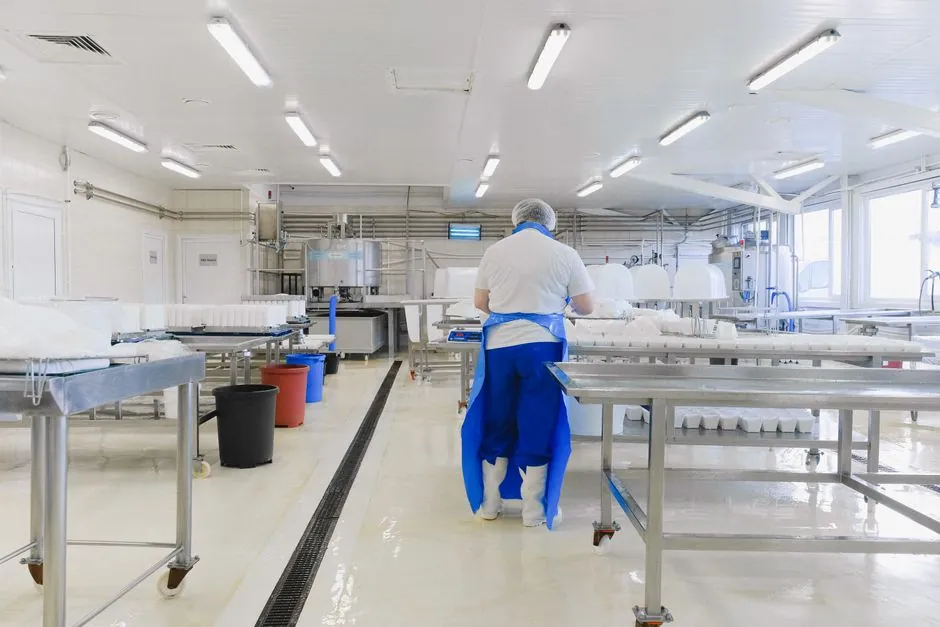
Food-grade thrust bearings differ from general industrial units in three measurable ways: the metal in the load path must be corrosion-resistant stainless (AISI 304 minimum, 316 for chloride exposure), the lubricant must carry an NSF H1 incidental food contact registration, and the seal must survive daily hot-water clean-in-place (CIP) cycles at 80-90 degrees Celsius with caustic and acid detergents [S1].
The application window covers screw conveyors, paddle mixers, hydrostatic cooker shafts, oil-press expellers, and extruder thrust blocks, where axial loads commonly run 5-50 kN on mid-size mixers and exceed 200 kN on 250-400 mm diameter extruder screws. Selecting the wrong thrust bearing here is one of the most common causes of contamination-related line shutdowns in feed and food plants [S1].
AISI 304 stainless races and balls are the baseline food-grade offering, rated to roughly -30 to +200 degrees Celsius continuous and passing 3-A sanitary and FDA 21 CFR food-contact criteria when finished to Ra 0.8 micrometer or better [S1]. For lines exposed to chloride-rich brine, salt, or acidic fruit products, AISI 316 lowers pitting corrosion risk by a measurable margin and is the default spec for meat, poultry, and seafood plants that run sodium hypochlorite sanitizers at 200-400 ppm free chlorine.
They cost 3-5x an equivalent steel unit, but where continuous operation above 180 degrees Celsius is required, they typically pay back inside two unplanned-downtime events.
Where the process runs purely alkaline or dry, a polymer-cage variant (PEEK or PTFE) avoids cage-fracture failures that show up in all-metal cages after repeated thermal cycling, and is commonly used on roller bearing arrangements in oven conveyors and proofer rolls adjacent to the thrust station.
Grease Specification: NSF H1, ISO VG, and Washdown Resistance
NSF H1 registration is the non-negotiable gate for any lubricant that could contact food at up to 10 ppm in the finished product, and the major food-grade grease families are aluminum-complex, calcium-sulfonate, and polyurea-thickened, each with a distinct water-washout rating. Calcium-sulfonate H1 greases typically post a water-washout figure below 5% at 79 degrees Celsius (ASTM D1264), which is the metric that separates a true washdown-duty grease from a standard H1 product [S1].
Base-oil viscosity should be matched to the bearing pitch diameter and speed: ISO VG 100-150 covers the slow-speed, high-load case (large extruder thrust blocks at 50-200 rpm), while ISO VG 220-320 suits mid-speed mixers in the 500-1500 rpm range. For very slow swing conveyors (under 50 rpm), a higher-viscosity ISO VG 460 with EP additives is the conventional pick, although the EP additive package must also carry H1 registration or it invalidates the food-grade claim.
Relubrication intervals on a sealed-for-life stainless thrust unit typically run 2000-4000 hours in mild washdown, dropping to 500-1000 hours when daily high-pressure spray balls hit the housing at 2-4 bar. Specifying a grease nipple in 316 stainless with a sealed cap (rather than a zinc-plated steel fitting) is a low-cost upgrade that prevents the nipple itself from becoming a rust source six months in.
Sealing, CIP Survival, and Ingress Protection (IP) Class

The sealing stack is what actually determines field life, and for a thrust bearing that sits beneath a mixer shaft lip, the practical minimum is IP66 plus a multi-lip nitrile or FKM contact seal, with a stainless deflector above it. EPDM is unsuitable above 130 degrees Celsius; FKM (Viton-class) is required when the CIP loop runs above that point, and silicone or PTFE backup lips are added when steam-in-place (SIP) cycles are scheduled.
Clean-in-place fluids hit 80-90 degrees Celsius with 1-3% NaOH or 1-2% phosphoric acid, and the seal must hold across thousands of these cycles without hardening. A 2K7 drop-in test or a 1000-hour hot-water immersion is the usual bearing-supplier qualification gate. Where the housing is a sanitary tri-clamp or DIN 11864 aseptic flange, the bearing cartridge must mate to the same geometry, otherwise the sanitary boundary is broken at the bearing.
Closed-face end-caps with O-rings on both upper and lower faces, rather than open shields, are the right answer for direct washdown zones. Open shields are acceptable only when an upstream lip seal keeps the spray off the rolling elements, which is rarely the case on a vertical mixer shaft.
Load, Speed, and Life Calculation Gates
Dynamic equivalent load (P) on a thrust ball or roller bearing follows the standard formula P = X Fr + Y Fa, with the Y factor typically between 1.5 and 2.0 for pure-thrust (Fr close to zero) loading and around 0.4-0.7 when combined load dominates. Catalogue basic dynamic load rating C is the figure that drives L10 life: L10 = (C/P)^3 x 10^6 revolutions for ball bearings, exponent 10/3 for roller thrust.
For a 250 mm extruder screw taking 200 kN axial at 120 rpm, a single-row cylindrical-roller thrust bearing (series 29400 or 29300) with C in the 600-900 kN range will land L10 in the 30000-60000 hour zone before contamination, and the actual relube-driven life in food service typically lands 30-50% lower. Where the calculated C falls short, a double-row angular-contact or tapered thrust bearing pair gives a 1.7-1.9x life uplift for the same bore at the cost of a stiffer mounting arrangement and a lengthened shaft stack-up.
Speed rating is governed by the product DN (bore mm x rpm). For stainless ball thrust units DN is usually capped around 250000-300000 mm-rpm; ceramic hybrid pushes this to 400000+, which is why hybrid is the only credible spec for a 100 mm bore mixer shaft at 3600 rpm. Exceed the catalogue DN and grease channeling drops cage temperature fast, the polymer cage softens, and the raceway shows smearing inside 500 hours.
Options Compared: Ball vs Roller vs Hydrostatic Thrust
Ball thrust bearings (single or double direction) are the cheapest and lightest food-grade option, handle loads up to roughly 100-150 kN at 60-100 mm bore, and fit the 70% of mixer and conveyor applications where axial is dominant and speed is moderate. Their weakness is shock sensitivity: a jammed screw or a stone in a feed mass can brinell the race in a single event, after which vibration and noise ramp up quickly.
Roller thrust (cylindrical or tapered) carries 3-5x the load of a same-bore ball, runs hotter, and needs more lubricant flow, but absorbs shock cleanly and is the default for extruders, oil-press expellers, and the heavy-paddle end of cooked-cool mixers. Tapered pairs require setting preload on assembly, which is an installation step that a washdown plant often gets wrong without jigs and shim kits.
Hydrostatic and hydrodynamic tilting-pad thrust bearings show up in the high-end of food lines, particularly on large cooker shafts and crystallizer drives above 100 kW, where L10 life is expected to exceed 100000 hours and oil-circulation lubrication is available. They cost an order of magnitude more at the bearing itself, but eliminate grease contamination as a failure mode entirely and pair naturally with a sanitary oil-mist or filtered-oil ring-lubrication system. For lower-speed, lower-power conveyor and slewing bearing applications, sealed-for-life stainless units are usually enough.
Failure Modes and What the Plant Floor Actually Sees
The dominant failure modes, in approximate order, are seal-driven contamination (50-60% of field failures), grease washout and channeling (20-25%), corrosion pitting on non-stainless shields or fittings (10%), and overload/brinelling (5-10%). Seal failure shows up first as grease darkening on the exterior, then discoloration in the product, which is the line-shutdown trigger in a sanitary plant.
Grease washout is signalled by a temperature rise of 8-12 degrees Celsius on the housing over baseline within the first hour of running after a washdown event, and it usually means the chosen grease viscosity is too low for that specific CIP loop temperature. Corrosion on zinc-plated hardware is the giveaway that the wrong fitting grade was specified; the housing itself is still intact, but rust bleed is a non-conformance under 3-A and most retailer audit schemes.
For diagnostic simplicity, a stainless-housed food-grade ball bearing with an integrated grease nipple, FKM seals, and a 5-year relube schedule gives the lowest total cost of ownership in most mid-size mixer and conveyor stations.
Sourcing and Standards Checkpoints
NSF H1 registration is the only lubricant standard with universal retailer and auditor recognition; FDA 21 CFR 178.3570 covers incidental contact lubricant ingredients in the US, and EU Regulation 1935/2004 governs food-contact materials more broadly. Sanitary equipment compliance runs through 3-A Sanitary Standards (especially 3-A 74-03 for fittings) and EHEDG Doc. 2 for hygienic design of pump and mixer bearings; ASME BPE and ISO 14159 are the parallel standards for surface finish and material traceability on the wetted side.
For process verification, the documentation that should arrive with every food-grade thrust bearing shipment is the H1 grease certificate, a 3.1 material certificate to EN 10204 for the rings and balls, a surface-roughness reading on the raceway (Ra 0.8 micrometer or better), and a passivation record for stainless components. Suppliers that cannot produce all four on request are typically not a viable source for primary-process equipment, and the procurement specification should call that out explicitly.
Where extrusion lines are being built or refurbished, the roller bearing selection spec map for paper and pulp lines provides a parallel walk-through of the same load, station, and contamination logic, useful as a cross-check when the food-grade stainless supply chain is constrained. Likewise, the roller bearing RFQ spec map for linear motion stages outlines the same lubricant and sealing discipline in a clean, non-washdown setting where tolerance class and runout dominate, and helps the buyer contrast what to relax and what to keep tight when adapting a linear-motion bearing to a horizontal food-line shaft.