
Thrust bearing selection in material handling systems is dominated by four decision gates: applied axial load, shaft speed, allowable misalignment, and contamination profile, and getting any one of them wrong shortens bearing life by an order of magnitude [S2][S4].
Material handling equipment spans conveyor head pulleys, pallet stacker lift screws, electric forklift mast sheaves, drum motors, vertical reciprocating conveyors (VRCs), and AGV drive axles, each with a distinct thrust load signature and duty cycle [S2][S4][S5]. Conveyor OEM Interroll markets rollers, drum motors, and the High Performance Conveyor Platform (HPP) that rely on integrated bearing units sized for 24/7 parcel, food, and tire-industry throughput [S2]. Superlift Material Handling specifies lift equipment from 500 lb to 100,000 lb capacity, where mast and screw-jack thrust loads are the controlling design input [S5].
Bearing Type Comparison by Load, Speed, and Misalignment
Ball thrust bearings handle pure axial load at high rotational speed (commonly 3,000 to 10,000 rpm) with low friction heat, but they tolerate almost no misalignment, typically less than 0.001 rad, and they cannot carry radial load [S2]. Cylindrical roller thrust bearings carry the heaviest pure axial loads in material handling, often 100 kN to 1,000 kN per bearing, at moderate speed (under 2,000 rpm) and accept minor misalignment up to 0.5° [S2]. Spherical roller thrust bearings self-align up to 1.5°, the widest envelope in the thrust family, making them the default for heavy conveyor pulleys and crusher-class feeders where shaft deflection is unavoidable [S2][S4]. Tapered roller thrust variants combine axial and radial capacity in a single row, which is why they dominate forklift mast and wheel-hub applications where combined loading is the norm [S4][S5].
For a direct comparison on the four decision gates used in material handling specification, the table below lines up the main thrust bearing types:
Ball thrust: axial load low-to-medium, speed high, misalignment under 0.001 rad, contamination tolerance low unless sealed. Cylindrical roller thrust: axial load high, speed moderate, misalignment under 0.5°, contamination tolerance medium. Spherical roller thrust: axial load high, speed moderate, misalignment up to 1.5°, contamination tolerance medium. Tapered roller thrust: combined axial and radial load high, speed moderate, misalignment under 0.5°, contamination tolerance medium. This matches the bearing family breakdown in the thrust bearing reference.
Application Mapping Across Conveyors, Lifts, and Stackers
Conveyor head and tail pulleys see combined belt tension and gravity loads; the dominant thrust component is axial, set by belt take-up and pulley skew, which is why spherical roller thrust units with adapter sleeves are the workhorse in mining, aggregate, and parcel conveyor pulleys [S2][S4]. Drum motors integrate the motor, gearbox, and bearings inside the pulley shell, and OEM selection favours sealed deep-groove ball bearings with a light axial preload from a thrust spring to hold the rotor axially under reversing belt tension [S2].
Vertical reciprocating conveyors (VRCs) and scissor lift tables generate pure thrust along the lift screw or hydraulic ram axis, with capacities spanning 500 lb to 100,000 lb at Superlift's published range [S5]. For mechanical screw VRCs, the screw carries a thrust bearing pair at the upper end, and the selection rule is: dynamic axial load divided by the speed factor yields required basic dynamic load rating C, and the chosen bearing's C must exceed this by at least 1.5x for a 20,000-hour L10 life target [S4][S5]. The same load path shows up in pallet stacker masts, where tapered roller thrust bearings sit at the mast pivot and handle the combined mast weight plus dynamic mast tilt loads during truck travel [S4].
For drum and roll handling in food, pharmaceutical, and packaging lines, stainless-steel washdown-rated units are mandatory, and the standard specification is 304 or 316 stainless races with H1 food-grade grease, sealed for life, IP65 or IP69K housings [S5]. Interroll's rollers and Supermarket Cassette lines for retail and e-commerce picking are designed for clean-room ambient operation with low-noise sealed ball bearings inside polymer shells, where the axial thrust is light but the duty cycle is continuous [S2].
Selection Criteria: Load, Speed, Alignment, Contamination
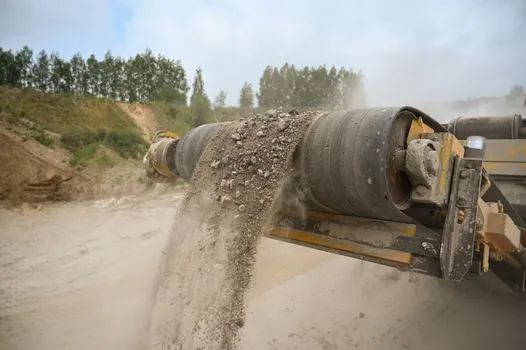
The first decision gate, applied axial load, must be calculated with a service factor, not just the static nameplate: typical conveyor and lift service factors run 1.2 to 1.8 for uniform duty and 2.0 to 3.0 for shock-loaded feeders and crusher-class conveyors [S2][S4]. The second gate, shaft speed, sets the cage and lubrication regime; above 3,000 rpm a precision-class ball thrust (ABEC-5 or better) with oil-air or oil-mist lubrication is standard, while below 500 rpm grease-lubricated roller thrust units are common [S2].
The third gate, alignment tolerance, separates the bearing families directly: ball and cylindrical roller thrust units need parallel shaft alignment within 0.001 to 0.005 rad, while spherical roller thrust accepts up to 1.5° (about 0.026 rad) of static misalignment without internal load redistribution [S2]. The fourth gate, contamination profile, drives sealing choice: for aggregate, cement, and grain conveyors, double-lip nitrile seals plus a contact lip on the inner ring are standard; for food and pharma, stainless-steel shielded units with FDA-approved lubricant dominate [S2][S5]. Material handling washdown environments push the spec toward IP65 minimum ingress protection on the bearing housing, with the Stagnoli IP65 LED loading-bay spec a parallel example of the IP rating baseline used across loading-dock handling equipment [S4].
Standards, Sizing Math, and Sourcing Signals
Bearing dynamic load rating C is defined per ISO 15:2017 (rolling bearings, radial bearings, boundary dimensions), and the L10 life calculation in hours uses the standard exponent of 10/3 for ball bearings and 10/9 for roller bearings, applied to the equivalent dynamic radial/axial load P [S2]. ISO 492 specifies bearing tolerances (normal, P6, P5) that govern the precision class you can pair with a given shaft and housing; precision-class P5 or better is standard for material handling drum motors and high-speed sortation conveyors [S2].
Material handling sourcing in 2026 leans on established OEM platforms: Interroll's HPP, MCP, and MPP conveyor platforms integrate pre-engineered bearing cartridges sized for the rated belt load, which removes much of the selection burden at the conveyor builder level [S2]. Autoquip's expanded VRC line and Superlift's 500 lb to 100,000 lb custom lift tables demonstrate that lift-equipment OEMs continue to publish capacity-driven bearing specs rather than generic catalog part numbers, so the buyer should size to the platform catalog, not to a stock bearing catalog, when the equipment is OEM-integrated [S4][S5]. A 2026 lift-truck user survey published by Material Handling 24/7 also reports that electric lift truck adoption continues to grow, which raises the demand for sealed, maintenance-free tapered roller thrust bearings in mast and steer-axle positions, since electric fleets run longer duty cycles per shift than legacy IC trucks [S4].
For buyers comparing options against the material handling reference, the practical filter is: confirm axial load and speed, confirm misalignment budget, confirm sealing and IP rating, then pick the cheapest bearing family that passes all four gates; choosing a spherical roller thrust where a ball thrust would do is the most common over-spec in this segment, and it costs both purchase price and parasitic friction [S2][S4].
Trackable signals to watch next: OEM-published 2027 conveyor platform updates from Interroll, any expansion of the Superlift 100,000 lb lift table line, and the next Material Handling 24/7 lift truck user survey release, since each will tighten or loosen the bearing spec band for new material handling builds [S2][S4][S5].
The underlying component specifications are covered under storage handling.
See also our earlier report, Steel plate selection for hospital construction and medical gas systems.