
DC-only TIG units, AC/DC TIG units, and MMA-capable inverter combos cover the bulk of 2026 industrial and light-fabrication demand, with current outputs spanning the 150 A hobbyist class to 400+ A plant-floor platforms per published OEM data [S1][S2].
Choosing the right TIG welder starts with the base metal, the thinnest section to be welded, and the duty cycle the shop actually runs; thickness drives whether DC is sufficient or AC square-wave cleaning is mandatory, while aluminum-magnesium alloys force an AC-capable machine [S1][S2].
DC TIG vs AC/DC TIG: current mode as the first spec gate
DC-only TIG machines handle steel, stainless steel, titanium, copper, nickel, and their alloys, with the TELWIN SUPERIOR TIG 421 DC + ACC rated at 400 V three-phase input and 8,000 W absorbed power for that exact material set [S1]. AC/DC machines add aluminum and magnesium welding by alternating polarity: during the EN half-cycle the oxide layer is cleaned, during the EP half-cycle penetration is achieved, a behaviour no DC-only source can replicate, and the TELWIN SUPERIOR TIG 422 WAVE AC/DC AQUA ships with user-selectable Sinusoidal, Square, and Optimised AC waveforms plus a MIX AC-DC preheat step [S2].
Industrial buyers should match current mode to base metal, not to brand hype: DC for ferrous and non-ferrous except aluminum-magnesium, AC/DC when the shop welds mixed stacks, and dedicated square-wave AC for thin-wall aluminum heat-exchanger and architectural fabrication where oxide removal must be repeatable.
Power input, absorbed power, and output class
Single-phase 230 V hobby and prosumer units cover light repair and auto body work, while 400 V three-phase industrial units deliver higher duty cycle and stable arc at high amperage, and the SUPERIOR TIG 421 DC + ACC is fixed at 400 V three-phase / 8,000 W for plant-floor integration [S1]. The SUPERIOR TIG 422 WAVE AC/DC AQUA accepts both 230 V single-phase (12,900 W) and 400 V three-phase (17,300 W) for shop-to-site flexibility on a trolley-mount chassis [S2].
For duty-cycle planning, absorbed power (W) approximates the mains-side load, while the rated welding current (A) and duty-cycle percentage (e.g. 60% at 250 A) determine real weld time; spec sheets that only publish absorbed wattage leave the duty-cycle question unanswered, and a process engineer should treat such listings as incomplete.
Process modes: TIG, pulse TIG, spot, and MMA on one chassis

Multi-process chassis now bundle TIG with MMA stick, pulse TIG, and spot welding, reducing the inverter count on a fabrication floor; the SUPERIOR TIG 421 DC + ACC delivers TIG, arc, pulse, MMA, and spot modes, including the THINSPOT utility for rapid, accurate spot welding on thin sheet metal [S1]. The AC/DC version adds MMA Pulse for position welding and continuous MMA for basic electrodes, with nine customised welding programs, bi-level current, start-up and end current, pre/post-gas, current up/down slope, DC balance, and square-wave frequency adjustments stored on-board [S1][S2].
Process bundling has a cost: shared cooling fans and shared IGBT stacks, so a chassis sold as TIG/MMA/spot is rarely optimised for heavy stick electrode work; electrode diameters up to 6 mm are within the SUPERIOR TIG 421 DC + ACC envelope, but plants running 4 mm cellulosic electrodes for pipeline tie-ins still need a dedicated MMA-skewed machine [S1].
Controls, parameter sets, and WAVE OS-style interfaces
Modern industrial chassis expose EASY and PRO parameter modes on a TFT colour display, with USB-traceable weld logs for QA, and the SUPERIOR TIG 422 WAVE AC/DC AQUA implements exactly that pattern via the WAVE OS interface and on-board E2PROM that stores the last 10 alarms [S1][S2]. EASY mode auto-selects parameters from material and thickness input, while PRO mode unlocks individual arc shaping, a useful split for a shop floor where operators of mixed skill levels share a single power source.
Remote-control readiness, foot-pedal or torch-roller inputs, and G.R.A. water-cooling connectors are now standard on 400 V three-phase platforms; buyers should verify the connector pattern matches existing torches and water coolers before standardising on a chassis, because retrofit water-cooled torches are not cross-compatible across OEM pin maps [S1].
Protection suite, cooling, and enclosure rating
Industrial TIG chassis carry thermostatic, overvoltage, undervoltage, phase-failure, overcurrent, water-cooling, and dust-buildup protections; the SUPERIOR TIG 421 DC + ACC lists all of these explicitly, and the SUPERIOR TIG 422 WAVE AC/DC AQUA adds a dedicated air-tunnel cooling that isolates the electronic components from dust, extending service life in grinding-shop environments [S1][S2]. A dust-loaded fan is the most common premature failure mode for inverter TIG chassis, so buyers in fabrication environments should weight the enclosure design at least as heavily as the rated current.
For site or shipyard use, the absence of an IP rating on most OEM data sheets is a gap: an IP23S chassis resists finger intrusion and vertical drip, but few published spec blocks state the rating, and process engineers should request the explicit ingress-protection code before approving a machine for outdoor or wash-down duty.
Consumables and accessories that gate TIG productivity
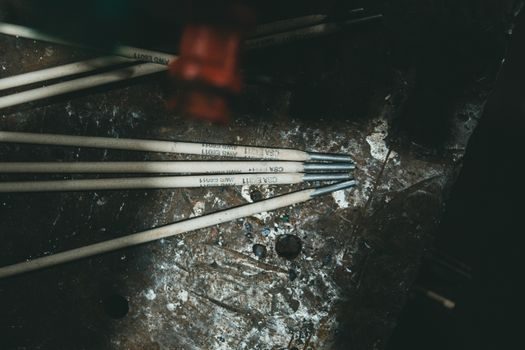
Beyond the power source, TIG productivity is gated by tungsten electrodes, filler rods, and practice coupons; Amazon's best-selling TIG equipment list (snapshot 2026-05-23) is dominated by 3/32 in x 7 in WT20 (thoriated) tungsten 10-packs at roughly $40, ER308L stainless filler 1/16 in x 16 in at roughly $38 per 5 lb, ER70S-6 mild-steel filler at roughly $28 per 5 lb, ER4043 aluminum filler, and 17-gauge steel practice coupons, with the top three listings each scoring 4.7 to 4.8 stars across 133 to 4,519 reviews [S3].
For thin-sheet work, the THINSPOT utility on the SUPERIOR TIG 421 DC + ACC shortens tack time versus manual foot-pedal control, and shops running high-mix thin-gauge stainless should pair a DC pulse chassis with a 1.6 mm or 2.4 mm lanthanated electrode rather than thoriated stock, which is a standard documented by AWS A5.12M/A5.12 for tungsten classification [S1].
Industrial vs DIY fit, and where the machine does not belong

Multi-process 400 V three-phase chassis fit fab shops, pressure-vessel subcontract, and process-piping shops; light 115 V / 230 V single-phase inverters fit auto-body, motorcycle, and on-site repair, with examples including the 6,000 W / 185 A / 115-220 V Miller-style clone sold at roughly $509 on cross-border marketplaces and the IGBT 2-in-1 MMA/Lift-TIG mini inverter sold at roughly $67 with VRD, hot-start, and anti-stick [S9]. For high-volume aluminum manufacturing, an AC/DC square-wave platform is the right tool; for stick-only heavy structural work, a dedicated MMA inverter remains cheaper per amp than a multi-process chassis, and over-spec'ing a TIG platform for MMA is a common capex mistake [S1][S2][S9].
Beyond welding, fab shops in 2026 are pairing TIG chassis with adjacent process tools: see this MIG welding machine spec map for comparison against GMAW, the MIG vs arc selection map for SMAW/GMAW trade-offs, and a related laser-cutter supply-side update for shops bringing sheet cutting and TIG welding under one roof. Code and standard updates land periodically; track the next revision of AWS D17.1 (aerospace fusion welding) and the IEC 60974-1 arc-welding equipment safety standard for the 2026 cycle if your QA system is ISO 3834-certified, and verify IP rating, duty cycle at rated current, and waveform options on the OEM data sheet before issuing a purchase order.
Component reference pages worth checking: coding machine, and core machine.
