
MIG (GMAW) selection in 2026 is dominated by IGBT inverter platforms in the 140-350 A bracket, with multi-process "3-in-1" / "6-in-1" units (MIG + MMA + TIG, sometimes Lift-TIG or HF-TIG, plus plasma cut on higher-end models) now mainstream on both OEM catalogues and cross-border e-commerce channels [S2][S3].
Industrial buyers running two-shift fabrication shops need to anchor on duty cycle, wire-feed platform, input voltage (single-phase 115/230 V vs three-phase 380/400 V) and the actual output envelope at 40 °C ambient — not the marketing "max" current printed on the front panel [S6].
Gate 1: Output Amperage and Duty Cycle Envelope
The first citable fact: at 40 °C ambient, an EU/CE-rated IGBT MIG unit such as the Lida MCU MIG-251 Pulse PRO is rated to 250 A, while the smaller MCU MIG-200 Pulse PRO is rated to 200 A — both explicitly branded as "PRO" pulsed-MIG platforms in the same OEM catalogue [S2]. On the cross-border retail side, 185 A compact units (e.g. 90%-new Miller BLUESTAR185, 115/220 V dual-voltage, 6000 W input) and entry-level 140 A stick/MIG combos cluster at the bottom of the price band [S3].
For a rule of thumb that survives procurement review: 1 A of MIG output handles roughly 0.025-0.030 mm of steel thickness on a single-pass fillet, so 140 A covers ~3.5 mm steel and 250 A covers ~6-7 mm steel comfortably. Push beyond 6 mm with anything below 200 A and you are buying frustration. For thin sheet under 1.5 mm, choose a machine with an explicit "synergic" or "pulse" mode — the Lida MCU Pulse PRO line calls this out by name, which is the cheapest way to avoid burn-through on galvanneal and auto-body panels [S2].
Gate 2: Wire-Feed Platform — Transformer, Thyristor, IGBT Inverter
Transformer-rectified MIG welders still exist for heavy steel and are cheap, but they weigh 60-100 kg and lack fine arc control; thyristor (SCR) stepped-control units sit in the mid-tier and are common in 380 V three-phase workshops; IGBT inverter platforms dominate the 2026 retail and OEM line cards because they pack 200+ A into 15-25 kg chassis and accept synergic/pulse firmware [S2][S3].
Wire-feed drive matters as much as the inverter topology. A four-roll driven feeder with a reversible 0.8/1.0/1.2 mm drive-roll kit is the practical baseline for steel; for aluminium you must switch to a U-groove drive roll and a Teflon/POL liners, with optional spool-gun support if the machine is a 5 kg mini spool unit [S2]. OEM 200-series PRO TIGs and MIGs from Lida ship as PRO TIG-200P/250P AC/DC LCD and MIG-200 Pulse PRO, with 1.0/1.2 mm drive-roll kits called out in the same product family [S2].
Gate 3: Input Power and Site Reality
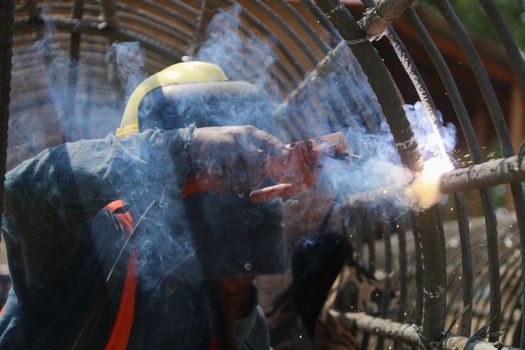
Single-phase 115/230 V dual-voltage is the North-American and small-shop norm; 230 V single-phase covers most of Europe at the 16 A breaker level; 380/400 V three-phase is mandatory above roughly 250 A continuous duty, because a 350 A three-phase MIG at 60% duty draws too much single-phase current for a domestic 32 A supply [S2][S3].
For site work, the AliExpress cross-border listings explicitly flag dual-voltage 115/220 V 185 A units as "portable welding machine" SKUs — the BLUESTAR185 is a 115/220 V example with 6000 W input and 185 A max output, sold as a 90%-new factory outlet item [S3]. The Millermatic 200/250 feeding roller listings (1.2/1.0/0.9 mm) on the same channel show that even the OEM 200-250 A single-phase segment is treated as a global shipping commodity in 2026 [S3].
Gate 4: Process Coverage — MIG/MAG, MMA, TIG, Plasma
The 2026 multi-process trend is real: a single chassis now ships with MIG, gasless MIG (flux-cored), MMA (stick), Lift-TIG or HF-TIG, and on the upper tier, plasma cutter. HITBOX sells a "6-in-1 270 A" SKU explicitly advertising MMA / Gas MIG / Gasless MIG / HF TIG / CUT with a digital panel and 2T/4T trigger latching [S3]. The Lida catalogue is organised the same way: MIG/MAG, TIG, MMA, Plasma Cutter, all under one supply chain, with PRO TIG-315P/350P AC/DC LCD COMB and HTIG-200P COLD as the TIG side, MMA-120/140 MINI LCD as the entry stick welder, and a separate Plasma Cutter category [S2].
If your duty is 90% steel MIG in a fabrication shop, skip the 6-in-1 novelty and buy a clean MIG/MAG with synergic control plus a separate dedicated TIG for stainless/aluminium. If you are a maintenance/repair facility that must do stick one day, MIG the next, and TIG the day after, a multi-process chassis reduces capex, training overhead and floor space. The wrong buyer for the 6-in-1 is a code-pedigree pressure-vessel shop — multi-process units typically lack the documented WPS/PQR support of a single-process industrial machine, so spec by project, not by SKU count.
Gate 5: Cooling, Duty Rating, Build and Certification
Two real engineering signals separate a 200 A hobby box from a 250 A industrial unit: the cooling fan + heat-sink stack (look for "intelligent fan" or "on-demand cooling" callouts) and the printed duty cycle at the rated output, not at a derated "max" figure [S2]. The Lida corporate page states 40+ high-precision production and testing equipment, 100+ workers, and 20+ engineers/QC, with annual welding-machine output above 200,000 pieces and certifications including ISO 9001, China CCC, and CE — that is a typical mid-tier Chinese OEM compliance stack for 2026 export [S2].
For a buyer scoring similar equipment catalogues, anchor on the published input voltage range, the drive-roll/feeding kit, and the IGBT module brand where the OEM names it. Past five gates, run a 10-minute weld test on a 6 mm steel coupon with 1.0 mm wire and 75/25 Ar/CO₂ — arc stability and spatter level tell you more than any spec sheet. As for related spec work in adjacent categories, an aluminium extrusion versus ladder selection map follows the same five-gate logic, and the pallet-jack selection map repeats the same gates-on-buyer pattern.
Wire, Gas and Consumables You Must Match to the Machine
Solid 0.8 mm wire with 75/25 Ar/CO₂ is the production-line norm for thin steel up to 3 mm; 1.0 mm wire with the same gas covers 3-8 mm; 1.2 mm is reserved for heavy steel above 6 mm. Flux-cored (gasless) wire trades slag for mobility, useful in field work and paint-contaminated steel but never on galvanised or stainless without verification [S6]. For aluminium, switch to a 1.0 or 1.2 mm 5356/4043 spool, 100% argon, and a U-groove drive roll with a Teflon liner — this is where entry-level machines fail because the liner and drive roll are still set up for steel [S2].
Decision Matrix: 140 A / 200 A / 250 A / 350 A Compared
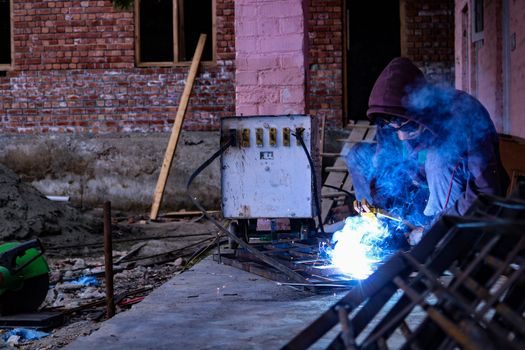
Across four realistic options on a four-criterion grid: a 140 A inverter (entry MIG/stick combo, $200-$600, 1-3 mm steel, 115/230 V single-phase, hobby/auto-body) versus a 200 A IGBT (mid-range synergic MIG, $500-$1,200, 1-6 mm steel, 230 V single-phase, light fabrication) versus a 250 A IGBT (industrial PRO/Pulse MIG, $1,200-$2,500, 1-10 mm steel, 230 V single-phase or 380 V three-phase, two-shift fabrication) versus a 350 A three-phase (heavy industrial, $2,500-$6,000, 3-15 mm+ steel, 380/400 V three-phase, structural and pressure-vessel code work) [S2][S3].
The 200 A class is the most crowded and the most commonly mis-purchased: many buyers need 250 A but settle on 200 A to save cost, then derate the machine to extend duty life. The 350 A three-phase class is overkill for general fabrication and only pays back in code-pedigree structural or boiler work. The 140 A class is genuinely sufficient for chassis, exhaust, and fence/gate work on thin steel under 3 mm.
Final trackable signals for 2026: watch for wider rollout of pulse-MIG firmware on sub-250 A chassis, more 6-in-1 multi-process SKUs reaching the $400 retail band, and tighter CE/CCC documentation from mid-tier Chinese OEMs such as Lida as the EU Machinery Regulation rewrite settles. As a related adjacent spec exercise, the explosion-proof junction box selection map and the globe valve sizing map use the same spec-first gate logic and pair well with welding-equipment procurement cycles.
Component reference pages worth checking: coding machine, core machine, and cutting machine.