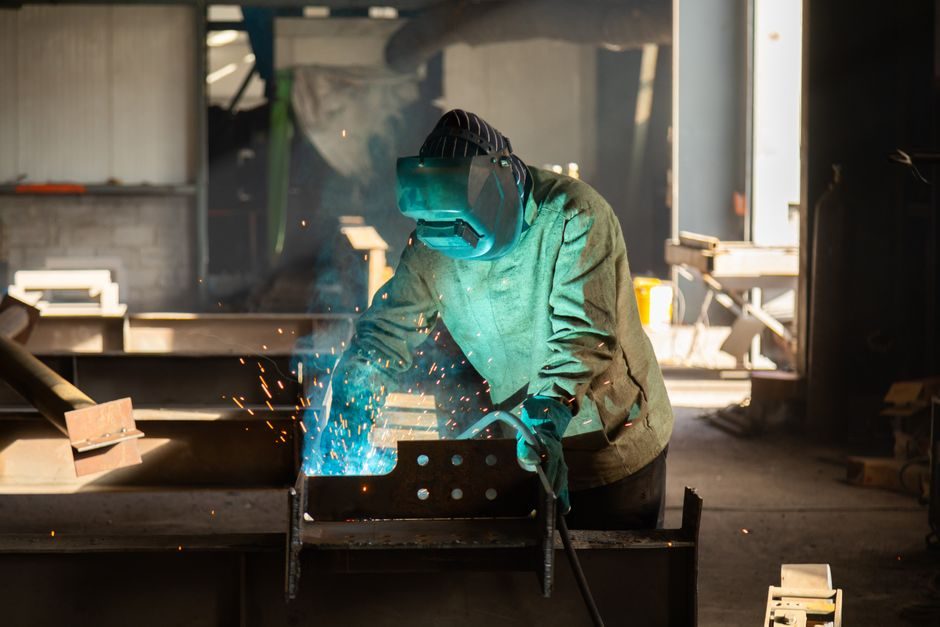
Four parameters define a MIG welding machine on paper: process mode, power-source topology, current output, and shielding-gas compatibility. On the current 2026-07-27 supply landscape, manufacturers such as Beijing HBC Technology offer digital inverters in the 250-630 A bracket [S4], while compact single-phase models in the 160-200 A range remain the entry tier for trade and light-fabrication work [S5].
MAUCOTOOLS, one European brand listed on DirectIndustry, groups its MIG line into manual, semi-automatic, and automatic process modes, with most power sources built on PFC (Power Factor Correction) plus multivoltage input so the same machine runs on indoor shop supply, generator power, or offshore platform feeders [S1]. Celette France SAS, also DirectIndustry-listed, sells a 6,000 W, 400 V three-phase, 50/60 Hz automatic MIG station with a 17 A minimum working current aimed at thin car-body steel [S2]. Wenling Riling Electric Apparatus and WIM India round out the supplier map with digital MIG platforms and IGBT single-phase product lines, both published 2026-07-27 [S9][S10].
Process Modes: Manual, Semi-Automatic, Automatic, Spot
Process mode is the first decision axis because it dictates operator skill level, fixturing cost, and achievable duty cycle. Manual MIG is the baseline: the operator controls travel speed and trigger timing while the wire feeder and power source run continuously, suited for pipe welding in the MAUCOTOOLS catalogue [S1]. Automatic MIG is the opposite extreme: Celette's 6,000 W three-phase spot/MIG station drops the operator out of the trigger loop and is engineered for car-body production cells where fixturing clamps the part and the torch follows a fixed path [S2].
For body-in-white automotive work, the Celette platform supports welding two different thicknesses in the same joint, a requirement that rules out the simplest manual MIG power sources [S2]. A selection gate breakdown for MIG welders walks through how duty cycle, wire-feed type, and inductance control interact with these process modes. Spot MIG behaves as a hybrid, applying a short fixed-time weld nugget rather than a continuous bead, which is why it is listed as its own technique alongside continuous MIG on DirectIndustry product pages [S2].
Power-Source Topology: Transformer, Thyristor, Inverter, IGBT Inverter
Inside the cabinet, four topologies dominate the 2026 supply. Conventional transformer-rectifier MIG welders are heavy, rugged, and cheap per amp, but they run on fixed mains voltage and have poor control over the welding current waveform. Thyristor (SCR) MIG welders add phase-angle firing for stepped current control. Inverter welders chop the mains at 10-100 kHz through IGBT or MOSFET stages, shrinking the transformer an order of magnitude in weight and giving closed-loop current control on a millisecond scale. [S2]
The IGBT DC-inverter pulse MIG line is what most current OEM catalogues lean on: Shaodong Lida Tools lists MIG-180FL, MIG-160HD/180HD/200HD as the entry MCU-controlled inverter family, and MCU MIG-251 Pulse PRO and MCU MIG-200 Pulse PRO as the pulse-MIG tier that drives double-pulse aluminum welding [S5]. Beijing HBC Technology has built its 250-630 A range on IGBT inverter platforms since 2006, with PULSE MIG and PULSE TIG derivatives in the same chassis family [S4]. Wenling Riling Electric Apparatus, a 2026-07-27 active Chinese supplier, brands itself as a "digital MIG welding machine supplier" specifically because IGBT inverter control with a digital front panel is now the table-stakes configuration for new 380 V three-phase units [S10].
Current Output and Duty Cycle: Matching Amperage to Workpiece
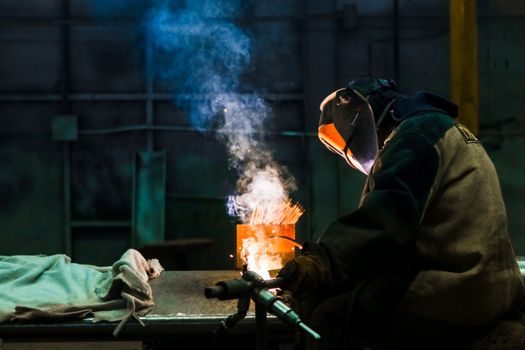
Output current is the second decision axis. The 160-200 A single-phase IGBT MIG welder covers sheet steel up to about 3-4 mm with 0.6-0.8 mm wire and CO2 or Ar/CO2 shielding, which is why Chinese export catalogues such as Shaodong Lida cluster the entry models in that band [S5]. The 250-350 A three-phase class covers structural steel up to about 8-10 mm with 1.0-1.2 mm wire and is the typical workshop workhorse. Above 400 A, heavy industrial MIG platforms handle thick plate, heavy fabrication, and MIG-brazed joints; Beijing HBC's top catalogued capacity is 630 A, which puts it in the same bracket as the submerged-arc and MIG-brazing applications used in shipbuilding and heavy pressure vessel work [S4].
Duty cycle is the hidden second half of any amperage spec. A 250 A MIG welder rated at 60% duty cycle at 40°C delivers 250 A for 6 minutes out of every 10, then must derate. Production buyers should match duty cycle to the longest expected continuous bead on the workpiece, not to the headline maximum. Celette's automotive platform is engineered for short bead runs, which is why it can advertise a 17 A minimum working current for thin steel without paying the thermal penalty of a heavy industrial rating [S2].
Shielding Gas and Wire Diameter: CO2, Ar/CO2, Ar/O2, Pure Argon
Gas mix is the third decision axis. Pure CO2 is the cheapest shielding gas, gives deep penetration, and produces more spatter, which is acceptable for non-critical carbon-steel fabrication on the entry 160-200 A IGBT machines [S5]. Ar/CO2 mixes (commonly 75/25 or 80/20) are the standard MAG shielding for general carbon-steel MIG and give a smoother bead with less spatter than pure CO2. Ar/O2 mixes (typically 98/2) are the standard for spray-arc MIG on carbon steel where higher travel speed is required.
Pure argon is the rule for MIG-welding aluminum and other non-ferrous alloys, paired with a 0.8-1.2 mm aluminum wire and either a spool gun or a push-pull wire feeder to handle the soft wire. Pulse MIG (single-pulse and double-pulse) modulates the arc current between peak and background levels to give heat-input control, which is what makes MIG-welding thin aluminum possible; Shaodong Lida's MCU MIG-251 Pulse PRO and MCU MIG-200 Pulse PRO sit in this category, while its MIG-180FL and MIG-160HD/180HD/200HD are non-pulse inverter MIG/MAG units [S5]. Wire diameter ties the whole selection together: 0.6-0.8 mm wire fits the 160-200 A thin-sheet class, 0.8-1.0 mm fits 200-300 A, 1.0-1.2 mm fits 300-500 A, and 1.2-1.6 mm is reserved for the 400-630 A heavy industrial class [S4][S5].
Comparison: Four MIG Classes on Spec Criteria

For sourcing, the four classes line up as follows against four buyer-facing criteria. Entry single-phase IGBT (160-200 A): low cost, single-phase 220-240 V supply, 0.6-0.8 mm wire, CO2 or Ar/CO2 shielding, suited to sheet-steel workshop work. Three-phase IGBT MIG/MAG (250-350 A): mid cost, three-phase 380-400 V supply, 0.8-1.2 mm wire, Ar/CO2 or Ar/O2 shielding, the standard workshop workhorse. Three-phase IGBT pulse MIG (250-400 A): higher cost, three-phase supply, single-pulse and double-pulse modes, 0.8-1.2 mm wire including aluminum, the workhorse for carbon-steel, stainless, and thin aluminum. Heavy industrial MIG (400-630 A): highest cost, three-phase supply, 1.0-1.6 mm wire, thick-plate structural work, shipbuilding, and heavy pressure-vessel fabrication, in the same chassis family as submerged-arc welders [S4][S5].
On the OEM side, a 2026-07-10 ECVV product index confirms that MIG, MAG, CO2, IGBT, and pulse control are now listed as distinct product lines by Chinese suppliers rather than as variants of one platform, which mirrors how DirectIndustry categorises European builders: MIG is the umbrella term, MAG denotes active-gas shielding, CO2 welders are a separate product type, and pulse control sits in its own class [S3].
Where MIG Fits and Where It Does Not
MIG is the right process when the workpiece is steel, stainless steel, or aluminum; the joint is long enough to justify continuous wire feed rather than repeated electrode changes; the operator has access to shielding gas; and the production volume justifies the wire-feed, gun, and gas-regulator cost. Manual MIG is faster and cleaner than stick electrode welding on thin material, according to MAUCOTOOLS, which is the process-level claim behind the wide adoption of MIG in light fabrication and pipe work [S1].
MIG is the wrong process for outdoor field work on heavy structural steel without gas shielding, for very short tack welds in tight spots where a TIG torch can reach but a MIG gun cannot, and for repair work on dirty or painted steel where the slag layer in stick or flux-cored arc welding tolerates contamination better. For thin car-body steel, the 17 A minimum working current of an automatic spot/MIG platform is a better match than a 200 A transformer stick welder, which is why automotive body-in-white cells run automatic MIG rather than manual stick or TIG [S2]. Trade buyers comparing MIG to TIG and MMA commonly start from the same power-source topology and add a wire feeder for MIG, which is why Chinese export catalogues such as Shaodong Lida, WIM India, and Riling sell MIG, TIG, MMA, and plasma cutting on a shared IGBT platform [S5][S9][S10].
Limitations, Failure Modes, and Standards to Watch
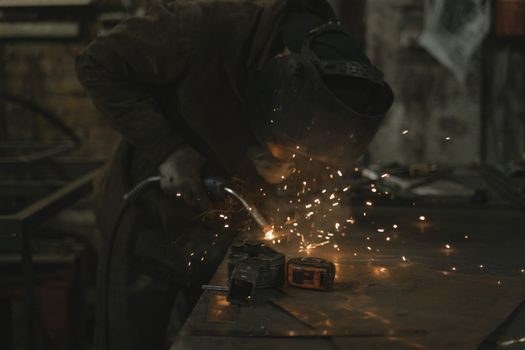
Three operational limits bite buyers most often. First, duty cycle at 40°C is the binding thermal rating, not the headline maximum amperage, and it is the spec that drops fastest when the ambient temperature rises in summer workshops. Second, wire-feed consistency on soft aluminum wire requires either a spool gun or a push-pull system; a standard roller-drive feeder will deform 1.0 mm aluminum wire and stall. Third, gas coverage fails in drafts: even a 2 m/s crosswind will strip shielding gas off a MIG arc outdoors, which is why multi-voltage, PFC-equipped MIG power sources are designed for off-shore and outdoor use as much as for indoor shops [S1].
On the standards side, CE-marked 400 V three-phase MIG platforms (as on the Celette automatic station) carry the European low-voltage and EMC conformity expected in automotive and general industrial installations [S2]. ISO 9001 and ISO 14001 are the dominant quality and environmental management certifications on Chinese supplier profiles, with 30+ certifications listed by Shaodong Lida as a procurement cue rather than a specific test mark [S5][S6]. Process standards that govern the weld itself (such as the common MIG procedure qualification tracks for carbon steel, stainless, and aluminum) sit outside the machine catalogue but should be cross-checked against the gas mix and wire grade on the supplier's data sheet before purchase.
The 2026-07-27 supplier signal is that IGBT inverter platforms have absorbed pulse-MIG, double-pulse MIG, and CO2/MIG/MAG modes into a single product family, which compresses the old distinction between transformer MIG, thyristor MIG, and inverter MIG into one electronics platform. A related supply-chain map for laser cutting machines shows the same tier compression in adjacent cutting equipment, and an open-path gas detector selection guide is the closest parallel in process instrumentation, where sensing principle, range, and certification collapse into a single data sheet. Procurement teams that anchor on a single specification point rather than the full current-gas-wire-duty-cycle envelope will continue to over-spec the cabinet and under-spec the wire-feed side, which is the dominant cause of MIG tender revisions in 2026.
Component reference pages worth checking: coding machine, core machine, and cutting machine.