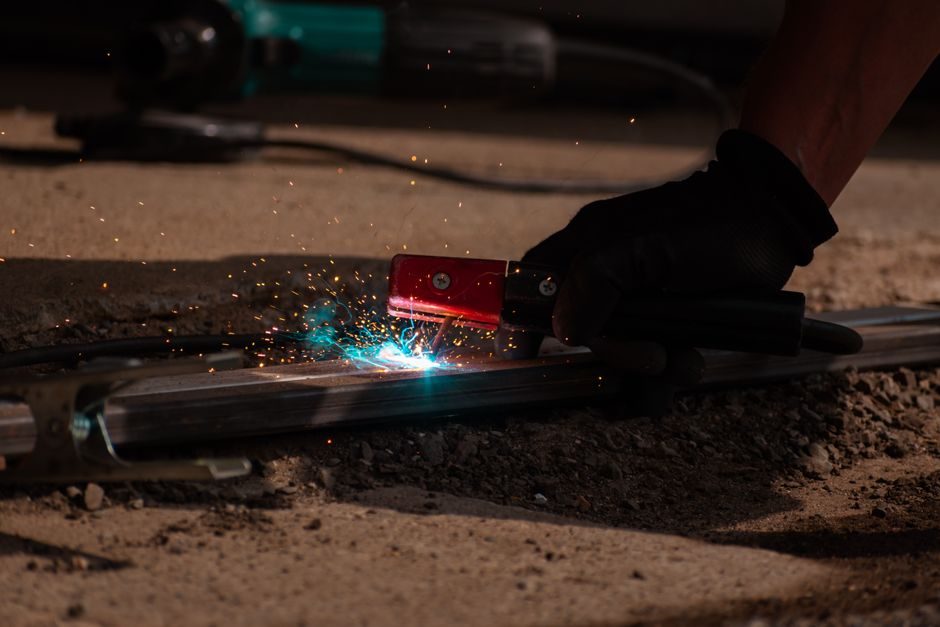
MIG (GMAW) and general "arc welding" — most often shorthand for MMA/stick (SMAW, ISO 4063 process 111) — sit on different points of the deposition-versus-portability curve, and the OEM catalog data from 2026 confirms the gap is widening, not narrowing [S1][S7][S8].
MIG/MAG is filed under ISO 4063 process numbers 131 (MIG) and 135 (MAG), both variations of Gas Metal Arc Welding that use a continuously fed consumable solid or flux-cored wire and an externally supplied shielding gas; conventional MMA/arc uses a flux-coated stick electrode that generates its own shielding gas on burn-off [S8]. That single difference — external shielding versus flux-generated shielding — cascades into duty cycle, weld appearance, and field-portability spec bands.
Process Boundaries: ISO 4063 Codes 111 vs 131/135
Manual Metal Arc (MMA) welding carries ISO 4063 process code 111, uses stick electrodes typically 2.5–5.0 mm in diameter, and requires no shielding-gas cylinder or wire-feed unit [S8]. MIG welding (process 131) and MAG (process 135) both use a 0.6–1.6 mm wire fed through a Euro torch connector, with MIG using inert gas (typically Ar) and MAG using active gas mixes (Ar/CO₂ or Ar/O₂) suitable for carbon-steel structural work [S8].
For process-engineering decisions, the practical consequence is that MMA can be deployed anywhere a 230/400 V supply and 10 kg of rods are available, while a MIG/MAG cell needs a wire feeder, gas regulator, 30 l cylinder, and a workpiece lead rated for the welding current — the EWM Taurus 505 Steel puls S ships with exactly that gas-side kit including a 30 l manometer regulator and water-cooled torch as standard [S1]. Robotic MIG cells add a further layer: Prima CNC's PM2500 integrates a four-axis CNC host (X/Y/Z linear + R rotation) with AC servo drive and a TBI ball-screw walking mechanism to position the MIG or TIG torch over the workpiece [S2].
Power Source and Duty Cycle Bands
The 2026 DirectIndustry product set shows MIG power sources clustering at 350–500 A output, with the EWM Phoenix 355 puls and Taurus 505 Steel puls S both rated for 550 A at 60% duty cycle on the 95 mm² workpiece lead — a number that matters because the lead, not the power source, is usually the thermal bottleneck in pulsed-MIG work [S1][S3]. REHM's MEGA.ARC series targets the productivity envelope with POWER.PULS and POWER.ARC waveforms, claiming 80% less grinding dust versus conventional MIG/MAG and an Industry 4.0-ready interface as an option [S4].
MMA-only inverter power sources cover a lower current band (typically 140–250 A) because stick welding does not need the high transient currents of pulsed-arc MIG; for field work above 250 A, MIG's water-cooled torch package (Euro connector, 7-pole intermediate hose, centrifugal pump cooling unit) is the OEM-standard answer to heat soak, exactly as bundled on the Taurus 505 [S1]. REHM's MEGA.ARC ships MMA as an optional add-on rather than the primary process, reflecting the market split: high-amperage pulsed-MIG for production, MMA for repair [S4].
Shielding Gas, Wire Feed, and Consumable Cost
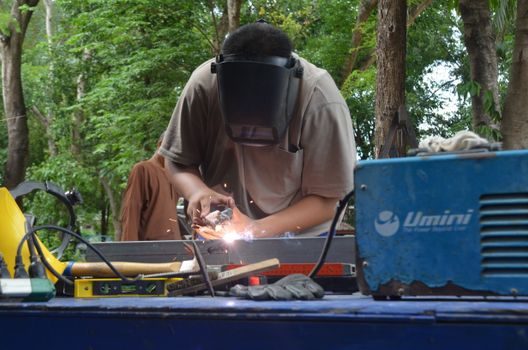
MIG/MAG requires a regulated shielding-gas supply: 30 l cylinder at 200 bar nominal with a manometer pressure regulator, typically set to 12–20 l/min flow for steel [S1]. MMA's flux coating eliminates that line item and makes stick the default for outdoor pipeline, structural, and ship-hull work where wind would strip a shielding envelope. The trade-off is deposition rate: MIG with 1.0–1.2 mm wire at 250–350 A typically lays 4–8 kg/h, while 3.25 mm MMA rods at 130 A deposit roughly 1.5–2.5 kg/h.
Wire-feed accuracy separates industrial MIG from hobby-grade units. EWM specifies the eFeed four-roll drive with 1.0–1.2 mm UNI rolls for low- to high-alloy steel, with tool-free polarity reversal for switching between solid wire (DCEP) and flux-cored wire (DCEN) [S1]. That four-roll geometry is the spec-level indicator of a production-grade wire feeder; a two-roll drive is the giveaway of a light-duty unit unsuitable for flux-cored or aluminium wire above 1.0 mm.
Synergic, Pulse, and MULTIMATRIX Control
Synergic MIG — where wire-feed speed, voltage, and current track a one-knob program — is now baseline on mid-range machines: the Phoenix 355 puls bundles MULTIMATRIX technology with 100+ pre-loaded synergic curves and infinite arc-dynamics adjustment for the choke effect on dip transfer [S3]. Pulsed MIG, as on the Taurus 505 Steel puls S, adds a controlled short-circuit-proof pulsed arc designed for the transitional spray-arc region, where conventional CV MIG risks lack of fusion on thin or position welds [S1].
REHM layers four waveform packages on the MEGA.ARC — POWER.PULS, POWER.ARC, ROOT, and FOCUS.ARC — to address the productivity-versus-beauty split between high-speed fillet welding and root-pass control [S4]. These pulse packages are not interchangeable with MMA: the power source must sustain a 50–500 Hz pulse train with 1–5 ms peak-time control, which is outside the duty profile of a stick welder. Specifying pulse-capable MIG for a 2 mm galvanised butt joint is over-engineering; specifying MMA for a 6 mm aluminium boat hull is under-engineering.
Application Routing: Manual, Robotic, and Field
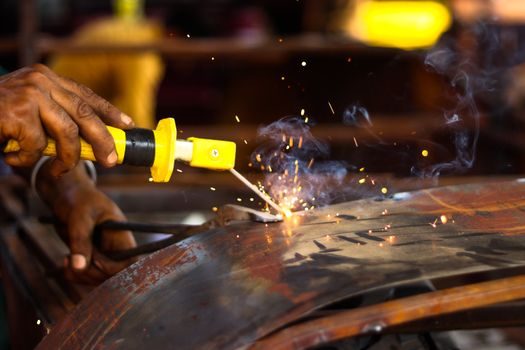
Manual MIG/MAG dominates car-body, structural-steel, and thin-gauge stainless fabrication. EWM's manual lineup (Taurus 505 Steel puls S, Phoenix 355 puls) targets fabricators who need 1.0–1.2 mm steel wire, synergic curves, and IP23 spray-water protection for shop-floor duty [S1][S3]. For factory automation, the PM2500 from Prima CNC is a four-axis MIG/TIG robotic cell with TBI ball-screw linear axes, Schneider electrics, and an LG PLC running the welding-sequence logic — the spec bands buyers compare on price, controller brand, and number of servo axes [S2].
MMA/stick remains the field-repair default: no shielding gas to freeze or vent, no wire-feed jams from contaminated liners, no robot integration. For oil-and-gas field piping, structural-site welding, and any outdoor job, the arc welding machine in its MMA form is the spec-first answer. Buyers weighing the two should match the process to the joint — and cross-check that the workpiece lead is rated for the chosen current, since 550 A at 60% duty on a 95 mm² lead is the practical ceiling for air-cooled leads on pulsed-MIG production work [S1].
Selection Criteria and Decision Matrix
Three criteria separate the two technologies for the spec sheet: deposition rate, position versatility, and field portability. MIG/MAG scores high on deposition (4–8 kg/h on 1.0–1.2 mm wire) and pulse-capable position welding (all-position pulsed arc on the Taurus 505) but loses on field portability because of the shielding-gas dependency [S1][S8]. MMA/stick scores high on portability and outdoor tolerance but loses on deposition rate and on the cosmetic finish of long fillet welds.
For steel thickness 0.8–6 mm in a workshop, MIG with synergic pulse (Phoenix 355 puls, MEGA.ARC POWER.PULS) is the cost-effective answer. For 6–20 mm structural steel in fixed fabrication bays, MAG with Ar/CO₂ mix is the workhorse. For outdoor field joints, repair, and emergency work, MMA/stick remains the spec-first answer because it removes the shielding-gas failure mode from the critical path [S7][S8].
Sourcing and Standards Anchors
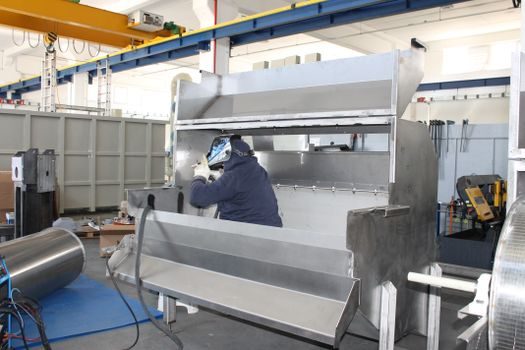
Process selection should be anchored to ISO 4063 process codes 111 (MMA), 131 (MIG), and 135 (MAG) when writing WPS/PQR documents, since the code determines filler-metal, gas, and electrical-parameter envelope the procedure must respect [S8]. For Chinese-supplied equipment, the catalogue tier ranges from LCD/LED inverter MMA units (KEYUE, Sanqiao) under USD 200 to EWM-class pulsed-MIG power sources above EUR 11,000 — a 50× spread driven by waveform control, duty cycle, and water-cooling rather than nameplate current alone [S1][S6][S9].
For a hands-on read of related spec-first comparison logic that buyers apply across the welding-and-assembly category, the [China laser cutting supply chain 2026 tiers map](/news/laser-cutting-machine-supplier-map-2026-price-tiers-spec-bands-sourcing.html) covers the same spec-band-vs-price-tier discipline. Where the MIG-versus-arc question overlaps with robotic cell selection, the PM2500 robotic platform is a useful reference point for the four-axis motion envelope that robotic MIG cells share with CNC cutting equipment. For buyers scoping a complete fab bay, the arc welding equipment category anchors the manual MMA end of the lineup and the coding machine category covers the downstream marking step.
Trackable signal: a second pulse-waveform package (REHM-style POWER.PULS / FOCUS.ARC) appearing in the entry-level 200–300 A MIG band would compress the price gap and accelerate MIG substitution for MMA on mid-thickness steel. A second trackable signal: the migration of Industry 4.0 / OPC-UA interfaces from optional (MEGA.ARC) to standard on the next EWM Phoenix refresh would push real-time weld-data logging into the EN ISO 3834 quality-control mainstream [S1][S4].